Amid Hamas refusal to disarm, US pitches $112 billion 'Project Sunrise' high-tech Gaza reconstruction plan
Plan presented to several regional partners as Trump peace plan remains stuck in first phase




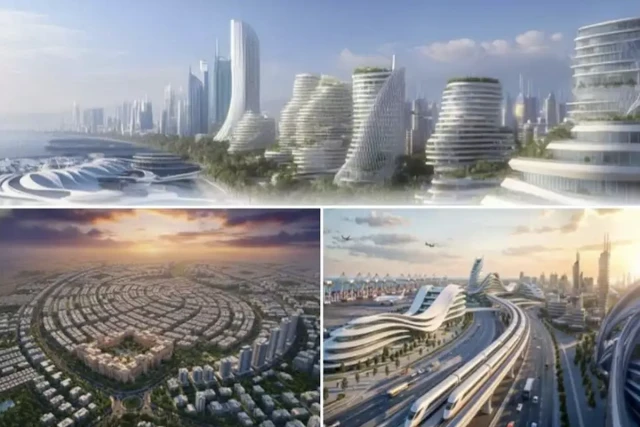
The administration of U.S. President Donald Trump presented an ambitious $112.1 billion plan to reconstruct Gaza as a smart city, with luxury beachfront hotels, a high-speed train connection, and AI smart grids in a proposal known as "Project Sunrise," according to a Wall Street Journal report on Friday.
The WSJ reported that a group of top White House aides, including Middle East envoy Steve Witkoff, President Trump's son-in-law Jared Kushner, and others, discussed forming a team to oversee the project to turn Gaza into a prosperous city, as outlined in a 32-page presentation to potential donor countries.
The presentation was said to be “sensitive but unclassified,” and did not offer details on which nations would be responsible for the funding, nor what would happen to the almost 2 million Gaza residents displaced by the two-year war that began on Oct. 7, 2023, when Hamas invaded southern Israel.
The WSJ reported that the United States has presented the slides to prospective donor countries, including Gulf states and other Middle Eastern partners such as Turkey and Egypt. The newspaper cited anonymous U.S. officials who expressed doubts about the plan’s feasibility, citing Hamas’ unwillingness to disarm or relinquish control of the Gaza Strip to any external authority, including the Peace Board proposed by Trump.
Steven Cook, a senior fellow for Middle East and Africa studies at the Council on Foreign Relations (CFR), also expressed his doubts about the plan.
“They can make all the slides they want,” Cook said. “No one in Israel thinks they will move beyond the current situation and everyone is okay with that.”
While Cook did not view the White House presentation, he said, “Nothing happens until Hamas disarms. Hamas will not disarm, so nothing will happen.”
One of the slides from the presentation apparently acknowledges this difficulty, stating in bold, red text: “Reconstruction plan contingent on comprehensive compliance by Hamas to demilitarize and decommission all weapons and tunnels.”
So far, Hamas has rejected any plan to give up its weapons and hand over control to another entity.
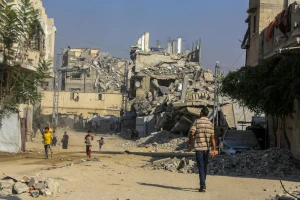
According to the presentation – slides of which were reviewed by The WSJ – the estimated cost for the project is $112.1 billion over 10 years. Significant difficulties remain in bringing the project to reality, including the estimated 68 million tons of rubble from the two-year war, the large amount of unexploded ordinance, the presence of terror infrastructure and booby-trapped facilities, as well as the continued refusal of Hamas to agree to demilitarization.
Secretary of State Marco Rubio appeared to understand the challenges in moving forward with the Gaza reconstruction plan when he said on Friday, “You are not going to convince anyone to invest money in Gaza if they believe another war is going to happen in two, three years.”
However, Rubio also expressed long-term optimism, saying, “We have a lot of confidence that we are going to have the donors for the reconstruction effort and for all the humanitarian support in the long term.”
"The Trump administration will continue to work diligently with our partners to sustain a lasting peace and lay the groundwork for a peaceful and prosperous Gaza," a White House spokesperson said in a statement.
A road map of the planned reconstruction appears to begin with efforts in the areas currently under Israeli control, including Rafah, which has seen significant demolition and clearing efforts by the IDF over the past several months. Early efforts would focus on removing destroyed buildings and rubble, demolishing terror infrastructure and constructing temporary housing for Gazans displaced during the war, along with building field hospitals and clinics.
Once significant progress is made in the clearing operations, work will begin on new infrastructure, including roads, power and water lines, and the revival of agriculture. Only afterward would construction begin on luxury properties and high-tech centers.
All of this reconstruction effort is scheduled for phase 3 of the Trump peace plan for Gaza, which is currently stuck in Phase 1 with Hamas yet to hand over the remains of the final deceased Israeli hostage, IDF Sgt. Major Ran Gvili.
Phase 2 of the peace plan would see the disarmament of Hamas and the withdrawal of Israeli military forces from the territory it now holds behind the Yellow Line.
Israeli leaders are pessimistic about the possibility of Hamas disarming.
Eli Cohen, Israeli minister of energy and Infrastructure, expressed the government's doubts that Hamas would voluntarily disarm or be disarmed by any international force, including the International Stabilization Force (ISF).
“Either Hamas disarms itself – which will not happen – or an international force acts against Hamas, but I doubt they will do so. We have to give it a chance, but it’s clear to me that we will have to do it. I think we will do it by force, because Hamas will not lay down its weapons – and only we are capable of doing so,” Cohen said in an interview with Kan Reshet Bet.
A Channel 14 News poll found that 77% of respondents oppose the U.S. plan to begin reconstruction projects in the Gaza Strip before Hamas disarms.
You might also like to read this: