Underground Judaism: Menorah pendant discovery from Byzantine era suggests Jews still worshipped in Jerusalem despite being banned





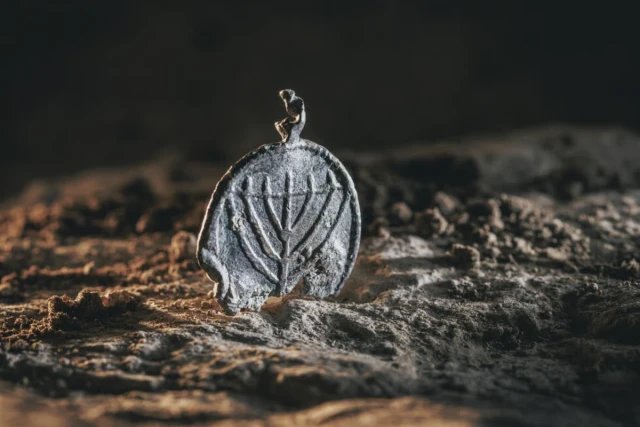
A 1,300-year-old pendant with a menorah design has been found in excavations near the Western Wall, indicating that Jews still came to worship there despite the official Byzantine ban at that time.
The treasure was found during Israel Antiquities Authority (IAA) excavations at the Davidson Archaeological Park in Jerusalem’s Old City, in cooperation with the City of David Foundation and the Jewish Quarter Development Company.
The initial discovery was made by Ayayu Belete, a City of David worker. “One day while I was digging inside an ancient structure, I suddenly saw something different, gray, among the stones”, Belete said. “I picked up the object out and saw that it was a pendant with a menorah on it. I immediately showed the find to Esther Rakow-Mellet, the area director, and she said it was an especially rare find. I was deeply moved and excited!”
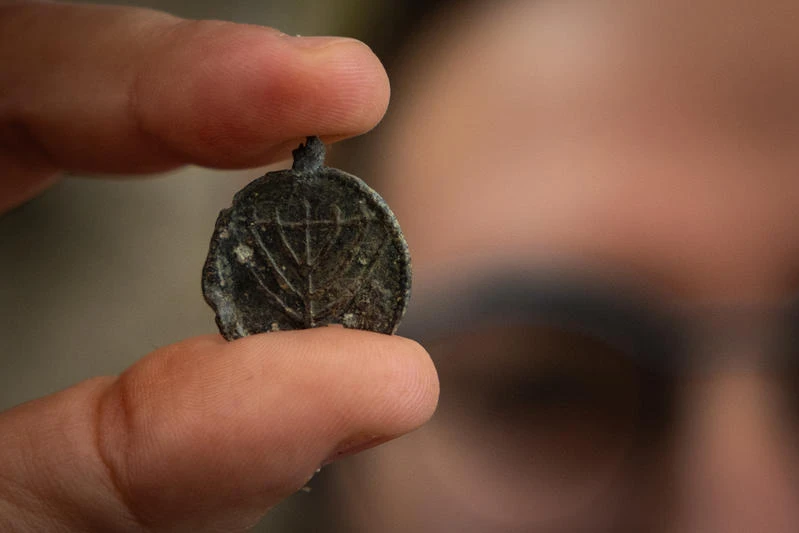
“A pendant made of pure lead, decorated with a menorah, is an exceptionally rare find,” IAA researchers including Dr. Yuval Baruch and Dr. Philip Vukosavovic confirmed. “Research has identified pendants of glass and other metals decorated with a menorah, but we know of only one other pendant in the world bearing the symbol of the menorah, made of lead. That pendant, of unknown origin, is housed in The Walters Art Museum in Baltimore, USA.”
The two-sided lead disc with a bail (hoop) at the top to attach it to a chain was found in a layer of earth some 8‑meters (26‑feet) thick that had been used as a foundation for Umayyad‑period structures, covering older Byzantine era remains, according to the researchers.
The fact that the pendant has a menorah design on both sides and was made of lead is already unusual, but the dating of the artifact to a time when Jews were banned from Jerusalem has really caused a stir.
“This fact complicates the understanding of menorah‑decorated objects in their historical context,” the researchers said. “It raises the question whether these were chance finds, or personal objects of Jews who came to the city for various reasons — merchants, administrative envoys or individuals visiting discreetly and unofficially.”
According to historical sources such as the Theodosian Code and the Jerusalem Talmud, Jewish people had been banished from the city following the Bar Kokhba revolt against the Romans in 135 AD. Emperor Hadrian established Aelia Capitolina, renaming Jerusalem and dedicating the city to Jupiter. The ban persisted under Byzantine Christian emperors, with the exception of one day a year: Tisha B’Av, when Jewish people were permitted to come and lament the destruction of the temple.
However, according to the Biblical Archaeology Society, historical records from Byzantine Christian pilgrims show that not only did Jewish people also travel to Jerusalem as pilgrims but that some still lived there, despite the ban.
Baruch, who has been directing the site’s excavations for some 25 years said, “This pendant, bearing the symbol of the menorah, is not just a material object; it is a personal seal, an emblem of memory and identity.” As an expert in menorah imagery, he reflected on the representation of the iconic artifact, in some ways a symbol of the temple itself.
“It probably belonged to an anonymous Jew who chose to wear it around his or her neck. This choice is not only the essence of a personal commitment to one’s religious faith, and perhaps even an expectation of that unanimously recognized person who held the artifact for national revival, but it also attests that during periods when imperial edicts were issued prohibiting Jews from residing in the city, they did not stop coming there!” he said.
Living and worshiping undercover is nothing new for the Jewish people, with Hanukkah dreidels telling the story of life under the Greeks when Torah study was banned, and many hiding symbols of faith even today in places where it is unsafe to be “visibly Jewish.” Yet this small lead pendant is just another testimony to the strength of Jewish identity and faith that continues regardless.
“During the Byzantine period the menorah became a symbol of national memory, and it expressed the expectation of national revival among the Jewish communities in the Land of Israel; in the Diaspora, they adopted it in exactly the same way,” Baruch emphasized. “Moreover, in recent years, there is increased archaeological evidence that shows that Jews, despite all the prohibitions and difficulties imposed on them, found the ways to reach Jerusalem - and it is possible that there were even some who settled there.”
Israel’s Minister of Heritage Rabbi Amichai Eliyahu also saw the menorah pendant as deeply symbolic, describing the discovery as “moving evidence of the continuity and devotion of the Jewish people to this city. Even in periods when Jews were prohibited from entering Jerusalem, the connection to the place did not cease.”
Is All Israel News’ faithful reporting important to you? Be part of it—help us continue by becoming a $5/month supporting partner.
You might also like to read this: