US condemns Iran’s appointment as vice president of UN nuclear conference



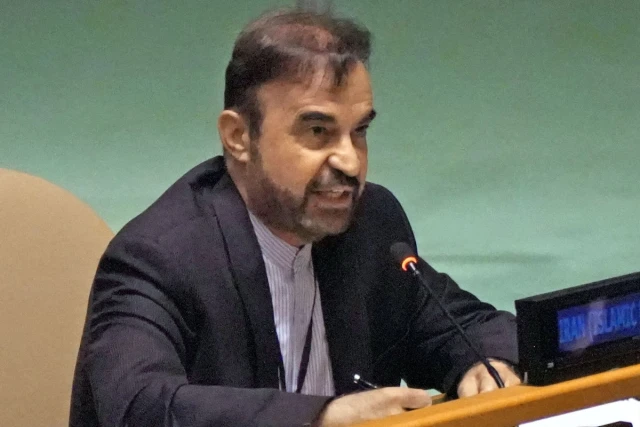
The United States criticized the United Nations after the Islamic Republic of Iran was selected on Monday as one of several vice presidents of the international organization’s nuclear nonproliferation conference.
Vietnam’s UN ambassador, Do Hung Viet, said Iran was chosen from “the group of non-aligned and other states.” The conference – the 11th since its founding in 1970 – is intended to review implementation of the Nuclear Non-Proliferation Treaty (NPT) among signatory countries, including Iran.
Christopher Yeaw, assistant secretary of the U.S. Bureau of Arms Control and Nonproliferation, condemned Tehran’s selection to the post as an “affront” to the NPT. In his address, the U.S. official said it was “indisputable that Iran has long demonstrated its contempt for the non-proliferation commitments of the NPT,” referring to Tehran’s alleged covert nuclear weapons program.
Yeaw also said Iran’s selection was “beyond shameful and an embarrassment to the credibility of this conference.”
Reza Najafi, the Iranian ambassador to the International Atomic Energy Agency, dismissed the U.S. criticism as “baseless and politically motivated.”
“It is indefensible that the United States, as the only state ever to have used nuclear weapons, and the one that continues to expand and modernize its nuclear arsenal… seeks to position itself as an arbitrator of compliance,” Najafi argued at the meeting, referring to the U.S. nuclear bombs dropped on the Japanese cities Hiroshima and Nagasaki at the end of the Second World War.
U.S. President Donald Trump has vowed to prevent the Iranian regime from ever acquiring nuclear weapons. The ayatollah regime officially denies that it seeks nuclear weapons and insists that its nuclear program is only for civilian use.
Tehran has however insisted on enriching uranium at a near-weapons-grade level, which has no civilian applications. Furthermore, the Iranian regime decided to place much of its covert nuclear program in heavily protected and, in some cases, subterranean locations.
In February, Iranian negotiators bluntly admitted to U.S. senior envoy Steve Witkoff that Tehran had sufficient highly enriched uranium to produce 11 nuclear bombs.
The realization that Tehran was negotiating in bad faith reportedly convinced Trump to order large-scale military strikes on Iran’s nuclear and military assets, beginning on Feb. 28 and known in the U.S. as Operation Epic Fury and in Israel as Operation Roaring Lion. Much of the Iranian regime’s leadership was eliminated, and much of its military infrastructure, including its nuclear sites, was destroyed in joint U.S. and Israeli strikes across Iran.
The Iranian ayatollah regime openly calls for Israel’s destruction and has also funded terrorist proxies such as Hezbollah, Hamas, and the Houthis. Tehran has so far refused to end its nuclear enrichment or scale back its missile arsenal and support for terrorist organizations across the Middle East.
Iranian sources revealed on Monday that Tehran had presented a proposal to end the conflict with Washington. The proposal focuses on postponing nuclear talks and shifting the focus to resolving the dispute over international shipping through the strategically important Strait of Hormuz. Trump is reportedly unhappy with the Iranian proposal, as it does not address Iran’s nuclear program.
White House spokeswoman Karoline Leavitt told media representatives on Monday that “the president’s red lines with respect to Iran have been made very, very clear, not just to the American public, but also to them (the Iranian leaders) as well.”
You might also like to read this: