US backs Israel-Greece-Cyprus power link despite Turkish opposition




The Trump administration is backing a major electricity grid project connecting Israel, Cyprus and Greece, giving new momentum to a project that had been delayed by strong Turkish opposition.
The proposed Great Sea Interconnector would use about 1,200 kilometers (750 miles) of underwater cables to connect Israel with Cyprus and the Greek island of Crete, eventually linking Israel’s electricity grid to the wider European network.
The project was launched in 2022 but was postponed amid Turkish objections over maritime boundaries and its disputes with Greece and Cyprus.
“The US supports energy security and cooperation in the Eastern Mediterranean, including through the Eastern Mediterranean Energy Center,” a US State Department spokesperson said in an official statement.
“The Trump administration remains committed to strengthening key energy partnerships that enhance global energy security and promote a safer and more prosperous future, with energy security for the U.S. and its partners,” the U.S. official added.
The project would also address Cyprus’ energy isolation. The island nation is the only European Union member state not currently connected to the wider European electricity grid.
Greek Prime Minister Kyriakos Mitsotakis has strongly supported the interconnector, as Greece and Cyprus maintain close political, commercial and cultural ties.
The project is complicated by Turkey’s longstanding dispute with Greece and Cyprus. Turkey has occupied northern Cyprus since 1974, and the self-declared Turkish Republic of Northern Cyprus, established in 1983, is recognized only by Ankara.
Turkey also disputes the maritime boundaries claimed by Greece and Cyprus and has opposed energy projects in the region that exclude it.
Dr. Hay Eytan Cohen Yanarocak, a Turkey expert at the Moshe Dayan Center at Tel Aviv University and the Jerusalem Institute for Strategy and Security, said Turkey views the development of regional energy infrastructure as part of its broader strategic interests.
“After they have already deployed a water pipeline between the countries, now the natural gas is coming,” Yanarocak told the Israeli business news outlet Globes.
“Ankara is aiming for the fact that if there is a future agreement in Cyprus that unites the parties on the island, then it will be required to deal with a significant Turkish incursion guaranteed in the eastern Mediterranean,” he explained.
Turkey’s opposition has previously contributed to delays in the underwater cable project, with Ankara threatening to interfere with the planned infrastructure.
Greece has more recently taken a harder line toward Turkey. Greek Foreign Minister Giorgos Gerapetritis condemned Turkish maritime moves in the Aegean Sea as illegal and unacceptable.
“Any attempt to violate our sovereign rights will be met with all the means at our disposal. Greece is prepared for any scenario, and if Turkey sends warships to the region, we will not refrain from responding,” the Greek top diplomat warned.
Yanarocak said the rivalry between Greece and Turkey is longstanding.
“Greece and Turkey have been in a constant state of rivalry, especially since the UN Law of the Sea was established,” he assessed.
“Turkey aims to resolve this with Athens bilaterally, while the Greeks do not want to lose their upper hand in the regional issue as a result of the Law of the Sea,” the Turkey expert explained.
The Israeli Energy and Infrastructure Ministry emphasized the strategic importance of the project.
“The Energy and Infrastructure Ministry sees strategic importance in the Great Sea Interconnector project, which will enable the connection of the electricity grid to Cyprus, and from there to Greece and the EU,” the ministry stated.
“The project is currently in the cost-benefit analysis phase for Israel and Cyprus. After that, negotiations will take place between the countries on the division of costs, and an application will be submitted for a grant from the EU, so the cost for Israel is yet to be set,” the ministry added.
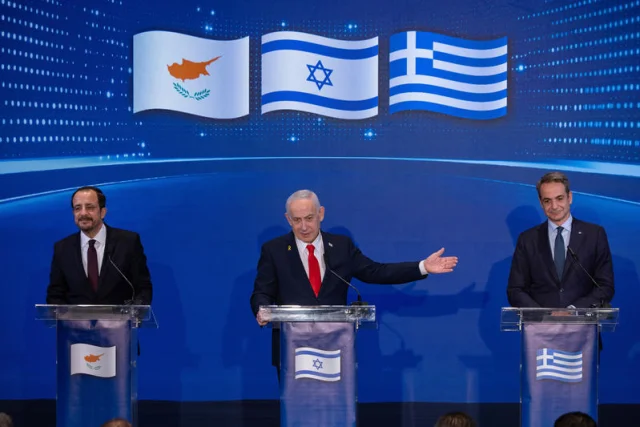
In December 2025, Israeli Prime Minister Benjamin Netanyahu hosted Cypriot President Nikos Christodoulides and Greek Prime Minister Kyriakos Mitsotakis during a trilateral Israel-Greece-Cyprus summit in Jerusalem amid Turkish threats.
“The alliance between Israel, Greece, and Cyprus is an anchor of responsibility, stability, and shared interests in a challenging region,” Netanyahu announced, stressing that the Jewish state would not allow Turkey to threaten its neighbors.
You might also like to read this: