Burned, destroyed and rebuilt – the remarkable history behind Jerusalem’s Hurva Synagogue




Imagine defaulting on a massive loan, but instead of seizing your property, the creditors burn your entire neighborhood to the ground and expel you and your entire community from the city for a century. It sounds crazy, but that’s what happened to the Ashkenazi Jewish community in Jerusalem in the year 1720 – and it’s the defining event that gave the Hurva Synagogue its name.
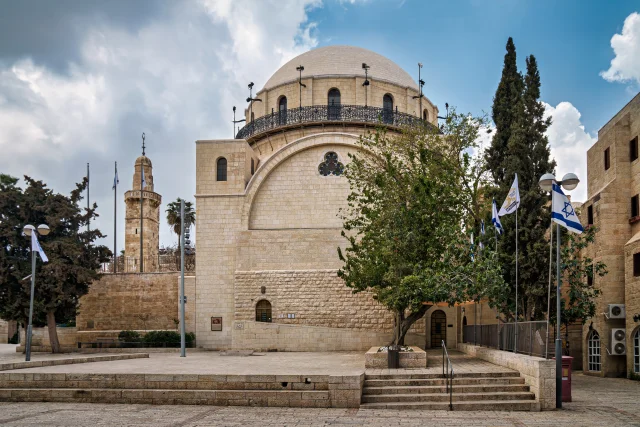
The Hurva Synagogue is a large, majestic structure with a big white dome in the middle of the Jewish Quarter of the Old City in Jerusalem. Today, it’s an inseparable part of the city's skyline. But the current structure was built only in 2010, and it has been built, destroyed, and rebuilt a number of times throughout its history, which is where its name, Hurva, “The Ruin,” comes from.
But let’s start from the beginning. There are Jewish ritual baths on the spot from the first century, and there are stories about a synagogue here in the 3rd century. But the earliest information we know for sure is that in the early 15th century, this area was known as the Ashkenazi Courtyard, which had developed following Rabbi Nachmanides’ arrival in Jerusalem in 1267 and the establishment of the Ramban Synagogue. It was under constant legal and physical friction as it shared a wall with the Sidna Omar Mosque, and in 1474 the synagogue was destroyed, but quickly rebuilt.
A century later, in 1589, the Muslim authorities had had enough and confiscated the synagogue. The Ashkenazi community was left with just a courtyard, in which they built a small, makeshift synagogue.
After a century, the roof of that building caved in, and rebuilding a non-Muslim house of worship required special Ottoman permission, and obtaining it – and financing the reconstruction – plunged the already struggling Ashkenazi community deep into debt. This is where Judah HeHasid comes in.
As I’ve mentioned here, Judah led about 1,500 Jews from Europe to Jerusalem, and the journey was disastrous. Many died along the way, and only a few hundred arrived. Judah himself died less than a week after arrival. The local Ashkenazi Jews had taken these huge loans and built the synagogue, likely relying on Judah’s leadership and connections with Europe’s rich Jews to help repay the debts. Now they were left alone and with hostile Muslim creditors and neighbors.
The Hurva Synagogue was burned to the ground in November 1720, and the Ashkenazi Jews were banished from Jerusalem. The Jews who wanted to stay had to dress as Sephardic Jews, learn Judeo-Arabic, and blend into the more native Middle Eastern Jewish community. For a century, the site of the Hurva was in ruins, and was known as “the ruins (Hurva) of Rabbi Judah HeHasid.” Or just “The Hurva” for short. A name the synagogue has to this day.
A century later, the students of the Vilna Gaon arrived in Jerusalem in the early 1800s and began negotiating permission to rebuild the Hurva, spending decades reclaiming the site. By the 1850s, European powers were increasingly competing for influence in the weakening Ottoman Empire, in part through their protection of religious minorities. With help from Moses Montefiore, the Rothschilds and European diplomats, permission was finally secured for a magnificent new synagogue. They built a magnificent neo-Byzantine structure rising 24 meters (78 feet) to the top of its soaring dome; inside, the ceiling was painted sky-blue and covered with golden stars. The dedication service took place in 1864.
In the early 20th century, the Hurva was the beating heart of Ashkenazi Jewish life in Jerusalem. In 1920, the first British High Commissioner to Palestine, Herbert Samuel, who was Jewish, was honored with the Maftir aliyah on Shabbat Nachamu, the Sabbath after Tisha B’Av. He then chanted the haftarah beginning, “Comfort, comfort my people,” an extraordinarily poignant moment for Jerusalem’s Jews. In November 1942, it became the site of a massive gathering and prayer session after devastating reports were received of the ongoing Holocaust in Europe.
During the modern reconstruction, archaeologists discovered a forgotten Irgun weapons cache from 1938 beneath the synagogue, apparently unknown to the Jewish defenders in 1948. Had the defenders of Jerusalem been aware of it, who knows what might have happened. As it was, the Old City of Jerusalem fell to the Jordanian invaders in 1948, and all the Jews were expelled.
The Jordanians destroyed almost all the synagogues in the parts of Jerusalem they occupied, including the Hurva, and turned the Western Wall into a garbage dump. The Hurva was dynamited on May 27, 1948, on the Jewish bonfire holiday of Lag B'Omer. On that particular night, the Jewish quarter was lit up with a massive bonfire of the Hurva.
The Hurva was once again "the Hurva."
After Jerusalem’s liberation in 1967, the Hurva was not immediately rebuilt. Instead, Israel reconstructed one of the arches and left it as a memorial to the Hurva. If one had visited Jerusalem between the 1970s and the early 2000s, the itinerary might have included a visit to this iconic arch stretching over the ruins of the Hurva, which became a symbol of Jerusalem in itself; framing the Jerusalem sky, symbolizing hope for the future and memory of the past.
In the early 2000s, the decision was made to rebuild the synagogue, and discussions took place about whether to build something new or reconstruct in the neo-Byzantine style of the 1864-1948 iteration. They decided to recreate the previous synagogue, using old photographs and even some of its original walls.
Today, if you stand in the right place, you can see three giant domes over the Jerusalem skyline: the Muslim Dome of the Rock, the Christian Dome of the Church of the Holy Sepulchre, and the Jewish Dome of the Hurva Synagogue.
You might also like to read this: