Trump says US forces will remain in region, threatens to renew military operations if Iran fails to keep agreement
Strait of Hormuz appears to be closed, as US & Iran issue contradictory statements over agreement




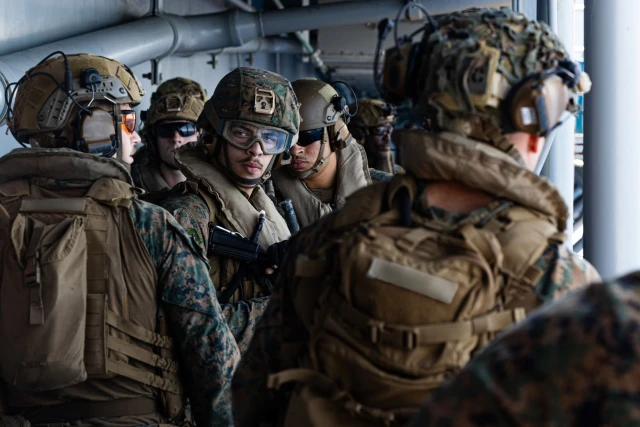
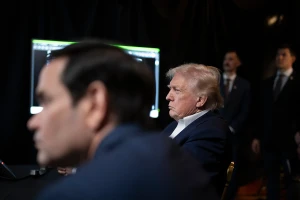
U.S. President Donald Trump said early on Thursday morning that all American military forces in the region will “remain in place” until Iran complies with the agreement, which formed the basis for the two-week ceasefire.
President Trump also threatened a resumption of military operations if the agreement is not followed, while again referencing a 10-point ceasefire plan that Iranian officials have shared.
“All U.S. Ships, Aircraft, and Military Personnel, with additional Ammunition, Weaponry, and anything else that is appropriate and necessary for the lethal prosecution and destruction of an already substantially degraded Enemy, will remain in place in, and around, Iran, until such time as the REAL AGREEMENT reached is fully complied with,” Trump posted to Truth Social.
“If for any reason it is not, which is highly unlikely, then the ‘Shootin’ Starts,' bigger, and better, and stronger than anyone has ever seen before,” he continued. “It was agreed, a long time ago, and despite all of the fake rhetoric to the contrary - NO NUCLEAR WEAPONS and, the Strait of Hormuz WILL BE OPEN & SAFE. In the meantime, our great Military is Loading Up and Resting, looking forward, actually, to its next Conquest. AMERICA IS BACK!”
Meanwhile, confusion continued over the details of the framework underpinning the temporary ceasefire, as well as the talks on a permanent agreement.
In a previous post, President Trump referred to “a totally FAKE TEN POINT PLAN” shared by the New York Times and CNN, which he said was not the actual agreement.
But Iranian officials and Iranian media have also referred to that 10-point plan as if it were the one agreed to by the Islamic Republic’s regime.
While the U.S. put forward a 15-point plan that the Iranian regime rejected, China and Pakistan proposed a separate 10-point plan that omitted the U.S.’s key demands and allowed uranium enrichment—something explicitly prohibited in the U.S. proposal
Iranian Parliament Speaker Mohammad Bagher Ghalibaf on Wednesday said that a ceasefire and negotiations with the U.S. on ending the war are “unreasonable.” He also accused the U.S. of violating three of Tehran’s 10 conditions for halting the fighting, indicating that significant gaps remain between the two sides.
Iranian media have also been sharing a Farsi-language version of a 10-point ceasefire plan, which includes the phrase “acceptance of enrichment,” regarding Iran’s nuclear program. This language was missing in the English versions of the plan shared with international media.
The 10-point plan, which the Iranian regime appears to be basing its negotiating stance upon, allows Iran and Oman to charge fees on ships transiting the Strait of Hormuz, according to a regional official who spoke with the Associated Press.
The official said Iran would use the money it raised for reconstruction. Although the strait lies within the territorial waters of both Oman and Iran, it has been considered an international waterway.
The White House later denied that the agreement allows tolls in the Strait, with Press Secretary Karoline Leavitt saying the agreement requires free passage of shipping through the waterway.
Leavitt referenced Trump’s original Truth Social post about the ceasefire agreement on Tuesday, which said the agreement was conditional on the “COMPLETE, IMMEDIATE, and SAFE OPENING” of the Strait.
She emphasized, “That’s very plain language and it should be taken at face value.”
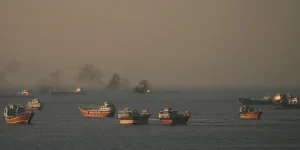
According to Windward, a maritime intelligence firm that tracks international shipping, only 11 vessels transited the strait on Wednesday, consistent with previous days during the war, indicating no change in the situation.
Overnight, Iran’s PressTV reported that the Strait has been closed again, saying an oil tanker was turned away upon approaching the crossing.
Iranian media affiliated with the regime published reports on Thursday suggesting that the Islamic Revolutionary Guard Corps placed sea mines in the Strait during the conflict. Iranian news agency ISNA said the IRGC has shared a map indicating safe transit routes to avoid naval mines it had placed.
Meanwhile, Iran’s ambassador to Pakistan announced early on Thursday that an Iranian delegation would arrive in Islamabad for ceasefire negotiations, before deleting the post.
Ambassador Reza Amiri Moghadam had written that despite skepticism related to “Israeli violations” of the ceasefire, an “Iranian delegation arrives tonight in Islamabad for serious talks based on 10 points proposed by Iran.”
The violations were a reference to continued Israeli strikes on Hezbollah targets in Lebanon, as Iran has claimed that the ceasefire agreement includes Lebanon, while both Israel and the White House have denied that Lebanon is included.
Asked about Lebanon during a press briefing on Wednesday evening, Press Secretary Leavitt said, “Lebanon is not part of the ceasefire, that has been relayed to all parties involved in the ceasefire.”
Leavitt: "Lebanon is not part of the ceasefire, that has been relayed to all parties involved in the ceasefire." pic.twitter.com/xeTpjRAkkB
— The Bulwark (@BulwarkOnline) April 8, 2026
The IDF has continued to strike Hezbollah targets in Lebanon, with Chief of Staff Lt. Gen. Eyal Zamir saying, “We will continue striking the Hezbollah terror organization and will utilize every operational opportunity. We will not compromise the security of the residents of northern Israel. We will continue to strike with determination.”
You might also like to read this: