Pentagon expands interceptor production after heavy demand from Israel, Ukraine




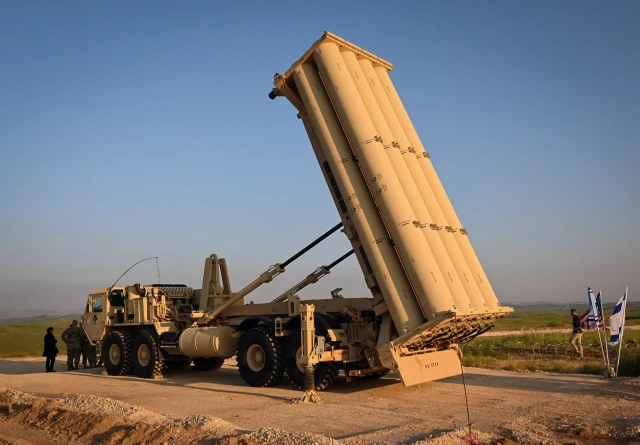
The Pentagon has launched a major effort to expand production of Patriot and THAAD interceptor missiles as the United States, Israel and other allies work to replenish air defense stockpiles depleted by years of conflict.
The move comes after unprecedented demand for interceptor missiles driven by wars in the Middle East and Ukraine, highlighting the growing challenge of sustaining modern air defense systems.
Israel has become one of the clearest examples of that challenge. Since Hamas' Oct. 7, 2023 attack, the country has faced repeated missile, rocket and drone attacks from Iran and its network of proxies, including Hezbollah in Lebanon, the Houthis in Yemen, Hamas in the Gaza Strip and Shi'ite militias in Iraq.
Despite the sustained attacks, Israel's multi-layered air defense network has intercepted the vast majority of incoming threats.
That defensive architecture includes the Iron Dome system, which protects against short-range rockets, artillery shells and drones; David's Sling, which counters medium-range threats; and the Arrow-2 and Arrow-3 systems, which intercept longer-range ballistic and cruise missiles.
More recently, the Iron Beam laser system has been added to defend against drones and rockets using the same radar system employed by Iron Dome to detect and track incoming targets.
The exact number of interceptor missiles remaining in the Israel Defense Forces' arsenal is among the country's most closely guarded secrets. However, it is widely understood that production lines are operating near maximum capacity to replace munitions expended over the past three years while preparing for future conflicts.
During the latest round of fighting with Iran, which began on Feb. 28 and continued into mid-April, many of the ballistic missiles launched at Israel were intercepted by U.S. forces. Those defenses included U.S. Army Terminal High Altitude Area Defense (THAAD) batteries and U.S. Navy destroyers equipped with the Aegis combat system and SM-3 and SM-6 interceptors.
A recent study by the Center for Strategic and International Studies estimates that the Pentagon's inventory of interceptor munitions has fallen to its lowest level in decades, while replenishing those stockpiles could take years.
The pressure on interceptor production extends beyond the Middle East. The United States continues to supply Ukraine with air defense munitions to defend against Russian ballistic missile and drone attacks, while also maintaining readiness for potential conflicts elsewhere.
Against that backdrop, the Pentagon announced on Monday that it is establishing framework agreements with defense contractors Northrop Grumman and Lockheed Martin to significantly expand production of key components for Patriot and THAAD interceptor missiles.
The goal is to triple annual production of Patriot PAC-3 interceptors and quadruple output of THAAD interceptors.
“Building the Arsenal of Freedom requires robust, dynamic supply chains at every level of the industrial base,” Michael P. Duffey, undersecretary of defense for acquisition and sustainment, said in a statement.
“Framework agreements with munition components suppliers like Northrop Grumman are vital to accelerating the tripling of PAC-3 and quadrupling of THAAD interceptor production,” he said.
The announcement follows last Thursday's award of a $58.6 billion U.S. Army contract to Lockheed Martin to expand Patriot production over the next seven years.
You might also like to read this: