








No US strikes after Trump decides against Iran escalation following Pentagon warning of interceptor shortage
Iran conflict appears to be spreading with attacks in Caspian Sea, Red Sea
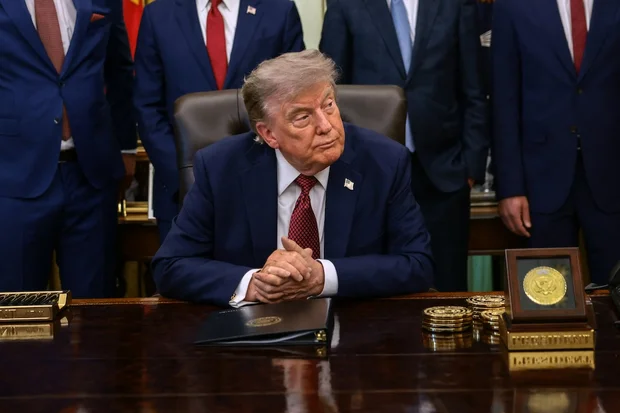
After 13 consecutive days of strikes on Iran, U.S. Central Command (CENTCOM) did not report any strikes on Iranian targets on Saturday, while diplomatic efforts have reportedly returned to the forefront, U.S. media reported over the weekend.
The U.S. military did not report any new strikes on Friday or Saturday night, after almost two weeks of constant strikes on Iranian targets.
The last round of U.S. strikes occurred overnight between Thursday and Friday of last week, when CENTCOM said it “targeted Iranian military command centers, drone storage facilities, communication networks, coastal surveillance sites, and maritime capabilities to further diminish the threat Iran poses to civilian mariners and commercial vessels transiting the Strait of Hormuz.”
A Department of Defense official told CNN that military operations against Iranian military targets are “on hold.”
At the same time, CENTCOM said the "U.S. naval blockade against Iran remains in full effect."
Last week, U.S. President Donald Trump threatened a major escalation in the conflict with Iran if attacks on ships transiting the Strait of Hormuz did not stop.
In a post to his Truth Social account, Trump threatened to escalate the conflict by striking Iranian infrastructure, saying that for every ship targeted, the U.S. would “bomb and destroy ONE BRIDGE OR POWER PLANT, including those located next to, or in, the Capital City of Tehran.”
On Sunday morning, Iranian army spokesman Mohammad Akraminia said the nation’s military ceased its attacks on U.S. military facilities in the region due to the halting of U.S. strikes.
“The Americans stopped their attacks over the past two nights. Since our strategy has been entirely retaliatory, we also stopped our retaliatory operations,” Akraminia explained in remarks carried in Iranian media.
However, Akraminia warned that the conflict would expand to other arenas if the U.S. insisted on “continuing the war.”
“I believe that if the Americans once again fall for the Zionists’ deception, or move in line with them, and insist on continuing the war, particularly through airstrikes, geographically this will expand further,” Akraminia said in remarks on state television.
Reports in CNN and The New York Times said both Vice President JD Vance and Chairman of the Joint Chiefs of Staff Gen. Dan Caine raised concerns about such an escalation in a meeting with Trump at the White House on Friday, due to low munitions stockpiles, particularly ballistic missile interceptors.
The report in the Times said that the U.S. military has run dangerously low on its stockpile of Patriot interceptors, which, along with concerns among Gulf partners regarding the risks of escalation, caused President Trump to postpone his planned broadening of strikes in Iran.
Following the meeting, White House Communications Director Steven Cheung said,
“President Trump has always been consistent in saying he prefers a diplomatic solution, but he continues to retain all options if Iran continues terrorist activities in the Hormuz or against allies,” Cheung said.
Cheung also said “it would be wise for Iran to work towards a negotiated deal. Otherwise, they know what will happen.”
“Look, we’re locked and loaded,” President Trump told reporters on Friday afternoon. “We’re ready to go, but we’re talking to them, so maybe there will be, maybe there won’t be a tipping point.”
At the same time, Iranian Foreign Ministry spokesman Esmail Baghaei said that deputy foreign ministers from Iran and Oman held talks about the Strait of Hormuz in Tehran over the weekend.
“During these meetings, the two sides exchanged views on shared principles and operational mechanisms for managing the safe passage of shipping through the Strait of Hormuz, while respecting the sovereign rights of the two coastal states,” Baghaei said.
However, there appears to be no change in shipping traffic through the strait, with minimal transits reported through the strait according to ship tracking websites.
Meanwhile, Iran accused Ukraine of attacking a commercial vessel in the Caspian Sea on Saturday, saying at least one person was killed.
Ukrainian President Volodymyr Zelenskyy on Saturday said the military “achieved very strong results with long‑range strikes in the Caspian Sea – including vessels used in military cargo shipments involving Iran, as well as a warship.”
⚡️Zelensky says Ukraine successfully struck vessels in the Caspian Sea that were transporting military cargo between Russia and Iran pic.twitter.com/GdrIXIo8Ag
— NEXTA (@nexta_tv) July 25, 2026
Ukrainian Ambassador to Israel Yevgen Korniychuk told Channel 12 News that the vessels contained components for drones and missiles on their way to Iran.
Kornitchuk also said the strikes were not the first time Ukraine hit military targets in the Caspian Sea.
Some Iranian accounts on social media originally attributed the strikes to U.S. efforts, before Ukraine announced responsibility. The accounts noted that the strikes happened near an Islamic Revolutionary Guard Corps (IRGC) naval base on the Caspian Sea.
Zelenskyy also said he would share intelligence with partner nations “regarding Russia’s new assistance to the Iranian regime.”
“Since the beginning of July, we have recorded active Russian satellite surveillance of the Gulf states and U.S. military facilities located there,” Zelenskyy claimed in a post to 𝕏. “These images subsequently appear in Iran. At the same time, there is a clear correlation between Russia’s satellite imagery of these sites and Iranian strikes – both before the attacks, in preparation for them, and afterward, to assess the damage inflicted.”
I will instruct our intelligence to share with our partners the information we have regarding Russia’s new assistance to the Iranian regime. Since the beginning of July, we have recorded active Russian satellite surveillance of the Gulf states and U.S. military facilities located…
— Volodymyr Zelenskyy / Володимир Зеленський (@ZelenskyyUa) July 25, 2026
The Iran conflict also appears to be spreading outside of the Persian Gulf, as Iranian-backed Houthi forces in Yemen fired missiles and drones at two Saudi Arabian oil facilities.
The Houthi attacks came following Saudi strikes on Houthi-controlled port city of Hodeidah on Friday.
BREAKING: Yemen's Houthis have successfully struck Saudi Aramco's Jazan oil refinery with 3 ballistic missiles overnight, causing multiple pillars of smoke to rise from the refinery.
— The Hormuz Letter (@HormuzLetter) July 25, 2026
Jazan is Saudi Arabia's 5th largest oil refinery putting out 400,000 barrels of crude per day,… pic.twitter.com/ZltYWR3sGk
Reuters reported that air defense systems in Yanbu, Saudi Arabia intercepted two ballistic missiles from Houthi territory on Saturday. Air raid warnings also sounded in the Red Sea port city of Jizan, close to the border of Yemen, where a large Aramco oil refinery is located.
Popular article:

interview Easter message of resurrection hope amid war at Jerusalem's Garden Tomb

biblical commentary Let my people go: a Passover message for today
4 IDF soldiers killed, 2 wounded in fighting in southern Lebanon, as Israel eliminates dozens of Hezbollah terrorists

Receive latest news & updates
A message from All Israel News
Help us educate Christians on a daily basis about what is happening in Israel & the Middle East and why it matters.
For as little as $10, you can support ALL ISRAEL NEWS, a non-profit media organization that is supported by readers like you.
Latest articles:
North American Jewish organizations to recruit 100 professionals to combat antisemitism
‘No need’ for pre-election Iran strike, IDF chief says as gov’t, opposition trade blame for potential escalation – report
terror attack 2 Israeli soldiers killed, 2 terrorists eliminated in Hebron shooting; IDF says much larger attack was prevented
analysis A people dwelling securely? Israel’s strategic standing, 3 years after Oct 7
Hamas on wheels: What I found in Dearborn reveals a troubling history and a battle over Israel