Biblical-era dye factory in Israel found to also produce olive oil, textiles
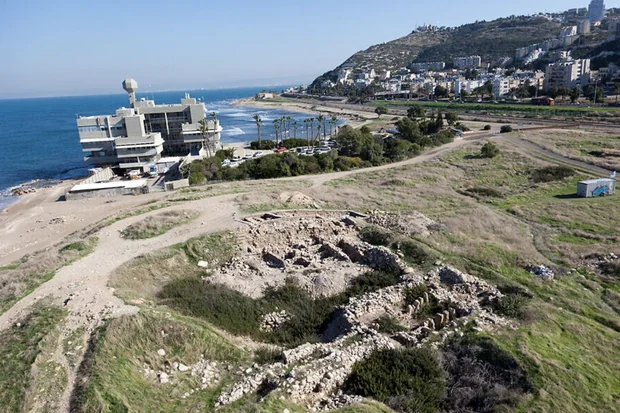
New research suggests that an ancient industrial center at Tel Shiqmona on Israel’s Carmel coast was used for more than producing the costly blue and purple dyes prized by biblical-era kings and priests, with evidence indicating that the site also supported olive-oil production, textile manufacturing and possibly livestock sheltering at different times of the year.
Published in the scientific journal PLOS One on Sept. 24, the study examines soil samples from the site to reconstruct how its buildings and resources may have been used throughout the agricultural year. The findings suggest that the facility operated as a multipurpose production center, with different activities taking place according to the seasons.
“When archaeologists find an olive press, the natural tendency is to say, ‘Olive oil was produced here,’” said University of Haifa researcher Golan Shalvi, who has participated in several excavation seasons at the site. “However, the olive harvest lasts for only a relatively short period at the end of autumn. Therefore, to understand how space was used, we need to ask what was done there during the rest of the year.”
Located near modern Haifa, Tel Shiqmona has been excavated since the mid-20th century. Archaeological discoveries have established the site as a major center for producing purple dye during the Iron Age, with researchers describing it as the largest facility of its kind in the Mediterranean region.
The approximately two-acre site contains archaeological layers dating from the Late Bronze Age (1500–1150 BC) through the Byzantine period (4-7 AD).
The site appears to have begun as a small Phoenician settlement before undergoing a major transformation around 9 BC, when the northern Kingdom of Israel developed it into a state-controlled industrial center for dye production.
Its location on the Mediterranean coast made it well suited to harvesting three types of murex sea snails, whose glands were used to produce blue and purple dyes.
The process was labor-intensive and required large numbers of snails to yield even small quantities of dye, making the finished products highly valuable.
These dyes were associated with royal and religious garments in the ancient world, including the ceremonial clothing worn by priests serving in the First Temple, traditionally attributed to King Solomon.
Archaeological evidence also suggests that the dyes produced at Shiqmona were traded beyond the Kingdom of Israel, reaching regions including Philistia, Moab, Edom and Judah.
Archaeologists have uncovered substantial infrastructure for dye production at the site, including at least 16 dyeing vats, each capable of holding approximately 350 liters. However, because the collection of murex snails was likely seasonal rather than a year-round activity, researchers sought to determine how the facilities might have been used during the rest of the year.
The research team analyzed soil samples from sedimentary layers dating to approximately 790–740 BC, during the reign of Israelite King Jeroboam II.
Based on their findings, the researchers proposed a seasonal cycle of activity at the site. Olive harvesting and pressing likely took place between October and December, while textile production may have followed the spring shearing of sheep. The buildings may also have served as shelters for livestock or supported other agricultural activities during different periods.
“There is no reason why the planned activity and seasonal pattern that we see at Shiqmona should not also be discovered at other sites through integrated research,” said David Friesem, head of the University of Haifa’s Laboratory for Environmental Micro-History in the Department of Maritime Civilizations. “Improving efficiency and maximizing the use of resources and space was clearly a feature of ancient societies, no less than it is of our own.”
The research team included Shalvi, Sonia Pinsky and Prof. Ayelet Gilboa of the University of Haifa’s Zinman Institute of Archaeology, alongside researchers from the university’s Environmental Microhistory Laboratory in the Department of Maritime Civilizations, led by Prof. David Friesem and Roni Zuckerman-Cooper.
Popular article:

interview Easter message of resurrection hope amid war at Jerusalem's Garden Tomb

biblical commentary Let my people go: a Passover message for today

4 IDF soldiers killed, 2 wounded in fighting in southern Lebanon, as Israel eliminates dozens of Hezbollah terrorists

Receive latest news & updates
A message from All Israel News
Help us educate Christians on a daily basis about what is happening in Israel & the Middle East and why it matters.
For as little as $10, you can support ALL ISRAEL NEWS, a non-profit media organization that is supported by readers like you.
Latest articles:
Israel’s 26th Knesset prepares to convene as coalition uncertainty looms

UK police arrest 139 at London protest supporting banned Palestine Action

Israel Aerospace Industries wins Lockheed Martin supplier awards for F-35, F-16 programs

After call with Netanyahu, Trump says 'one or two sites in Iran need to be dealt with’

'IN THE WAR ROOM' – The gutsy gamble against Iran that changed the war