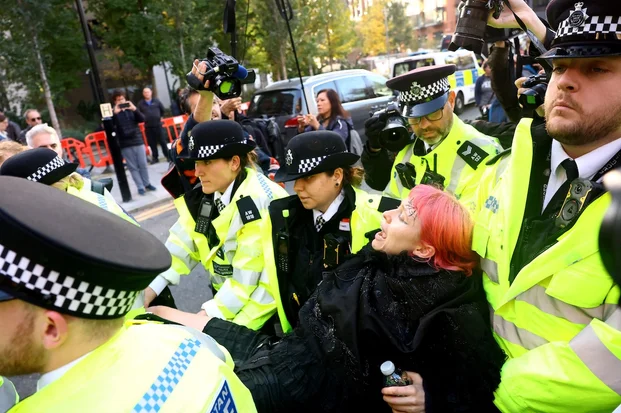
Case against 3 Ra’am activists suspected of election bribery stagnates as court rejects police request to extend detention
Police found cash envelopes, voting slips in searches conducted without proper warrants
The case against three activists for the Islamist Arab Ra’am party who are suspected of bribing people to vote in last week’s election has stalled, as the Beersheva Magistrate’s Court expressed reservations about the case on Sunday.
The three suspects were arrested the night before the elections, after police found envelopes containing cash and voting slips in their homes. However, at a court hearing last week, police acknowledged that the searches had been conducted before the necessary warrants were issued.
Police arrested four more suspects on Thursday who have since been released to house arrest. Israeli media later reported that intelligence leading to the arrests was given to the police by Ido Norden, Prime Minister Benjamin Netanyahu’s acting chief of staff.
The case unfolded amid unprecedented turnout among Arab voters, prompting the Likud party to allege that the election had been “stolen." The allegation came before reports emerged that Shin Bet was investigating a separate, potentially more serious bribery case, involving funds allegedly funneled from Qatar or Turkey.
Authorities have since stressed that the case, which reportedly focuses on the other Arab party, the Joint List, will not endanger the integrity of the overall outcome of the vote.
The two cases are being investigated separately, and no suspected connection between them has been identified. Meanwhile, the case against the Ra’am activists appears to be faltering.
On Sunday, the Beersheva Magistrate’s Court rejected the police request to extend the detention of two southern Bedouin Ra’am activists by eight days, while ordering the third, physician Saef Abu Raesh (38), to be released unconditionally.
The detention of Hussein Masoudin (63) was extended by two days, while Ibrahim al-Garibi (42) was released to house arrest until next Sunday.
The presiding judge, Eran Tzabari, sharply criticized the police's handling of the case, including its request to ban Abu Raesh from using the internet. Tzabari argued that the police had offered sufficient evidence for a house arrest or to ban Abu Raesh’s internet access, noting he led an ordinary, law-abiding lifestyle and relied on the internet for his work.
“The reasonable suspicion has not strengthened, and it can even be said that the level of the reasonable suspicion has actually decreased,” the judge ruled.
Responding to Abu Raesh’s attorney, who argued that the police had conducted an illegal search, the investigator replied: “A search was conducted without a warrant. Call it illegal. There was recent intelligence. A search warrant was not necessary.”
The attorney further denied that cash envelopes were found, saying, “This man simply held home meetings. He is a doctor. He went from house to house and explained to people why it was important to go to the ballot box. We should be proud of what he did as an act of good citizenship. He chose to bring about change in society through democratic influence.”
Regarding Masoudin, whose detention was extended, Judge Tzabari reportedly said the case was notably different from the other two suspects.
Ynet News reported that envelopes containing money with the Arabic words “Islamic Movement” were found at Masoudin's home and that Ra’am party voting slips were found in his car.
A representative of the investigating unit said: “This is a second request to extend detention for an offense that is quite serious. When I say it is quite serious, I mean it is very serious.”
The Likud party is reportedly preparing to file for the annulment of the results at polling stations where it claims voters were bribed, Ynet News reported. "New elections must be held at these polling stations,” senior party officials said.
The outlet also cited a Bedouin source from the Negev, where most of Ra’am’s voter base lives, who described the system that Abu Raesh’s attorney had referenced, saying it was widely used by Arab parties ahead of elections.
According to the practice, political activists visit low-income families and offer financial assistance as an incentive to vote.
The assistance ranges from NIS 200 to 300 ($65 to $95) and can include fuel vouchers worth NIS 100 ($32) for people who transport residents to polling stations.
Masoudin’s attorney said the envelopes bearing the name of the Islamic Movement, the religious movement associated with Ra’am whose northern branch has been outlawed, each contained NIS 1,000 ($320).
“I don't understand what all the fuss is about,” the Bedouin source said. “We learned this from [ultra-Orthodox party] Shas, which has been doing it for years and even distributes money in synagogues.”
“So why all the fuss now? Just because we're Arabs? Because we turned out to vote and became a powerful political force?” he added.
Popular article:

interview Easter message of resurrection hope amid war at Jerusalem's Garden Tomb

biblical commentary Let my people go: a Passover message for today

4 IDF soldiers killed, 2 wounded in fighting in southern Lebanon, as Israel eliminates dozens of Hezbollah terrorists

Receive latest news & updates
A message from All Israel News
Help us educate Christians on a daily basis about what is happening in Israel & the Middle East and why it matters.
For as little as $10, you can support ALL ISRAEL NEWS, a non-profit media organization that is supported by readers like you.
Latest articles:
Al Jazeera airs unseen footage of Hamas' senior military leaders before Oct. 7 massacre
US, Israeli flags trampled and burned during French protests
Israel heading back to elections? Netanyahu said to prefer new vote over unity government
Israel’s 26th Knesset prepares to convene as coalition uncertainty looms
Biblical-era dye factory in Israel found to also produce olive oil, textiles