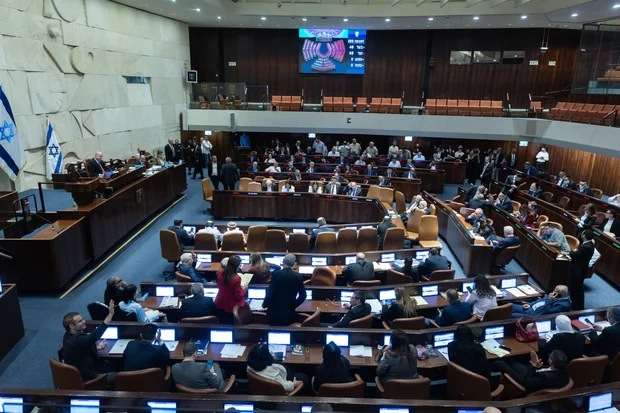
Foreign interference probe poses no danger to Israel's election results, says Shin Bet, election committee
New conflict threatens to overshadow already complicated negotiations over a new government

After a political uproar that included calls to invalidate Tuesday’s elections over an investigation into alleged foreign interference, Israel’s domestic intelligence agency Shin Bet and the Central Elections Committee (CEC) stressed that the probe is limited in scope and will not endanger the integrity of the election results.
The new conflict threatens to overshadow already highly complicated negotiations over a new government, with a cross-bloc coalition currently appearing the only possible option.
In a letter released to Israeli media on Thursday morning, CEC Chairman and Supreme Court Deputy President Noam Sohlberg instructed Shin Bet Director David Zini to investigate suspicions of foreign funding and improper influence by foreign entities on the elections.
The letter came after three Arab residents of the Negev were arrested on Tuesday on suspicion of trying to bribe voters with cash to vote for the Ra’am party, which, alongside the Joint List, saw a record turnout that jumped by more than 20% in some communities.
After the Likud party claimed the elections had been “stolen” and amid calls for new elections, the Shin Bet on Thursday issued a clarifying statement, saying that “the investigation is focused and limited in scope. Only those who acted in violation of the law will be dealt with. An entire sector of society must not be stigmatized.”
The CEC’s acting director-general, Dean Livneh, also said the investigation would “not affect the final [election] results that will be submitted to the President, and it does not concern any particular sector or community.”
In its statement, the Shin Bet also clarified that the information at the root of the investigation was collected via intelligence means and didn’t come from any political actor.
This came in response to speculation that the investigation was connected to the arrest of the three suspects in the Negev, which came as a result of calls to the police made by Netanyahu’s chief of staff, Ido Norden, according to Israeli media reports. The Prime Minister’s Office denied this.
The Shin Bet further urged people to avoid speculation about “the content or nature of the suspicions,” vowing the results of the investigation would be presented fully and transparently to the CEC.
“With the approval of the chairman of the Elections Committee and at his request, Prime Minister Benjamin Netanyahu, Gadi Eisenkot, head of the Yashar party, and opposition leader Yair Lapid were personally briefed by the Shin Bet chief over the past 24 hours on the main points of the suspicions under investigation,” the statement concluded.
Livneh said that the reports published throughout the day were “entirely unfounded,” and reiterated in a Channel 12 interview that the allegations are unlikely to affect the election results even if found credible. He added that this means some individual votes might be invalidated but “only if direct proof is found.”
Sources in the Shin Bet told Channel 12 that the certified election results would be presented to President Isaac Herzog as scheduled on Wednesday, Nov. 4.
“The claims about systematic intervention or stolen elections constitute political manipulation of the allegations that are being probed,” the sources said.
The Israel Police also pushed back against allegations that the elections were “stolen.” The Likud party had named the probe “Ra’am-gate” in an ironic nod to the “Qatargate” affair, and characterized it as “a terrorist attack against democracy, intended to bring about foreign control of the Knesset, the Islamization of Israel, and the overthrow of right-wing rule.”
A police source told Israeli media there had been “very few irregular incidents” on election day and that there was “no investigative or intelligence-based substantiation” for claiming the outcome had been invalidated.
Opposition leaders broadly accused the Netanyahu bloc of trying to exploit the investigation for its own political ends, against the backdrop of increased calls for a unity government from public intellectuals and media personalities.
The Likud said, “it is clear that no Zionist party must cooperate with Ra’am and the Joint List, replace the Speaker of the Knesset with votes purchased with cash, or form a government that poses a danger to Israel.”
Religious Zionism leader and Finance Minister Bezalel Smotrich called for the heads of the Arab parties to be interrogated by Shin Bet, while Moshe Feiglin, leader of the Zehut party, who ran together with Smotrich, further demanded, "These elections must be canceled immediately!"
CEC Deputy Chairman Vladimir Beliak (Yesh Atid party) hit back, saying, “I suggest that the Likud stop making all these claims. They lost the election; they lost 15 seats. That is no reason to annul the election.”
Yashar leader Gadi Eisenkot accused Netanyahu of having launched “a coordinated and organized campaign to delegitimize the election results.”
In another statement, Eisenkot called for the Shin Bet to “investigate the suspicions fully, immediately, and without bias,” while accusing Netanyahu of “delaying the publication of the election results on schedule and creating fictitious delegitimization of the activities of the 26th Knesset.”
“The attempt to exploit information (which has not yet been investigated), whose details and the scope of the suspicions have not yet been clarified, in order to challenge the official election results—in which the Israeli public voted against the government of failure—is unacceptable and must be rejected outright,” Eisenkot said.
Together party leader Naftali Bennett said he remained unimpressed “by Netanyahu’s cries of panic and those who serve as his mouthpieces. Everyone knows that for a long time I repeatedly demanded that Netanyahu declare Qatar an enemy state, and time and again he refused and instead chose to whitewash it.”
“If the security of the state is indeed truly before his eyes, then instead of spreading panic among the public, he should declare Qatar an enemy today and remove it from his office and from the State of Israel,” Bennett said.
Popular article:

interview Easter message of resurrection hope amid war at Jerusalem's Garden Tomb

biblical commentary Let my people go: a Passover message for today

4 IDF soldiers killed, 2 wounded in fighting in southern Lebanon, as Israel eliminates dozens of Hezbollah terrorists

Receive latest news & updates
A message from All Israel News
Help us educate Christians on a daily basis about what is happening in Israel & the Middle East and why it matters.
For as little as $10, you can support ALL ISRAEL NEWS, a non-profit media organization that is supported by readers like you.
Latest articles:

Bolsonaro’s election defeat in Brazil puts Latin America’s pro-Israel shift to the test

Elections 2026 Final election results project complete deadlock in Israel, no majority in sight as coalition talks begin
Norwegian auction house cancels sale of Nazi-looted Torah fragment following outcry

Beyond Bibi: Israel’s election tests America’s bipartisan alliance

72% of US Jews, 75% of Israeli Jews feel strongly connected, according to new study