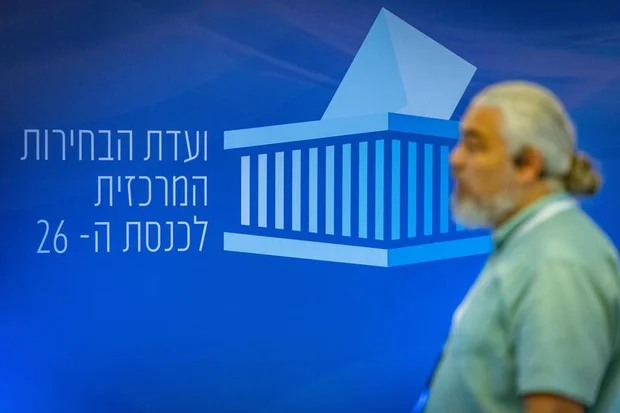
Elections 2026 Final election results project complete deadlock in Israel, no majority in sight as coalition talks begin
Likud leads with 27 seats, Yashar trails with 21 – Arab parties with record 19 seats

Israel’s Central Elections Committee reported the final count of this week’s election late Thursday, with none of the blocs coming close to the required 61-seat majority after only slight changes after the counting of the double envelopes, which turned out to be far fewer than estimated.
Prime Minister Benjamin Netanyahu’s bloc maintained its lead with 53 seats, beating out Yashar party leader Gadi Eisenkot’s bloc with 48 seats.
The Arab parties maintained their record combined total of 19 seats, with the Joint List falling by one to 11 seats, while Ra’am rose to 8.
Statements by party leaders this week suggest that a breakthrough in the coalition negotiations is not imminent. President Isaac Herzog is expected to begin consultations with various party leaders as early as this weekend, listening to their recommendations on who should be tasked with forming a government.
🇮🇱2026 FINAL Election Results Dashboard (Pending Verification) https://t.co/6ul2SCeiTA
— Israel Elects (@israel_elects) October 29, 2026
With none of the blocs reaching 61 seats, speculation in recent days has focused on the possibility of Eisenkot receiving the support from parties outside his bloc to form a minority government.
Following Eisenkot’s disappointing results and new allegations of election interference further weakening chances for cooperation with the Arab parties, attention has shifted to the ultra-Orthodox parties United Torah Judaism (UTJ) and Shas. Reports and rumors suggest they could break with Netanyahu and offer at least passive support for a minority government by abstaining from a vote.
Netanyahu’s Likud party won 27 seats, defying most polls to remain the largest party in the Knesset, despite losing 5 seats compared to the 2022 elections.
🗳️The 26th Knesset will include 18 parties, elected as part of 11 party lists. https://t.co/L1UFtmlIzn
— Eylon Levy (@EylonALevy) October 30, 2026
UTJ maintained its size at 7 seats – an underwhelming performance from the party whose ultra-Orthodox voter base has by far the highest natural population growth in the country.
UTJ's leadership has signaled it could enter talks with the Eisenkot-led Change Bloc, according to Haredi journalist Yishay Cohen. UTJ’s price would be an agreed-upon IDF conscription law and arrangements to secure the status of yeshiva students.
However, the office of UTJ Knesset Member Yaakov Asher denied to Channel 12 that party officials had been instructed to begin talks with Eisenkot.
Shas is the biggest loser among the coalition, dropping from 11 seats in 2022 to only 6, after losing another mandate to Likud through the double envelope count.
Nevertheless, The Jerusalem Post reported that beleaguered Shas leader Aryeh Deri is not ready to defect from Netanyahu, though joining a unity government alongside the Likud may still be possible.
Despite persistent scandals, the two far-right parties in the coalition maintained their 2022 strength, with Jewish Power (Otzma Yehudit) winning 7 mandates, and the Religious Zionist/Zehut party securing 6.
Gadi Eisenkot and Naftali Bennett met Thursday evening at Bennett’s home to discuss 'forming Israel’s next government as quickly as possible.' https://t.co/XNhY53Zm3g
— i24NEWS English (@i24NEWS_EN) October 29, 2026
In the Change Bloc, Gadi Eisenkot’s Yashar party led with 21 seats. On Thursday, Eisenkot accused the Likud of “a coordinated and organized campaign to delegitimize the election results,” warning that his “teams are working to complete preparations for submitting legislation for a vote when the Knesset session opens.”
“The days when Netanyahu used government institutions against Israel’s interests and for his own personal needs are over.”
Avigdor Liberman’s Yisrael Beitenu party won 7 seats, up by one compared to 2022. The hawkish leader has reportedly cut off contact with his colleagues in the Change Bloc, dodging calls from Eisenkot and Together (B'Yachad) party chairman Naftali Bennett.
On Thursday, Liberman doubled down on promises. “We will not sit with Bibi or Tibi, not with [Haredi leaders] Goldknopf or Deri, not with [Ra'am MK] Yasser Hujirat or the other supporters of terror, neither directly nor indirectly,” he stressed, effectively ruling out the possibility of joining an Eisenkot-led minority government supported by the ultra-Orthodox or Arab parties.
“The only coalition that makes sense is a complex coalition, but one made up exclusively of Zionist parties, with the entire Likud party included, but without Bibi [Netanyahu]," Liberman added. "The first decision of the next government must be to establish a state commission of inquiry, and the first law must be a universal conscription law. A coalition in which these two items are not front and center from the outset is irrelevant to us”
The Together party, led by Bennett and Yair Lapid, won 12 seats, a catastrophic loss of influence for Lapid’s Yesh Atid, which had led the opposition with 24 seats last time. Seven seats belong to Bennett’s faction and 5 to Yesh Atid. These numbers may become relevant if Likud approaches Bennett with an offer to split with Lapid and join a Netanyahu-led unity government, as has been reported.
Both Bennett and Lapid called on the people of Israel to show patience through the coming months of negotiations. “It will be difficult. I have no insurance policy. This is not an exact science, and not even mechanics; it is a complicated political process. But we have one thing that we did not have on Monday morning: an enormous Israeli majority that declared that this is what it wants,” Lapid stated.
“If you want to know whether something is happening behind the quiet that you are hearing now, the answer is yes,” he added.
Yair Golan’s "The Democrats" party will enter the Knesset with 8 seats, doubling its power since 2022 but falling short of some polls that had projected double digits.
The far-left leader has called for full cooperation with the Arab parties and has met most opposition leaders in recent days in an effort to coordinate joint political action.
The Democrats reportedly said it is committed to “working swiftly and decisively to establish a government of ‘repair and rescue’ for Israel, recognizing the scale of the responsibility and the opportunity created by the election results.”
The final count also confirmed that all three smaller parties previously thought to have a chance of crossing the 3.25% electoral threshold all fell short.
Yoaz Hendel’s "Reservists/Economic" party received a small boost from the counting of double envelopes but still only reached 2.7%.
Ofer Winter’s “People of Israel” party (1.7%) and the “Charedi Public” party (0.2%) fell well short of the threshold, disappointing their supporters.

Please take a moment and join others who are praying for Israel at this very moment by adding your light on the live prayer map with a simple click at prayforisrael.live.
Popular article:

interview Easter message of resurrection hope amid war at Jerusalem's Garden Tomb

biblical commentary Let my people go: a Passover message for today

4 IDF soldiers killed, 2 wounded in fighting in southern Lebanon, as Israel eliminates dozens of Hezbollah terrorists

Receive latest news & updates
A message from All Israel News
Help us educate Christians on a daily basis about what is happening in Israel & the Middle East and why it matters.
For as little as $10, you can support ALL ISRAEL NEWS, a non-profit media organization that is supported by readers like you.
Latest articles:

Bolsonaro’s election defeat in Brazil puts Latin America’s pro-Israel shift to the test
Norwegian auction cancels sale of Nazi-looted Torah fragment following outcry
Beyond Bibi: Israel’s election tests America’s bipartisan alliance

72% of US Jews, 75% of Israeli Jews feel strongly connected, according to new study
explainer When will Israel's new gov't be formed? When will the new Knesset be sworn in? Here's the timeline