Karin Prien could become Germany’s first Jewish president




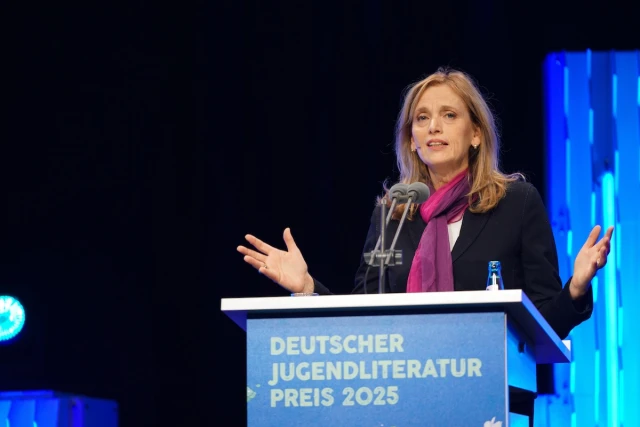
Karin Prien, Germany's federal Minister for Education and Family Affairs, has emerged as a potential candidate to succeed President Frank-Walter Steinmeier in 2027, a move that would make her the country’s first Jewish head of state. She has already made history as the first woman of Jewish origin to head a ministry in a post-war German government.
Prien was born in Amsterdam in 1965 to a Jewish family. Her parents’ home was filled with books by Jewish authors such as Saul Bellow, Philip Roth and Isaac Bashevis Singer. After moving to Germany, she studied law and political science in Bonn. She admitted in an interview with the Jewish Telegraphic Agency that her Jewish ancestry is unusual for a person in her position in post-war Germany.
“The fact that I’m a person with a Jewish biography is something unusual in Germany,” Prien said at a reception earlier this month in New York. “It’s not normal."
Unlike the powerful U.S. and French presidencies, the German federal presidency is largely ceremonial and more comparable to the Israeli presidency. Yet a potentially Jewish-born president in post-war Germany would be considered symbolically significant.
“The development of the German-Jewish friendship we have today, some people describe it as a miracle,” she said. “But still, there is a lack of normalcy in the relationship between German Jews and non-Jewish Germans. I think it’s something special when a Jewish person, or a person with a Jewish biography, is in a leading political position in Germany,” Prien assessed.
As a member of Germany’s Christian Democratic Union (CDU) party, Prien embraced both liberal democracy and support for Israel at a time of growing antisemitism and hostility towards the Jewish state.
“It would be a very strong symbol if a Jewish person would become president of Germany in 2027,” Prien said. While growing up in a secular home, she nevertheless absorbed Jewish culture at home, and she wears a Star of David necklace in her official parliamentary portrait.
“I want to show that it has to be normal to show Jewish symbols,” Prien explained. “It’s kind of a statement."
Lauren Rose, executive director of the World Jewish Congress executive office, praised Prien for meeting with Jewish organizations.
“I really appreciated the fact that she took time to meet with the WJC and other Jewish organizations,” Rose said. “It further shows the key commitment that Germany has when it comes to really taking the concerns of Jewish communities seriously.
The Hamas Oct. 7, 2023, attack brought Prien closer to her Jewish identity and strengthened her ties with the Jewish state amid growing global Jew-hatred.
“I can see that authoritarian ideologies - they are attractive to people,” Prien told the Jewish Telegraphic Agency. “And they are becoming more and more attractive. And not only in Germany, but also in other liberal democracies.”
She visited Israel for the first time last October after the final 20 living Israeli hostages returned from Gaza to the Jewish state. During her visit, Prien toured the Yad Vashem Holocaust memorial in Jerusalem.
“It’s important to explain to people in Germany that for the Israeli people, [the right to self-defense is] really about how to survive,” Prien said after her visit to Israel. “And that doesn’t mean that I or the German government is in consensus with every step that is made by the Israeli government." Yet, the challenge of antisemitism remains in Germany over 80 years after the Holocaust.
In January, the home of Andreas Büttner, Germany’s commissioner for Combating Antisemitism, was torched and marked with the terrorist organization Hamas’ characteristic red triangles that were used during the Oct. 7 massacre of 1,200 Israelis.
“My work against antisemitism is probably pushing people toward violence,” Büttner said while stressing that he would continue combating Jew-hatred in Germany.
You might also like to read this: