Israeli opposition leader Yair Lapid meets US Democrats, urges them 'not to give up on Israel'



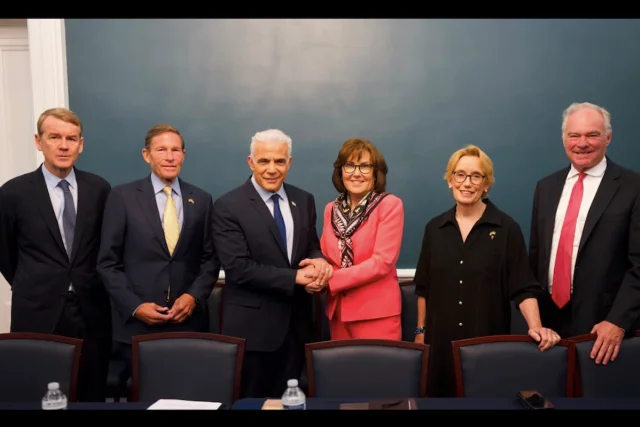
Israeli opposition leader Yair Lapid, head of the Yesh Atid party (“There Is a Future”), met this week with U.S. Democratic lawmakers in Washington, D.C., to strengthen ties amid growing tensions over attempts by some lawmakers to block U.S. military assistance to Israel.
Israel has traditionally enjoyed bipartisan support in Washington. However, in recent years, segments of the U.S. Democratic Party have become increasingly critical of Israel, particularly over its policies toward the Palestinians and its conduct during the war against Hamas in Gaza.
Lapid, who served as prime minister after forming a power-sharing government with Naftali Bennett (2021-22) that ended Netanyahu’s long tenure, urged Democratic lawmakers to continue supporting Israel despite disagreements with its current government.
“I told them not to give up on Israel and to stand with us in the face of the challenges,” Lapid said. “I took advantage of the visit to convince them that they were wrong, and presented them with the facts on the ground,” Lapid continued, referring to his opposition to the efforts among Democrat lawmakers to block arms exports to Israel.
The meeting was organized by U.S. Sen. Jacky Rosen (D-NV), a strong supporter of Israel who opposed resolutions seeking to restrict arms transfers to the Jewish state. Democratic lawmakers who attended included Sen. Tim Kaine (D-VA), Sen. Michael Bennet (D-CO), Sen. Richard Blumenthal (D-CT), Sen. Maggie Hassan (D-NH), Sen. Cory Booker (D-NJ), Sen. Brian Schatz (D-HI), Sen. Alex Padilla (D-CA), Sen. John Hickenlooper (D-CO) and Sen. Catherine Cortez of Nevada.
Some critics in the U.S. and Israel have blamed Netanyahu’s close ties with U.S. President Donald Trump for the deterioration of relations with the Democratic Party. However, the erosion of Democratic support for Israel is also linked to the growing influence of far-left progressive lawmakers within the party and predates Trump’s first presidency in 2016.
Earlier in July, the U.S. House of Representatives narrowly approved a $1.15 trillion defense bill that included $750 million in funding to strengthen security cooperation between the United States and Israel. Most Democratic lawmakers opposed the bill. In April, the U.S. Senate rejected two resolutions backed by Sen. Bernie Sanders (I-VT) that sought to block a $450 million arms transfer to Israel.
Lapid, a lawmaker who has previously blamed Netanyahu for tensions with Washington, urged Democratic lawmakers to distinguish between criticism of the Netanyahu government and support for Israel’s right to defend itself against the Iranian regime and Tehran-backed terrorist proxies, including Hezbollah and Hamas. At the same time, Lapid stressed the importance of any Israeli government working to rebuild ties with the Democratic Party.
“Boycotting those who speak out against you is not the way,” Lapid argued, likely referring to the Netanyahu-led government.
“In the face of opposition in the Senate, you need to work hard, meticulously, to repair relations with both parties. It’s not always fun, but that’s how you fix things. Not with whining and not with boycotts,” he added.
Lapid has also signaled that he intends to challenge Netanyahu in the upcoming election in October. Support for Israel in the United States has declined following the Hamas massacre of 1,200 Israelis on Oct. 7, 2023, and the subsequent wars with Hamas, Hezbollah, and Iran.
A July poll conducted by The Economist and YouGov found that nearly half of U.S. respondents supported Netanyahu’s arrest for alleged “war crimes” if he entered the country, with Democrats far more likely than Republicans to hold this view. Polls also show significant support among Democratic voters for accusing Israel of genocide in Gaza, a charge rejected by Israel, the United States, France, and the United Kingdom.
You might also like to read this: