How Israel became the defining fault line in Colorado's biggest Democratic primary upset


For years, Democrats in the U.S. have highlighted issues such as healthcare, abortion, climate change and income inequality. Those issues remain central to the party's platform, with Democrats continuing to move left on many of them.
However, in one of the biggest Democratic primary surprises of 2026, another issue has emerged as perhaps the clearest dividing line within the party: Israel.
It has permeated the Democratic Party in virtually every corner of the country. Look at what has happened in Colorado. The state, known for the Rocky Mountains, is now also home to far-left Democratic socialists who view Israel with disdain.
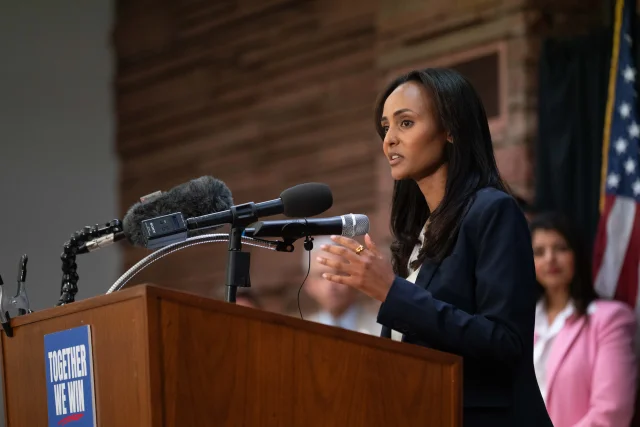
The stunning defeat of 15-term Democratic Congressman Diana DeGette by Democratic Socialist Melat Kiros one month ago in the Democratic primary wasn’t simply a story about generational change or a progressive insurgency.
It also offered a window into how dramatically the debate over Israel has evolved within parts of the Democratic Party.
Kiros, a first-time candidate backed by the Democratic Socialists of America, rose to national prominence largely because of her outspoken criticism of Israel’s war in Gaza.
Long before she launched her congressional campaign, she had become a well-known figure among progressive activists after publicly challenging major law firms over their response to the Israel-Hamas war.
Once she entered the race, instead of those views being shunned by voters in her district, they actually became one of the central reasons supporters rallied around her. Critics in turn sounded the alarm.
Kiros has repeatedly described Israel’s military campaign in Gaza as “genocide” and has called for ending U.S. military support for Israel’s current operations. She has argued that Democrats must fundamentally rethink America’s relationship with Israel and has supported an arms embargo against the Jewish state.
Those positions energized many younger progressive voters who believe the Democratic Party has been too supportive of Israel for too long.
But they also generated fierce opposition from Jewish organizations, pro-Israel Democrats (at least the ones that are still left) and even some fellow Democrats who believed Kiros crossed important moral and political lines.
Perhaps no moment better illustrated that divide than her response to a question about the firebombing attack on a pro-Israel gathering in Boulder earlier this year.
When asked whether the attack was antisemitic, Kiros declined to give a direct yes-or-no answer.
“I don’t know what’s in the perpetrator’s heart,” she said, while emphasizing that innocent people had been attacked. That response immediately ignited controversy.
Colorado Attorney General Phil Weiser, who is Jewish, publicly criticized her comments, saying the attack clearly targeted Jews and that failing to recognize it as antisemitism sent the wrong message.
Jewish organizations echoed those concerns, arguing that the attack fit the widely accepted definition of antisemitic violence because it targeted a gathering identified with the Jewish community.
Supporters of Kiros pushed back, saying she was being careful not to speculate about an individual’s intent and that condemning violence should not require abandoning criticism of Israeli government policies.
That wasn’t the only controversy surrounding Kiros.
She has also faced scrutiny over previous comments describing the Oct. 7 Hamas attack as an “inevitable consequence” of decades of occupation and apartheid. Critics argued those comments appeared to rationalize or minimize Hamas’ massacre of Israeli civilians.
Kiros has rejected that interpretation, saying she was attempting to explain the historical conditions that produced the violence – not justify the attack itself.
She has maintained that acknowledging historical causes is different from endorsing terrorism. Still, for many Jewish voters and pro-Israel Democrats, the distinction has not erased their concerns.
The controversy also extends to Kiros’ broader views on Israel’s future.
She has argued that criticism of Zionism or advocacy for different political arrangements between Israelis and Palestinians should not automatically be labeled antisemitic. But her critics say that some of the slogans and frameworks she has defended effectively deny Israel’s right to exist as a Jewish state.
What makes Colorado particularly significant is that Kiros wasn’t running against a conservative Democrat. She defeated Diana DeGette, one of the House’s longest-serving progressive members.
That is the inherent problem for Democrats. They are fighting amongst themselves and in the process potentially turning off a lot of independent voters who may not care that much or even at all about the Israel issue.
Indeed, Colorado is just yet another example of what’s happening nationwide to Democrats. Many primary candidates are now being asked not simply whether they support Israel, but whether they support continued military aid, whether Israel is committing genocide, whether Zionism itself should be questioned and how they define antisemitism.
It really has become an issue, not just in Colorado, but around the country, and the Democrats need to figure out the way forward quickly or risk electoral catastrophe in the future.
You might also like to read this: