








Mount Arbel: The most biblical place never named in the Bible
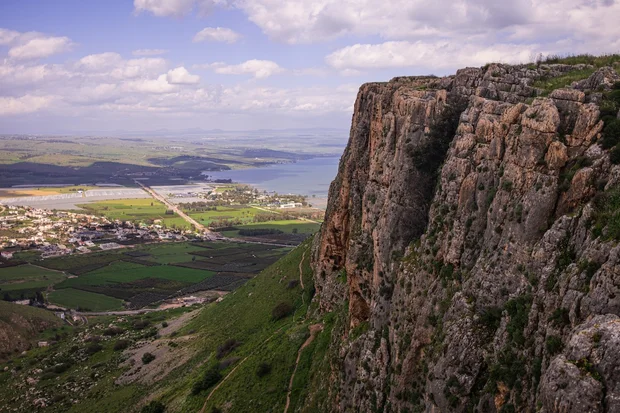
Few places in Israel offer a view quite like Mount Arbel. Standing on its cliffs, 400 meters (1,200 feet) above the Sea of Galilee, you can see much of the landscape where Jesus carried out His ministry. Magdala lies directly below. Capernaum is visible to the north. The Golan Heights rise beyond the lake, and on clear days even Mount Hermon appears on the horizon. Yet despite overlooking so much biblical history, Mount Arbel itself is never mentioned by name in Scripture. It’s one of the most biblical places that’s not mentioned in the Bible. It’s easy to see why many people think of it as “the balcony of the Galilee.”
Although we call it a mountain, Arbel is really more like a giant stone ramp that rises gently from Tiberias before suddenly ending in one of the most dramatic cliffs in Israel, right around the town of Magdala, roughly a half hour’s drive north of Tiberias. You can drive up to the top from the southern side, barely even noticing you’re going up a mountain, but if you want to get there from the northern direction, you need to park your car in the Arab village of Wadi Hamaam and start climbing. The Israel Nature and Parks Authority has made it surprisingly accessible, with marked trails, ladders, and safety cables where needed.
In the Old Testament, this was the land of Naftali. It became a part of the northern kingdom of Israel after the split, and thus was ruled by King Ahab. The area was, however, always under threat from the Aramean kings in Damascus. Armies marched through here often. When the Northern Kingdom finally fell to the Assyrians in the 8th century, the Bible explicitly tells us they conquered the north first before they went on to Samaria. (2 Kings 15:29).
In the New Testament, this area of Galilee takes center stage in Jesus’ ministry. Since Arbel lies between Magdala and Capernaum, Jesus and His disciples almost certainly passed beneath its cliffs as they traveled through Galilee. There was also a small village named Arbel on the plateau above the cliffs. Did Jesus preach there? Did He ever climb the mountain to pray? We cannot know, but it is certainly possible.
The cliffside of the mountain is of limestone, so it’s dotted with a lot of natural caves, and these caves became significant in the Jewish wars we know about from the era both before and after Jesus’ ministry. Almost two centuries before Jesus, there was the Maccabean revolt, and the book of Maccabees briefly mentions a Seleucid general passing through and killing the Jews in “Arbela” before he continued to Jerusalem (1 Mac 9:2). Josephus also mentions the wars of Herod shortly before Jesus’ birth. Jews who rebelled against Herod were hiding in the caves, but Herod, backed by Rome, lowered soldiers in huge wooden boxes—like cages—down along the cliff face, from which they could then reach and kill the rebels in the caves using long spears, hooks, or throwing burning torches and smoking them out. After the time of Jesus, the caves here were fortified by Josephus himself, preparing for the rebellion against Rome.
The strategic importance of this landscape continued long after biblical times. Just a few kilometers west of Arbel lies the Horns of Hattin, where Saladin decisively defeated the Crusaders in 1187 and opened the road to Jerusalem. In the 17th century, a Druze ruler of the area, Fakhr ad-Din al-Maani, who ruled from Beirut to the Galilee under the Ottomans, fortified these caves into a cave fortress. As someone who lives in Jerusalem, it is strangely familiar to touch these Ottoman walls. They were built during the same period as Jerusalem’s city walls and feel almost like a small piece of home transplanted to the Galilee.
Today, Mount Arbel is part of a protected nature reserve, and the climb is one of the highlights of the famous Jesus Trail, a 3- to 4-day hiking route connecting Capernaum and Nazareth. It also forms part of the Israel National Trail, which stretches the length of the country from north to south. For anyone who loves hiking, a trek up – or down – Mount Arbel is an experience that belongs on every Israel itinerary.
If you prefer a circular hike, you can drive to the Mount Arbel Nature Reserve at the top of the mountain. From the visitor center, a black trail follows the side of the cliff, while a more challenging red trail descends along the steeper rock face and includes sections of climbing. About halfway down, the black trail joins the red one, allowing you to descend via the black trail and return to the top on the red trail without retracing your steps. The full loop takes about two hours, provided you stop often, take plenty of photos, and explore the Ottoman-era fortress along the way.
Standing on Arbel, it becomes clear why this landscape has drawn armies, pilgrims, prophets, rebels, and hikers for thousands of years. Few places in Israel combine breathtaking scenery, biblical geography, dramatic military history, and outstanding hiking in quite the same way.
Popular article:
interview Easter message of resurrection hope amid war at Jerusalem's Garden Tomb
biblical commentary Let my people go: a Passover message for today

4 IDF soldiers killed, 2 wounded in fighting in southern Lebanon, as Israel eliminates dozens of Hezbollah terrorists

Receive latest news & updates
A message from All Israel News
Help us educate Christians on a daily basis about what is happening in Israel & the Middle East and why it matters.
For as little as $10, you can support ALL ISRAEL NEWS, a non-profit media organization that is supported by readers like you.
Latest articles:
North American Jewish organizations to recruit 100 professionals to combat antisemitism

‘No need’ for pre-election Iran strike, IDF chief says as gov’t, opposition trade blame for potential escalation – report

terror attack 2 Israeli soldiers killed, 2 terrorists eliminated in Hebron shooting; IDF says much larger attack was prevented
analysis A people dwelling securely? Israel’s strategic standing, 3 years after Oct 7

Hamas on wheels: What I found in Dearborn reveals a troubling history and a battle over Israel