









ANALYSIS For Arab voters in Israel, personal safety – not Palestinian state – is top priority
Palestinian identity, statehood take a back seat to immediate needs, according to one analyst
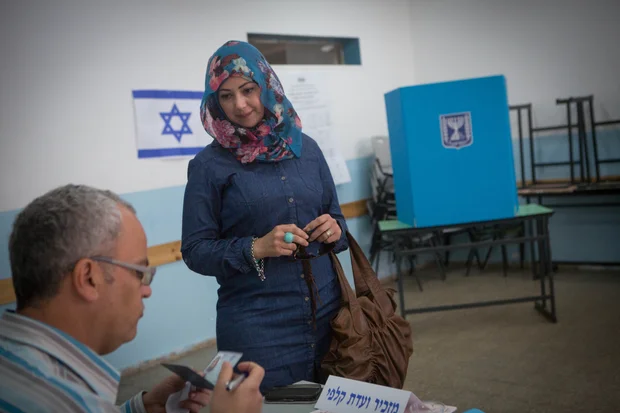
JERUSALEM – For Arab citizens of Israel, politics can be a harrowing balancing act between their Palestinian ethnic identity and everyday concerns as Israeli citizens.
Arab Israelis, who comprise 18% of voters and more than 20% of the overall population, are increasingly prioritizing immediate domestic issues over the long-term goal of Palestinian statehood – even while questions of identity remain unresolved.
“Our national identity is at war with our civic identity,” Mohammed Darawsheh said during a lecture hosted by the Palestinian Academic Society for the Study of International Affairs (PASSIA) at Notre Dame of Jerusalem.
“The vertical discourse is about identity. The horizontal discourse is about roads, crime, education and housing,” he said. “We want to be normal citizens. We want equal opportunities.”
Darawsheh, a conflict resolution specialist and director of strategy at Givat Haviva’s Center for Shared Society, said Arab citizens are balancing their Palestinian identity with a civic struggle for equality inside Israel.
“Whose state is it? Is it the state of the Israelis – or is it the state of the Jewish people?” Darawsheh asked, citing Israel's 2018 Nation-State Law as evidence that Arab citizens are not treated equally.
Calls to change Israel’s Star of David flag or national anthem about a Jewish homeland may resonate with many Arab citizens, he said, but are politically unrealistic at the moment.
More urgent is organized crime in Arab communities, which has failed to receive adequate attention from police, Darawsheh argued. Already this year, about 150 Arab citizens have been killed in criminal violence. In the week before the lecture, eight Arabs were killed and no arrest was made, while a Jewish rabbi's suspected killer was arrested within hours of his murder that same week.

Safety before statehood
Darawsheh cited polling showing that Arab voters rank personal safety, education, employment and housing as their top priorities. Establishing a Palestinian state ranks fifth.
He said polling consistently shows little desire among Arab citizens to leave Israel for a future Palestinian state, even while supporting its creation. Only 3% to 7% say they would relocate if a Palestinian state were established.
“We are home. I’m 27th generation,” Darawsheh said. “We don’t feel the need to move 10 miles south and live in Jenin. I’m in my homeland.”
He also pointed to funding disparities, saying Arab municipalities receive roughly 60% of the development budget allocated to Jewish municipalities, Arab students receive about two-thirds as much public funding and Arab municipalities exercise jurisdiction over only about 3% of Israel’s land despite comprising more than one-fifth of the country’s population.
Despite those challenges, Darawsheh called education the Arab community’s “tool of mobility.” Since 2003, university enrollment among Arab students has risen from roughly 3.5% to 20%, increasing to 26% when including those studying abroad. Arab students are now represented in medicine, dentistry, nursing, pharmacy and engineering at rates that exceed their share of the population.
“It is despite the system and not thanks to the system,” he said.
Two competing political visions
The platforms of Israel’s Arab parties reflect different approaches to advancing Arab interests.
Ra’am, led by Mansour Abbas, prioritizes advancing the socioeconomic status and infrastructure issues of Arab citizens. The party is willing to cooperate with Jewish parties in the government in order to do so and was the first independent Arab party to join a coalition.
Balad, led by Sami Abu Shehadeh, focuses on redefining Israel as a state of all its citizens – not solely the “Jewish” state – and advocating for equal rights for the Arab minority and for Palestinian self-determination. Shehadeh rejects joining an Israeli government under the current framework.
For Arab voters, the conundrum is balancing long-term aspirations versus what is achievable today, Darawsheh said.
“That’s the consideration of Arab parties. They will put the flag and anthem on the shelf for now while practical issues like housing take priority," he said. “It doesn’t mean the Palestinian issue isn’t important. It’s just not going to go anywhere right now.”
The Right Partnership
Arab political participation in Israel has evolved significantly over the past three decades. Darawsheh pointed to Yitzhak Rabin’s government in the 1990s as evidence that even small Arab parties can wield considerable influence.
“With only five seats, we did wonders,” he said of the Rabin era.
In 2021 and with just four seats, Abbas’ Ra’am party became “kingmaker,” joining the coalition and giving Naftali Bennett’s government a majority.
This time, however, with elections expected in October, building such partnerships may be more difficult.
“The numbers game is worthless if you don’t have a Jewish partner,” Darawsheh added. “We don’t need 15 seats or 20 seats. We need the right partnership.”
Darawsheh cited polling showing that before Oct. 7, 2023, about 23% of Jewish Israelis said they feared or distrusted Arab citizens. Today, he said, that figure stands at 72%. Among Arab citizens, fear and distrust of Jewish Israelis rose from 17% to 51%.
As campaigning heats up, several Jewish parties have already rejected inclusion of Arab parties in a coalition. A few exceptions include the Yashar party headed by current frontrunner Gadi Eisenkot and the Democrats.
Knesset Member Naama Lazimi of the Democrats argued this week that Jewish parties must remain open to Arab participation, especially if it keeps Prime Minister Benjamin Netanyahu from power.
“We sat in a government with Ra’am. The partnership worked,” she insisted. “Israeli liberals – 74% of the secular public – want Ra’am in the government.”
A bigger obstacle, however, could be the refusal of Arab politicians to run on a joint list, Darawshe said. Running together, Arab parties have netted up to 15 seats in the 120-member Knesset. On separate tickets, many failed to cross the electoral threshold.
Still, Darawsheh maintains that influence depends less on the number of seats.
“We don’t need 15 seats – or 20 seats,” he said. “We need the right partnership.”
Popular article:
interview Easter message of resurrection hope amid war at Jerusalem's Garden Tomb

biblical commentary Let my people go: a Passover message for today

4 IDF soldiers killed, 2 wounded in fighting in southern Lebanon, as Israel eliminates dozens of Hezbollah terrorists

Receive latest news & updates
A message from All Israel News
Help us educate Christians on a daily basis about what is happening in Israel & the Middle East and why it matters.
For as little as $10, you can support ALL ISRAEL NEWS, a non-profit media organization that is supported by readers like you.
Latest articles:

ANALYSIS Hamas openly threatens Israel with ‘more Oct 7 attacks’ as intelligence shows terror group is rearming

ANALYSIS More than 1,300 antisemitic posts blame Israel, Jews for French riots – report

ANALYSIS Thailand turns to Israeli anti-drone technology to counter growing battlefield threat

ANALYSIS Israeli fighter jets flew to Iranian border in ‘power projection,’ deterrence exercise ahead of elections next week

ANALYSIS Israel targets nuclear fusion leadership as AI drives soaring energy demand