Historic treasures uncovered at Great Synagogue of Vilnius reveal traces of Jewish life




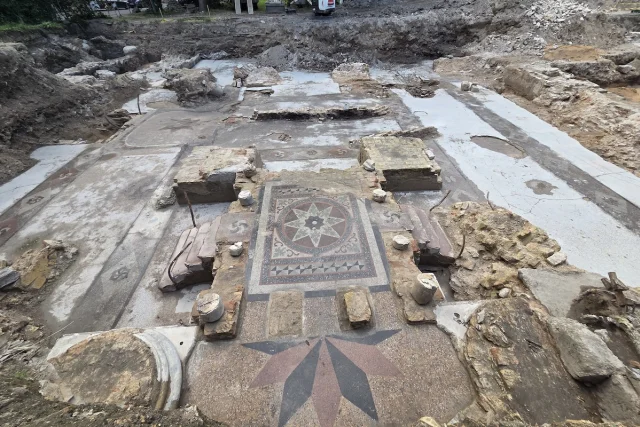
Israeli and Lithuanian archaeologists, during the latest excavations at the site of the historic Great Synagogue of Vilnius, Lithuania's capital city, have uncovered ruins of the central bimah (platform stage), sections of the main prayer hall, colorful terrazzo floors and engraved plaques bearing the names of worshippers.
The recent excavation, led by the Israel Antiquities Authority (IAA) and Lithuania's Cultural Heritage Preservation Institute – with funding from the Good Will Foundation and in cooperation with the Lithuanian Jewish (Litvak) Community – has also revealed parts of the women's gallery and a plaque engraved with the Ten Commandments.
"The removal of the old school building that covered the historic synagogue enabled us, for the first time, to expose additional extensive and continuous sections at the heart of the building: the main prayer hall, paved with colourful terrazzo floors decorated with floral and geometric patterns; plaques bearing names; and many other finds that offer us a moving, almost personal encounter with the people who prayed here and with the community life that developed around the synagogue over the course of centuries," said IAA Director Jon Seligman and Justinas Račas of the Cultural Heritage Preservation Institute.
Built in 1633, the Great Synagogue of Vilnius was the spiritual center of one of Eastern Europe's most prominent Jewish communities until 1941, when it was heavily damaged during the Nazi occupation, and most of the city's Jewish population was deported. Although parts of the structure survived the war, Soviet authorities demolished the remaining ruins in 1947, and a school was built on the site a decade later.
Excavations at the site began in 2011 and encompass both the synagogue and the surrounding Shulhoyf, the Jewish communal complex that developed around it over the centuries.
Among the recent discoveries are seat plaques identifying individual worshippers, particularly women, in the ezrat nashim, or women's gallery. Archaeologists also uncovered plaques bearing the names of members of a major Jewish charitable society involved in administering the Vilna Jewish community.
According to the IAA, one of the most significant finds was a plaque marking a seat donated by "Gitel Klachek, wife of the late Yechezkel, Shamash d'Mata" (city sexton). The Klachek family was a wealthy and influential family that owned numerous businesses near the synagogue.
Although there were once ambitious plans to fully restore the synagogue as a functioning house of worship, the current plan is for the site to become a museum and memorial dedicated to the history of Vilnius' Jewish community. Historical records indicate that the site was used as a Jewish place of worship as early as 1440, and the surrounding neighborhood was home to a thriving Jewish community from that period until 1941. Today, Lithuania's Jewish community numbers only around 4,500 people.
You might also like to read this: