









Rare First Temple-period figurine mold discovered in Jerusalem Old City excavations
Female figurine could be linked to worship of goddess Asherah, mentioned in Hebrew Bible
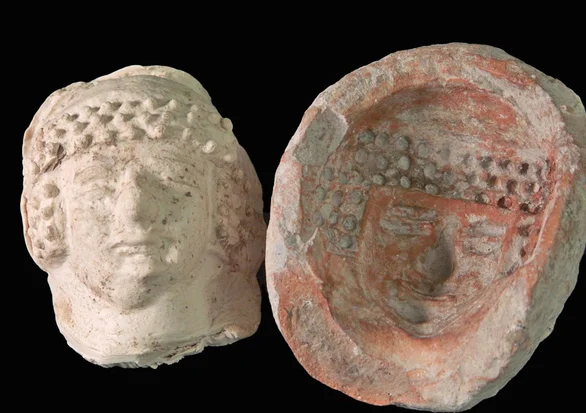
A rare First Temple period mold used for casting the face for female figurines was discovered recently in excavations in the Old City of Jerusalem, the Israel Antiquities Authority (IAA) announced.
The mold was found during excavations at the Kishle, a former Ottoman-era prison, within the grounds of the Tower of David Jerusalem Museum.
“The mold was discovered while sifting soil removed from fills and accumulations dating to the First Temple period,” explained Dr. Amit Re'em and Dr. Ayala Zilberstein, excavation directors on behalf of the Israel Antiquities Authority.
“The Kishle excavation, which has been ongoing for several years, continues to surprise us time and again,” they added.
The two directors called the Kishle dig “one of the most significant archaeological excavations conducted in Jerusalem in recent decades,” adding that the site preserves “the city's history in a clear and continuous sequence—from the days of the Kings of Judah, through the many periods that shaped Jerusalem, and up to the British Mandate.”
The find is the first such production mold to be discovered in Jerusalem, the scholars said.
“Clay figurines from the First Temple period are known from almost every archaeological excavation conducted in Jerusalem and throughout Judah,” said Dr. Re’em, the IAA director of Jerusalem district archaeology.
“Until now, however, no production molds for these figurines had ever been discovered in Jerusalem,” Dr. Re’em continued. “This raised the question of whether they were manufactured locally or imported from elsewhere. The discovery of this mold at the Kishle is therefore the first of its kind in Jerusalem, providing direct evidence that at least some of these figurines were produced within the city itself."
Archaeologists are familiar with three principal types of First Temple period figurines:
Female figurines, commonly known as Judean Pillar Figurines, typically depicting women with prominent hairstyles and their hands positioned beneath their breasts.
Horse-and-rider figurines.
Zoomorphic (animal) figurines, primarily representing horses, though other animals also appear.
The figurines were coated with a white slip, and surviving traces of pigment indicate that they were originally painted in yellow, red, and black.
The female figurines were usually made of two separate parts. The head and body were usually formed by hand, while just the face was made using a mold, as the one discovered. Such figurines usually stand between 10-20 centimeters (4-8 inches) in height.
“The meaning and function of these figurines are still not fully understood,” says Debbi Ben-Ami, Curator of the Iron Age at the Israel Antiquities Authority. “The fact that they have been found in almost every household, as well as in streets and tombs, indicates that they were objects of everyday use.”
“The identity and purpose of the Judean Pillar Figurines remain the subject of scholarly debate,” she continued. “They have previously been interpreted as representations of a fertility goddess – perhaps the goddess Asherah – and some have even suggested they were children's toys.”
Ben-Ami said scholars "hope that the newly discovered mold from Jerusalem will provide fresh insights and help answer some of the questions that continue to occupy researchers.”
The goddess Asherah is mentioned in various books of the Hebrew Bible. She was well-known across the ancient Semitic world and was associated with fertility and motherhood. She was considered the consort of the Canaanite high-god El and of Yahweh, the God of Israel, among much of the ancient Israelite population.
Several prophets specifically condemned the worship of Asherah and her association with Israel’s God by much of the population.
Worship of Asherah included sacred trees, groves, and wooden poles, referred to in the Biblical texts as Asherah poles. These may have represented her presence or served as cultic objects.
Archaeological findings, such as figurines and inscriptions, indicate that she was venerated in both public temples and private homes, reflecting a widespread practice of veneration.
Eilat Lieber, Director and Chief Curator of the Tower of David Jerusalem Museum, said the find highlights a unique opportunity available to visitors to the museum, the ability to help sift soil from the excavations.
“This summer, visitors will have the extraordinary opportunity to take part in real archaeological research by sifting soil from the Kishle excavations. Every fragment recovered helps illuminate another chapter in the story of Jerusalem, making participants true partners in preserving and revealing the city's remarkable heritage,” she said.
“According to the Sages, the First Temple was destroyed because of three principal sins: idolatry, sexual immorality, and bloodshed,” said Israel’s Minister of Heritage, Rabbi Amichai Eliyahu.
“The discovery of a mold for producing figurines from the First Temple period in the heart of Jerusalem offers us a tangible glimpse into the world in which the prophets of Israel lived and into the spiritual and cultural realities they confronted," he explained.
"When such an artifact emerges from the soil of Jerusalem, history becomes real and immediate: this small piece of pottery tells the story of the beliefs, customs, and spiritual challenges that characterized the capital city in ancient times,” Eliyahu added.
Popular article:

interview Easter message of resurrection hope amid war at Jerusalem's Garden Tomb

biblical commentary Let my people go: a Passover message for today

4 IDF soldiers killed, 2 wounded in fighting in southern Lebanon, as Israel eliminates dozens of Hezbollah terrorists

Receive latest news & updates
A message from All Israel News
Help us educate Christians on a daily basis about what is happening in Israel & the Middle East and why it matters.
For as little as $10, you can support ALL ISRAEL NEWS, a non-profit media organization that is supported by readers like you.
Latest articles:

North American Jewish organizations to recruit 100 professionals to combat antisemitism

‘No need’ for pre-election Iran strike, IDF chief says as gov’t, opposition trade blame for potential escalation – report

terror attack 2 Israeli soldiers killed, 2 terrorists eliminated in Hebron shooting; IDF says much larger attack was prevented

analysis A people dwelling securely? Israel’s strategic standing, 3 years after Oct 7

Hamas on wheels: What I found in Dearborn reveals a troubling history and a battle over Israel