








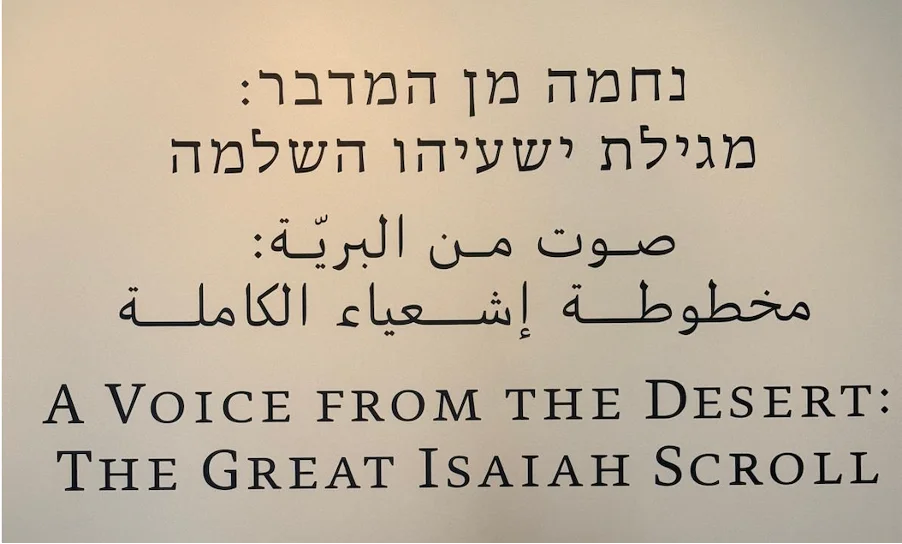
all israel edu A voice from the desert: The Great Isaiah Scroll
Sixty years ago, the State of Israel inaugurated its national museum – the Israel Museum in Jerusalem. The museum was established to showcase the treasures of Jewish culture and art, from antiquity to the modern era, alongside important archaeological discoveries from the Land of Israel that testify to the connection between the Jewish people and their homeland over thousands of years. Since its founding, it has been Israel's largest and most important museum.
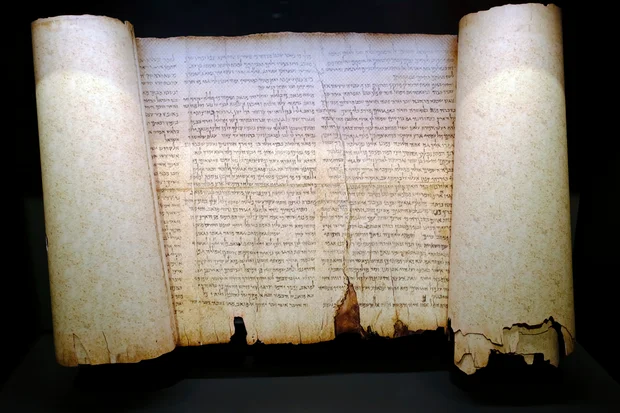
To mark the museum's 60th anniversary, its directors gathered to decide on a special exhibition that would reflect both the museum's unique character and the richness of Jewish heritage. After careful deliberation, they reached a remarkable decision: they would bring out from the museum's vaults one of Israel's most significant national treasures – an artifact whose value cannot be measured and which, for six decades, had remained inaccessible to museum visitors: the Great Isaiah Scroll from the Qumran Caves near the Dead Sea.
The exhibition was meticulously planned. Curators carefully considered how to display such an invaluable artifact – one requiring highly specialized preservation conditions – to the large number of visitors expected to see it. The exhibition was scheduled to open at the end of February and to run for only four months.
But in Israel, as often happens, nothing goes exactly according to plan. Shortly after the exhibition opened, war broke out with Iran, and hundreds of ballistic missiles were launched toward Israel. The scroll had to be immediately removed from public display and returned to the museum's secure underground storage, where it would be protected until the danger had passed. The exhibition was suspended until the fighting ended. After the immediate Iranian threat subsided, at least for the time being, the exhibition reopened and was extended through mid-September 2026.
This episode is just another chapter in the extraordinary story of the Great Isaiah Scroll – the most important manuscript discovered amongst the Dead Sea Scrolls.
The Discovery of the Scroll
The discovery of the scroll is itself a fascinating mystery.
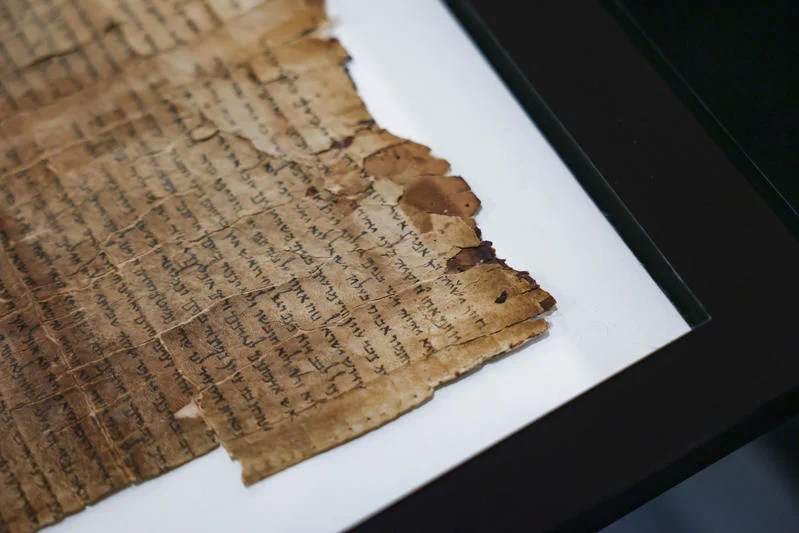
One summer day in 1947, a Bedouin from a Judean Desert tribe brought several leather scrolls wrapped in linen cloth and stored inside clay jars to an antiquities dealer in Bethlehem.
Years later, the Bedouins told a story about a goat that had wandered off, a boy who threw a stone toward it, and the sound of breaking pottery that surprised the shepherds. Is this story true? It is doubtful. The cave's entrance was extremely small and could only be seen when standing almost directly in front of it. A much more likely explanation is that Bedouin shepherds were already searching the area for hidden treasures and antiquities, and that the cave was discovered during one of these expeditions.
Whatever the truth may be, the antiquities dealer in Bethlehem did not fully understand what he had acquired. He tried to interest a Christian Syrian priest, who purchased the finds and later sold them to Bishop Athanasius Samuel. Even the bishop did not yet grasp the full significance of the discovery.
News of the ancient scrolls eventually reached Jerusalem and Professor Eleazar Lipa Sukenik of the Hebrew University – the very university that Albert Einstein had helped establish some twenty years earlier. Sukenik took a bus to Bethlehem, hoping to purchase the scrolls for the university. He had enough money to buy only three of the seven scrolls that had been found.
The three scrolls Sukenik acquired were:
the War Scroll, previously unknown.
the Thanksgiving Scroll (Hodayot), also a new discovery.
several fragments of another copy of the Book of Isaiah.
The dealer demanded considerably more money for the complete Great Isaiah Scroll than Sukenik could pay that day. He intended to return shortly with additional funds.
But he never got the chance to return to Bethlehem.
War Interrupts the Purchase
The date was November 29, 1947.
On the very day Sukenik purchased the three scrolls, the United Nations General Assembly in New York voted to partition the British Mandate of Palestine into two states: one Jewish and one Arab.
The following day, Israel's War of Independence began. It lasted about a year and a half, until early 1949. All roads between Jerusalem and Bethlehem were closed, and Jerusalem came under siege.
Bishop Samuel, who possessed the remaining scrolls, transferred them for safekeeping to Beirut. At that time, Beirut was considered far safer than the war-torn Land of Israel.
For several years the scrolls remained in Lebanon, while Bedouins continued discovering additional scrolls throughout the Judean Desert and selling them to the highest bidder. At the same time, the Jordanian government, which annexed the Judean Desert, sponsored archaeological expeditions to search for more scrolls.
In the years that followed, hundreds of additional manuscripts were discovered. Most were in bad condition, and none matched the remarkable completeness of the Great Isaiah Scroll waiting quietly in Beirut.
From Beirut to New York
Bishop Samuel eventually realized the immense value of what he possessed.
In 1949, he transported the four scrolls by ship from Beirut to New York. He began touring museums and universities along the East Coast, exhibiting the scrolls while simultaneously attempting to sell them.
Because such a sale would have violated legal restrictions, he discreetly placed a small classified advertisement in The Wall Street Journal, making no obvious connection to the famous scrolls being displayed in major institutions.
By sheer coincidence, in 1954, Yigael Yadin – the son of Eleazar Lipa Sukenik and already a renowned archaeologist in his own right – was in the United States. (Yadin would later become famous for excavating Masada.) An acquaintance pointed out the small advertisement in the WSJ.
Yadin immediately understood what it referred to and secretly contacted Bishop Samuel. Negotiations were conducted in complete secrecy, and the young State of Israel raised the purchase price: $250,000.
The Great Isaiah Scroll, together with the other three scrolls, was brought to Jerusalem. At last, all seven of the original Dead Sea Scrolls discovered in 1947 were in Israel's possession.
Meanwhile, the hundreds of additional scroll fragments discovered in subsequent years remained in Jerusalem's Rockefeller Museum, which at the time was under Jordanian control.
During the Six-Day War in 1967, Israel captured East Jerusalem, and the Rockefeller Museum's collection of Dead Sea Scrolls also came under Israeli custody.
What Makes the Great Isaiah Scroll So Special?
The Great Isaiah Scroll is unique for several reasons.
First, it is the only Dead Sea Scroll preserved almost entirely intact. It measures 7.34 meters (24 feet) in length.
Any modern Hebrew reader can read it almost as easily as today's printed Hebrew Bible. Its text is nearly identical to the traditional Masoretic Text, differing mainly in spelling conventions that reflect the Hebrew orthography of its own era.
Scholars date the scroll to approximately 125 B.C. It appears to have remained in use for at least a century before being hidden in a cave at Qumran around 70 A.D. Since the scroll predates the establishment of the Qumran settlement by many years, it was most likely written elsewhere – perhaps in Jerusalem or the Galilee.
A Scroll from the Time of Jesus
The New Testament records in Luke 4:16 that Jesus read from the Book of Isaiah in the synagogue. This is the only passage in the Gospels that explicitly describes Jesus reading publicly from a biblical scroll.
The Great Isaiah Scroll, now displayed at the Israel Museum, was in active use during precisely that same historical period.
Today, visitors to the museum can stand before the scroll and read the very passage Jesus read:
"The Spirit of the Lord is upon me, because He has anointed me to proclaim good news to the poor..." (Isaiah 61).
Could it be, and it is not a far-fetched idea, that we are reading from the very same scroll from which Jesus himself read in the synagogue at Nazareth?

Support our independent, on-the-ground reporting from Israel. Become a $5/month Ally.
Popular article:
interview Easter message of resurrection hope amid war at Jerusalem's Garden Tomb
biblical commentary Let my people go: a Passover message for today

4 IDF soldiers killed, 2 wounded in fighting in southern Lebanon, as Israel eliminates dozens of Hezbollah terrorists

Receive latest news & updates
A message from All Israel News
Help us educate Christians on a daily basis about what is happening in Israel & the Middle East and why it matters.
For as little as $10, you can support ALL ISRAEL NEWS, a non-profit media organization that is supported by readers like you.
Latest articles:
all israel edu North American Jewish organizations to recruit 100 professionals to combat antisemitism

all israel edu ‘No need’ for pre-election Iran strike, IDF chief says as gov’t, opposition trade blame for potential escalation – report
terror attack 2 Israeli soldiers killed, 2 terrorists eliminated in Hebron shooting; IDF says much larger attack was prevented
analysis A people dwelling securely? Israel’s strategic standing, 3 years after Oct 7
all israel edu Hamas on wheels: What I found in Dearborn reveals a troubling history and a battle over Israel