








Book sensation 'Regime Change' pulls back curtain on Trump, Netanyahu
.
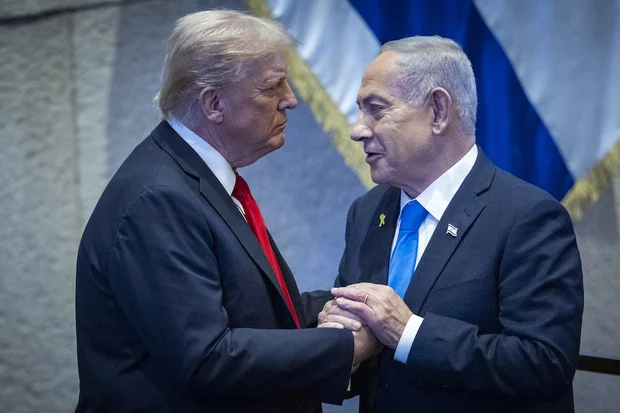
U.S. President Donald Trump’s relationship with Israeli Prime Minister Benjamin Netanyahu has long been the subject of endless speculation. Supporters say they are close allies. Detractors say the relationship is tense. Is one manipulating the other? The questions go on and on.
According to New York Times Reporter Jonathan Swan, the answer is far more complicated than the simplistic narratives dominating cable news and social media. That’s one of the central takeaways from "Regime Change," the explosive new book Swan co-authored with his NYT Colleague Maggie Haberman.
The book has quickly become one of the publishing sensations of the year, surpassing 500,000 copies sold across hardcover, audiobook and ebook formats in just one month.
Publishing insiders say it’s on pace to become the bestselling nonfiction book of 2026, with Simon & Schuster already ordering a seventh printing that brings the total hardcover print run to 460,000 copies.
While "Regime Change" chronicles the drama, personalities and power struggles surrounding Trump’s second administration, it also offers one of the most detailed looks yet at the complicated and often combustible relationship between Trump and Netanyahu.
During his interview with me, Swan pushed back against attempts to portray their relationship in simplistic terms. “I think it’s a very nuanced picture and people often try to make it a very black and white thing,” he explained. “People say he hates Bibi, he loves Bibi. Actually, the relationship has been a bit up and down. It’s been quite fraught at times. It’s been very close at times.”
Swan said Trump himself described Netanyahu during their interview for the book as “not afraid of war” and “a good wartime partner.” Still, the relationship nearly unraveled after the 2020 presidential election. Trump became convinced – incorrectly – that Netanyahu had been the first foreign leader to congratulate Joe Biden after the election.
According to Swan’s reporting, Netanyahu later visited Trump at Mar-a-Lago carrying documentation showing numerous world leaders had congratulated Biden before he had. That episode helped repair some of the lingering resentment, but it hardly eliminated the tension.
One of the more fascinating themes throughout "Regime Change" is the sharp contrast between Trump’s public frustrations with Netanyahu at times and his deeply rooted support for Israel itself. Swan believes many of Trump’s critics – and even some of his supporters – misunderstand that distinction.
“The thing that a lot of the anti-interventionists on the right either refuse to see or are a little delusional about is Trump has always been more hawkish about Iran and more pro-Israel than many of the people who consider him an isolationist,” Swan said.
He pointed to Trump’s record.
“He pulled out of the Iran nuclear deal over the objections of a bunch of his advisers. He authorized the killing of Qassem Soleimani. Many people worried about that,” he said.
And Swan believes Trump’s views only hardened after leaving office.
“He was briefed by the FBI that Iran was trying to kill him,” Swan noted. “Trump has a deeper attachment to Israel than many of the people around him. Actually, more than many of the younger next generation of Republicans.”
While many younger conservatives and America First voices have become increasingly skeptical of U.S. involvement in the Middle East, Swan argues that Trump has remained remarkably consistent.
“If you’re Netanyahu,” Swan said, “for all the things that might frustrate you about Trump, you’re very unlikely to get a more pro-Israel president to follow him.”
He even suggested that would likely remain true under many possible Republican successors: “If JD Vance is the next president, you’re certainly not going to get it from Vance. He’s more skeptical of Israel than Trump.”
One of the biggest debates surrounding the recent Israel-Iran conflict centered on whether Trump was acting independently or allowing Netanyahu to steer American policy.
I asked Swan directly whether the “tail was wagging the dog.” If you listen to Tucker Carlson, Israel is calling the shots. If you listen to Trump, he says he’s the one calling the shots. What’s the truth?
Swan didn’t hesitate. “I think it’s closer to the Trump version,” he answered. However, he admits, “It’s not black and white like most things.”
Swan describes Netanyahu as an exceptionally persuasive advocate who aggressively argued for American involvement during a Situation Room meeting detailed in the book. But persuasion wasn’t the same as control.
“After that meeting,” Swan explained, “Trump heard very skeptical takes on Netanyahu’s presentation from CIA Director John Ratcliffe and Marco Rubio.”
Despite those warnings, Trump proceeded anyway. “He still had this gut instinct that we should go ahead with this operation in Iran,” he explained.
That decision, Swan argues, demonstrates something often overlooked: “Trump was absolutely not manipulated by Netanyahu based on our reporting.”
Instead, Swan believes Trump’s own instincts proved even more hawkish than many members of his national security team.
“People trying to say this was all Bibi are just ignoring some really basic facts about the way Trump has operated," he said.
Perhaps the most surprising stories in "Regime Change" involve Trump’s blistering private criticism of Netanyahu. At one point, Swan recounts, Trump repeatedly referred to the Israeli prime minister as “a con man.”
That frustration stemmed partly from Trump’s lingering anger over the 2020 election but also from his belief that Netanyahu was attempting to push him toward military confrontation with Iran faster than he wanted.
Another extraordinary episode involves a tense phone call during negotiations over a hostage deal. According to Swan, Trump had become convinced Netanyahu was trying to derail the agreement.
“So they had this phone call,” Swan recalled, “and Trump just unleashes on Netanyahu.” Trump reportedly shouted, “Everyone’s sick of you. All the Jews are sick of you. Even the two Jews on this call,” referring to Jared Kushner and Steve Witkoff.
Yet almost as quickly as the explosion began, it ended.
“At the end,” Swan laughed, “he’s basically saying, ‘I think everything’s fine.’ Maybe the next day it was, ‘I love you.’” That emotional whiplash, Swan says, perfectly captures Trump’s relationship with Netanyahu: “He has these eruptions. Then he comes back and they get on well.”
So why is that? “I think Trump sometimes feels Netanyahu is making his life more complicated than it should be,” Swan concludes.
Whether it’s disagreements over Iran, hostage negotiations or Israeli military operations against Hezbollah in Lebanon, Trump periodically lashes out when he believes Netanyahu is complicating his broader diplomatic objectives.
“So it’s a complicated relationship,” Swan said. “And depending on the week, you’re either going to get quite positive things being said about Netanyahu – or it could be the complete opposite.”
Popular article:
interview Easter message of resurrection hope amid war at Jerusalem's Garden Tomb

biblical commentary Let my people go: a Passover message for today

4 IDF soldiers killed, 2 wounded in fighting in southern Lebanon, as Israel eliminates dozens of Hezbollah terrorists

Receive latest news & updates
A message from All Israel News
Help us educate Christians on a daily basis about what is happening in Israel & the Middle East and why it matters.
For as little as $10, you can support ALL ISRAEL NEWS, a non-profit media organization that is supported by readers like you.
Latest articles:
North American Jewish organizations to recruit 100 professionals to combat antisemitism

‘No need’ for pre-election Iran strike, IDF chief says as gov’t, opposition trade blame for potential escalation – report

terror attack 2 Israelis critically wounded, 2 terrorists killed in Hebron shooting; IDF says larger attack was prevented

analysis A people dwelling securely? Israel’s strategic standing, 3 years after Oct 7

Hamas on wheels: What I found in Dearborn reveals a troubling history and a battle over Israel