Feast of Tabernacles: Past, present and future





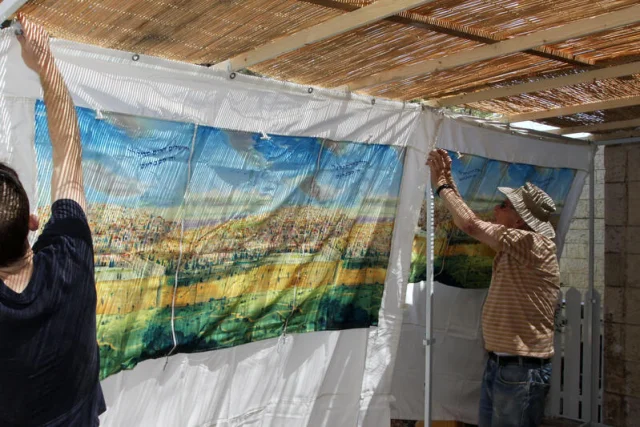
Sukkot, the Feast of Tabernacles, begins in the middle of the seventh month of the Jewish calendar, on Tishrei 15, when the moon is at its fullest. It has been this way for the past 3500 years, since God gave the instructions at Sinai, and according to the Bible, it will continue even once the Messiah returns.
The Jewish calendar follows the cycles of the moon but weaves in and out of the Gregorian calendar with “leap months,” keeping it in line with the seasons, but have you noticed that some interesting things have been happening according to both calendars lately?
The Oct. 7 invasion took place at the very end of Sukkot three years ago but it was also almost exactly 50 years since the Yom Kippur attack, which took Israel by surprise on Oct. 6, 1973. Both were planned to fall on significant holidays, but it seems interesting that a jubilee period fell between them. At least according to the Gregorian calendar.
Those attacks were planned to hit the holidays on purpose, but other events seem impossible to have been organized. For example, it was at the start of Sukkot, a year after the invasion, that the mastermind behind Oct. 7 was finally found and eliminated. He was killed almost by mistake.
In a providential turn, some have linked it to the story of King Ahab; Sinwar had been hiding and disguising himself to avoid being traced by Israeli intelligence. His time came anyway one Wednesday when a brand new army recruit killed him, apparently without realizing it, during an exchange of fire with Hamas militants. It was only later that everyone understood what had happened.
“But someone drew his bow at random and hit the king of Israel between the sections of his armor…” (1 Kings 22:34).
In the biblical account, the prophet Micaiah told Ahab he would be killed in battle, but Ahab thought he could outsmart death by wearing different clothes and hiding himself. Sinwar tried these tactics, but like Ahab, his death was inevitable. As it turned out, it was not the skill of Israeli intelligence nor the might of the IDF but God who got the glory.
The firefight that killed Sinwar took place during a “chance encounter” as part of a routine IDF operation, Army Radio reported.
It was not an insignificant event. As we approached the first anniversary of that Black Sabbath, it was almost impossible to imagine how we could possibly rejoice at Sukkot ever again, but the Bible commands Israel to “rejoice” and to be "altogether joyful” at Sukkot (Deuteronomy 16:13-16). How could it be done?
The news that Sinwar had met his end, with such poetic justice, brought a wave of relief across Israel and the entire Jewish world, so people could enter the week’s festivities and enjoy it with their families after all.
Similarly, the following year, again at Sukkot, the remaining hostages were all released. The joy in Israel was profound. Even supermarkets announced the good news over the tannoy to shouts of joy.
It was Monday, Oct. 13, according to the Gregorian calendar, two years since they had been dragged into captivity. But according to the Jewish calendar, it was exactly two years. They were released on Simchat Torah, the greatest and most joyful day of the feast—the last day of Sukkot. What are the chances of that, tell me? It does make you wonder if another surprise might be waiting for us this Sukkot.
Observing patterns such as these might help us guess but the truth is only God knows what is coming. However, He has put a few details down for us in His book. We can say with certainty that future Sukkot will be even more joyful than anything we’ve known up to this point.
The prophet Zechariah describes a day coming when the Lord will be King over all the earth. His feet will stand on the Mount of Olives, which will be split in two, and living waters will flow out from the temple in Jerusalem.
“Then everyone who survives of all the nations that have come against Jerusalem shall go up year after year to worship the King, the Lord of hosts, and to keep the Feast of Booths” (Zechariah 14:16).
The Feast of Tabernacles will become mandatory in the Messianic Age. Interestingly, rebellion against the Messianic mandate will be possible – at least for a limited time – but it will not go unpunished.
There are several prophetic portraits of this time when the nations stream to Jerusalem to worship the Messiah, but there is an interesting detail in the parallel passage of Isaiah 60, which is addressed to Zion:
"Lift up your eyes all around, and see;
they all gather together, they come to you;
your sons shall come from afar,
and your daughters shall be carried on the hip.
Then you shall see and be radiant;
your heart shall thrill and exult,
because the abundance of the sea shall be turned to you,
the wealth of the nations shall come to you.
A multitude of camels shall cover you,
the young camels of Midian and Ephah;
all those from Sheba shall come.
They shall bring gold and frankincense,
and shall bring good news, the praises of the Lord.
All the flocks of Kedar shall be gathered to you;
the rams of Nebaioth shall minister to you;
they shall come up with acceptance on my altar,
and I will beautify my beautiful house."
Isaiah describes people coming on camels from Midian, in northeast Saudi Arabia; from Sheba, commonly thought to be Yemen; and from Kedar, the city named after Ishmael’s son. Only after that do we see the “coastlands” coming to pay tribute. It seems that the first to ascend the hill of the Lord will be the descendants of Ishmael.
Passages such as Isaiah 60 and Isaiah 54 describe the “many children” of Zion appearing, representing those born again on the basis of what was accomplished in Jerusalem 2,000 years ago.
This theme is also mentioned in Psalm 87, which describes people from “Rahab and Babylon, Philistia, Tyre, and Cush” as being “born in Zion.” Rahab represents Egypt; then there’s Babylon; Philistia, Tyre, and Cush represent the Philistines, the Lebanese, and the Sudanese, all of whom have been sworn enemies of Israel. Yet here they are, legitimate sons of Zion, coming to worship the Lord in Jerusalem!
Sukkot is a special time of tabernacling together – primarily, it is about God tabernacling with us and us with Him as we remember how He pitched His tent in the middle of the Israelite camps, but it also points to a prophetic time when Isaac and Ishmael will tabernacle together as well on Zion’s holy hill. And it will beautify God’s glorious house.
You might also like to read this: