Dealing with sin on Yom Kippur



The Day of Atonement, or “Yom Kippur” is described in the Bible as a day set aside each year specifically to deal with sin. However, instead of taking our sin to God as individuals, the Day of Atonement was established in the Bible as a way to deal with sin collectively, as a nation.
It seems that Israel needs this opportunity for a fresh start, perhaps now more than ever.
Israel’s multifront war includes not only the seven hostile forces surrounding it – Hamas, Hezbollah and the Houthis, along with terrorist entities in the West Bank, Syria and Iraq, and, of course, the Islamic regime in Iran – but also an incessant media war that has become the eighth front.
Now, a ninth front is emerging: the conflict within Israel itself, as factions increasingly fight against one another. Israel is a fractured nation desperately in need of healing.
Two months ago we observed “Tisha B’Av,” mourning the two temples that were destroyed on that day in history, due to “baseless hatred” of brother against brother, according to the Jewish Sages.
Now we see the Ultra Orthodox in fierce conflict with secular Israelis, radical settlers like the Hilltop Youth in violent clashes with Palestinians while peacenik Israelis try to prevent their actions, and the most extremist rhetoric among politicians in the history of modern Israel.
Like a reset button taking Israel back to factory settings, Yom Kippur is a Godsend that gives the whole community a blank slate in preparation for the coming year.
Of course, without the sacrificial system, a temple, or even a tabernacle, Yom Kippur cannot be properly observed, but an extraordinary number of Israelis take part each year in the opportunity to do some soul-searching, attend synagogue, and repent through fasting and prayer.
The full instructions for carrying out the day appear in Leviticus 16, and even to the familiar, a careful reading yields a few surprises. For example, while many are aware that Yom Kippur is the only time in the whole year that anyone is allowed to enter the most holy place, there is a lot more going in and out of the holy of holies than you might have thought. The high priest has to make three separate trips.
There is no mention of a cord around his ankle to pull him out in case of death – that legend developed after the Bible was written – but it developed due to the deadly seriousness of entering into such a holy place. Sin, after all, leads to death and it must be dealt with. First and foremost in the priest's own household.
The day’s activities require not just two goats as many might imagine, but five different animals: a bull, two rams, as well as the two goats. Four of the five are slaughtered to make atonement for sin, but the scapegoat gets sent into oblivion rather than sacrificed on the altar like the rest.
The bull is offered to atone for the sin of the high priest and his household first of all. This must be done before he can help anyone else.
While the high priest is kept busy, the people themselves do nothing – nothing at all. The only requirement is that they should “afflict themselves,” which has since been interpreted as fasting. The Bible emphasizes that no one should do any work whatsoever. This mirrors the grace of forgiveness experienced by Christians who receive absolution without doing anything to deserve or earn it – simply humbling themselves to accept God’s forgiveness as a gift.
Another surprise is that the high priest is not wearing the outfit you might be imagining. Instead of his full regalia with the breastplate of precious jewels, he has to wear simple, white linen and a regular turban. It is like a metaphor for coming simply and humbly before God with all outer glory stripped away.
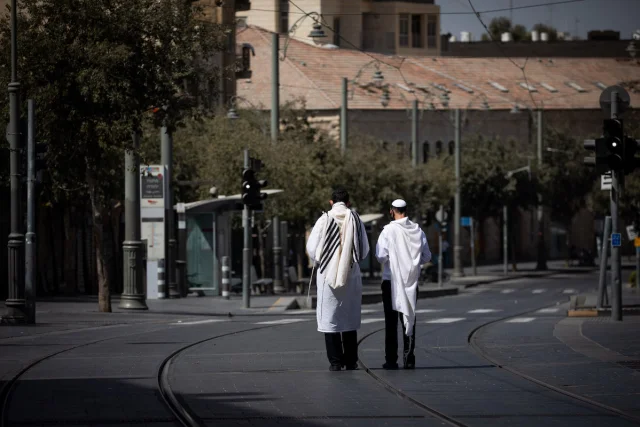
Today it is still traditional to wear white on Yom Kippur as a symbol of that purity and humility.
“Yom Kippur” is translated as “Day of Atonement,” but the English word “atonement” was coined by Bible translator William Tyndale to convey the process of our relationship with God being restored: “at-one-ment” means being made one. When our sin is dealt with, we can be reconciled to Him.
In Hebrew, however, the meaning is a little different. Kippur means covering. Our sin is covered, so that God cannot see it. This is also the principle behind the yarmulke, or “kippa,” from the same word – a covering.
“Blessed is the one whose transgressions are forgiven, whose sins are covered,” declares David (Psalm 31:1). The concept of covering sin rather than taking it away entirely appears throughout the Hebrew Scriptures, and is even part of the ark of the covenant itself: the lid is called the “kapporet” or atonement cover, where the figures of cherubim guarding God’s presence witness the shed blood of sacrifice.
It is on that mercy seat that the blood of all those animals was sprinkled seven times by the high priest each year, ironically with the motion of whipping, according to the Mishna:
“He sprinkled from the blood, one time upward and seven times downward. And he would neither intend to sprinkle the blood upward nor to sprinkle it downward, but rather like one who whips,” (Mishna Yoma 5).
In the Babylonian Talmud, Yoma 55a, this is clarified:
“The Gemara asks: What is the meaning of: Like one who whips? Rav Yehuda demonstrated the action with his hand, like one who lashes with a whip on the back of another.”
The hard work was done unilaterally by the High Priest, stripped of his glorious regalia to look like all the others, and the transmission of sin to a sacrificial offering all point to the One the book of Hebrews calls the Great High Priest. The One whipped on our behalf, not only covering our sin but taking it away, as far as the East is from the West.
We all need forgiveness, on a personal and a national level. There is not a single person or nation without sin, including the nation of Israel.
However, accusation is the full-time job of Satan, the Adversary. While God brings conviction and leads us to repentance, the Accuser points out guilt with no recourse to forgiveness.
While the world finds fault with Israel, Israelis themselves are also tearing each other apart. Instead of joining with the voices of accusation or angrily taking sides in internal disputes, we need to recognize there is a tenth front: the spiritual battle.
Please cover Israel as a nation in your prayers this Yom Kippur. Pray for repentance, healing and forgiveness – for reconciliation with God and with each other.
You might also like to read this: