Edom is a real place: A word about the brother who watched


Twice now I have left a man standing at the end of a page without telling you who he was. In two earlier words to the Christians drifting from Israel, I ended on the same figure — Edom, the brother who stood on the other side and watched his brother bleed — and each time I let him stand there and walked away. A warning is not an explanation. So let me go back for him. He deserves the whole indictment.
Start with the thing that makes the whole story unbearable. Edom was Esau — the twin, Isaac's firstborn, Jacob's own brother, raised at the same table, heir to the same covenant that ran from Abraham. This was no grudge between foreign nations. There were two boys in one household. And the rupture between them did not begin with a war. It began with a meal.
You remember it. Esau came in from the field faint with hunger, and Jacob had pottage, and Esau wanted it enough to trade for it. Hear what he traded.
Genesis chapter twenty-five, verse thirty-four:
Then Jacob gave Esau bread and pottage of lentiles; and he did eat and drink, and rose up, and went his way: thus Esau despised his birthright.
He sold the covenant for a bowl of soup and went his way as though nothing of weight had changed hands. That is the seed of Edom, and the sin that grows from it is one sin: treating a sacred thing as though it were ordinary. Everything Edom does afterward is that first decision, grown up.
Now watch it grow. Generations later Israel came up out of Egypt, worn from the wilderness, and asked Edom for nothing but a road — the King's Highway, with the promise to pay for the water they drank.
Numbers chapter twenty tells you the answer the brother gave.
And Edom said unto him, Thou shalt not pass by me, lest I come out against thee with the sword.
Israel did not force it; the text says Israel turned away from him. But mark what has happened: the brother has refused the brother a road. The coldness is setting like concrete, and it goes on setting, century by century, until it reaches the day the prophets could not forgive.
That day was the fall of Jerusalem. When the foreigner broke the city and carried her people off, Edom was there — not, at first, with a sword, but the way a man is there at the edge of a fight he has decided is not his to stop.
Obadiah is where this is settled, and it is a strange little book: twenty-one verses, the shortest in the Old Testament, and God spent the whole of it on one man's conduct on one day. Not a treatise on the nations. One indictment, of one bystander. And when you read the charge, watch where the accusation actually falls.
Obadiah, verse eleven:
In the day that thou stoodest on the other side, in the day that the strangers carried away captive his forces, and foreigners entered into his gates, and cast lots upon Jerusalem, even thou wast as one of them.
Read it again and find the accusation, because it is not where you expect it. God does not charge Edom with breaching the wall — the strangers entered the gates and cast the lots. Edom's crime is the two words in the middle: thou stoodest. He stood on the other side and watched. And the verse collapses the distance he thought he was keeping — even thou wast as one of them. The man who only watched was counted with the men who did it. Heaven kept no gentler category for the bystander.
The next verse presses the knife further. Every line of it goes after what the bystander saw and what he said.
Obadiah, verse twelve:
But thou shouldest not have looked on the day of thy brother in the day that he became a stranger; neither shouldest thou have rejoiced over the children of Judah in the day of their destruction; neither shouldest thou have spoken proudly in the day of distress.
Looking, gloating, talking — the whole charge sheet is the sin of the spectator who has picked a side in his heart and lets it show. And the other prophets, naming Edom's guilt, name the same thing. The Psalmist by the rivers of Babylon does not ask God to remember what Edom built or burned. He asks Him to remember what Edom said.
Psalm one hundred thirty-seven, verse seven:
Remember, O LORD, the children of Edom in the day of Jerusalem; who said, Rase it, rase it, even to the foundation thereof.
Who said. The cheering from the sideline. And Amos had already fixed the crime in a phrase: Edom pursued his brother and cast off all pity, and kept his wrath for ever. The brother who will not stop hating the brother. That is Edom. But now I want to do what the first two words did not, and take you out of the text and onto the ground.
Because here is the thing most Christians never learn about Edom: he is not only a symbol. He is a place. You can drive to him.
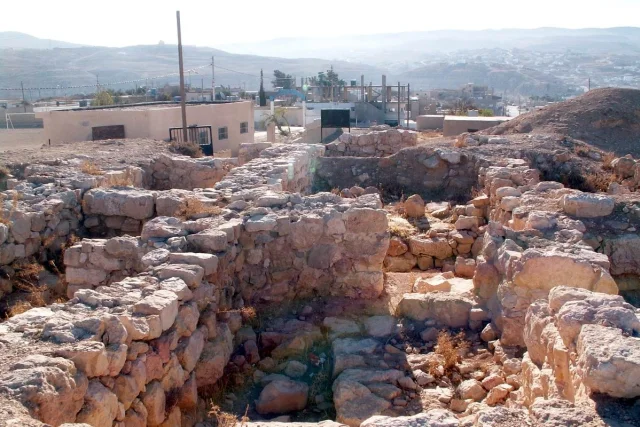
Edom was a real kingdom on real dirt, in what is now southern Jordan, and its strongholds still stand. Go to a mountain the ancients called Sela — the word simply means the rock — and you will find an Edomite fortress on a sandstone summit rising some six hundred feet off the valley floor, reached by a single stair cut into the cliff by men who built it because they believed no army would ever climb it. They built their safety into the height and felt untouchable.
Then history answered that confidence. Carved into the sheer rock of that same mountain, roughly three hundred feet up the steepest face, there is a relief: a carved image and a long inscription, and it is not Edomite. It is Babylonian. It is the image of Nabonidus, king of Babylon, with the symbols of his gods around him, put there in the sixth century before Christ by the very empire that came and took the fortress that thought it could not be taken. The conqueror climbed the unclimbable rock and signed it. The relief is set so high and sheer that the scholars who finally studied it had to reach it on ropes. But it is there: a foreign king's face carved into the cliff of the brother who thought his height made him safe, looking down where the Edomites used to look down.
Up the same highway is another name you know from the prophets — Bozrah, the old Edomite capital, which the maps now call Busayra, still standing on its ridge. And it matters that these are places and not metaphors, because as long as Edom stays a symbol, the warning stays comfortable. A ruin you can stand in front of, a cliff with a conqueror's face on it, is a fact — and it says that the God who judged the brother who watched did it in history, to a real people who thought their rock was high enough.
And He is not finished with the reckoning. Long after Edom the kingdom was rubble, Isaiah saw a figure coming from that direction, from Edom's chief city — one of the soberest visions in Scripture.
Isaiah chapter sixty-three, verse one:
Who is this that cometh from Edom, with dyed garments from Bozrah? this that is glorious in his apparel, travelling in the greatness of his strength? I that speak in righteousness, mighty to save.
Whatever else that vision holds, it tells you the file on Edom was never closed. The name that began as a brother's, and became a bystander's, ends as the address of a reckoning. God remembers where the brother stood.
Now I have to be careful, and I will be. I am not going to give you a date, or point at a flag on today's map and tell you that nation is Edom and here is the timetable of his fall. That is what the pamphlet-writer does, and it has embarrassed the Church too many times to repeat. I do not know the schedule. No honest man does.
The claim I am making is narrower than a prediction, and heavier. Edom is not only a nation that fell. Edom is a posture, and the posture is still available — to anyone, in any age, including this one, including you.
Look again at what the posture is, for it is what the earlier words were driving at. Edom's judged sin was not that he stormed the gate — the foreigners did that. It was that he stood on the other side of the road on the day of his brother's calamity, and looked, and let his heart be glad, and said a hard word at the worst moment, and counted himself uninvolved the entire time. And Heaven counted him as one of them.
There is no third category. That is what the modern Christian most needs to hear, because he has convinced himself there is one. He imagines a safe middle ground between the man who throws the stone and the man who stops it, a neutral place where he can watch his brother's calamity, let a fashionable accusation pass unchallenged, and still call his hands clean. Obadiah closes that middle ground. The one judged was not the man who struck. It was the man who watched the striking and found he did not mind. Silence, in a room that has turned against your brother, is not neutrality. It is a vote. It is the posture of Edom, and Edom is a real place, with a conqueror's face carved into his rock, testifying to what became of the brother who thought watching was safe.
So I will end this word where I have ended the others, but now you know the man I am pointing at. He was a brother who sold the sacred for a bowl of soup, and later refused his own kin a road through his land. And on the day the gates broke, he stood on the other side and watched — and it was the watching that damned him.
What will you do while your brother bleeds?
You might also like to read this: