2 years after Nasrallah assassination: Israeli intel officers say they knew 'when he went to sleep, what he liked to eat'
Tens of thousands mourn Hezbollah leader in Beirut



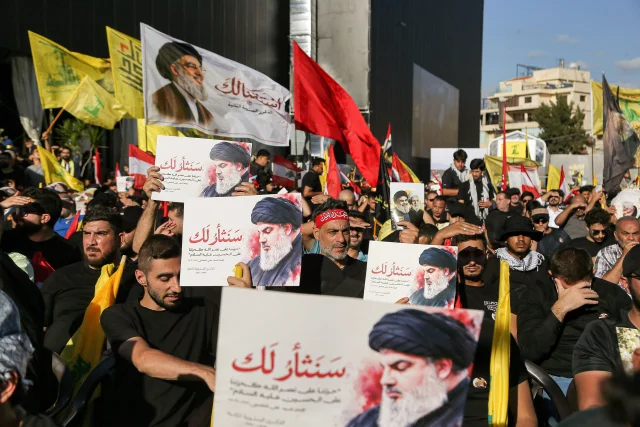
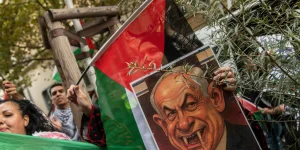
Tens of thousands of Shiite Lebanese gathered to commemorate the second anniversary of the assassination of Hezbollah Sec.-Gen. Hassan Nasrallah by the Israeli military
Meanwhile, Israel Defense Forces officials revealed new details about the secretive, spectacular operations that led to the killing of one of the world’s most wanted terrorists after a decade-long hunt.
It is hard to overstate the significance of the massive surprise strike that took out Nasrallah while he was inside a bunker beneath a civilian neighborhood in Hezbollah’s Dahiyeh stronghold in southern Beirut.
The mythical leader had haunted Israelis for decades. He had a key role in creating the broader Iranian axis, particularly building up Hezbollah’s arsenal with Iranian weapons to the point where the possibility of a full-scale war with the terror group was estimated to cost Israel thousands, if not tens of thousands, of lives.
BREAKING - reports coming in this strike on a Hezbollah stronghold in Beirut has resulted in the assassination of leader Hassan Nasrallah.
— StopAntisemitism (@StopAntisemites) September 27, 2024
Reminder to all - Hezbollah has the blood of HUNDREDS of U.S. service members on their hands, along with Israelis. pic.twitter.com/XISoE9I8nr
There were even—probably far-fetched but still indicative—rumors that he was being considered as a future supreme leader of the Iranian regime. His combined political and spiritual status and death as a “martyr” for the anti-Israel cause has enshrined him as a modern-day saint for Shiites around the world.
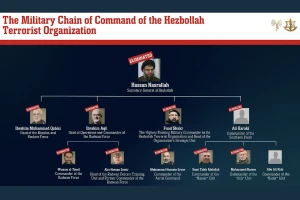
In the end, Nasrallah’s death was the first of an unprecedented series of blows that reduced the vaunted Iranian proxy to the point where most Lebanese parties didn’t even bother to send representatives for the ceremonies marking the death of the man who had effectively ruled the country.
Iran’s new supreme leader, Mojtaba Khamenei – who, if he is even still alive, has stayed under the radar for fear of sharing Nasrallah’s fate – circulated a message via Iranian state media, eulogizing him with flowery language demonstrating his saintly status.
Describing him as “the heroic prince of the Arabs and the great symbol of the Resistance Front,” Khamenei said, “Nasrallah was, throughout the history of the Levant up until today, and after the prophets and their successors, a man unmatched in greatness in that ancient land.”
However, Lt.-Col. (res.) Moran Levanoni, a researcher at the Institute for National Security Studies (INSS), told The Jerusalem Post that Hezbollah's symbolic effort to reassert itself in the center of Lebanese politics via a mass event in Beirut was falling short. “Hezbollah still has a very big problem within Lebanese politics, and it’s losing ground,” he said.
In the years preceding the strike, Israel’s intelligence services had built a comprehensive picture of Nasrallah’s life.
Maj. (res.) R., an operations officer in the Israeli Air Force’s targeted assassination cell, told Ynet News that after the start of the war, “Nasrallah felt comfortable because he understood that Israel’s attention was focused on Gaza. He operated relatively routinely. He was careful to move covertly, but not as though he were in a full-scale war.”
Maj. G., who commanded the Intelligence Directorate’s Lebanon target section at the time of the strike, told Ynet that for two years, his team had “studied the man to understand his lifestyle and what he was doing at all times. The investigation went down to the most intimate and precise details of his daily routine: when he went to sleep, what he liked to eat, who he usually traveled with.”
Two years ago today, this was the incredible and beautiful moment when the rat of Beirut, Hassan Nasrallah, the notorious terrorist who led the Hezbollah terrorist organization, was sent to hell by the Israeli Air and Space Force.
— Babak Taghvaee - The Crisis Watch (@BabakTaghvaee1) September 27, 2026
GBU-31 JDAMs dropped by F-15I Ra’am strike… pic.twitter.com/S5R4fcndhC
He added, “On the one hand, Nasrallah created the impression that he was constantly operating in secrecy. On the other hand, he was deeply involved and made public appearances. He was involved in everything, from situation assessments to decisions on budgets and force buildup. He decided whether to invest in the Radwan Force or in missiles. He was very involved.”
The devastating beeper operation didn’t send Nasrallah into full panic mode, but significantly limited his ability to grasp the broader situation.
As one Shiite cleric told the Saudi newspaper Asharq Al-Awsat, every Israeli assassination of a field commander deprived him of “an eye that helped him see clearly.”
“He had difficulty grasping the scale of the events and obtaining a complete picture of the situation,” G. explained.
“We expected him to move to a new location, but he remained at the site we knew. We assess that this happened because he misjudged what was happening on the ground. The location was comfortable and familiar to him, and he failed to properly analyze the sequence of events. He did not understand that he needed to leave.”
“He froze, perhaps because of a mistaken assumption. He did not think Israel would go all the way. I think he categorized the pager attack and the assassinations of senior figures as an exchange of blows. He did not see that we were escalating it into a war.”
Speaking to The Jerusalem Post, people familiar with Nasrallah’s routine said that on the day of the strike, he chose to remain in his underground compound in Dahiyeh, beneath a multi-story residential building, rather than relocate to a safer location.
During the strikes on Sept. 27, 2024, the IDF dropped 83 bombs, according to Col. (res.) S., who managed the IDF’s target bank in the Air Force’s Nahalat Binyamin unit.
As R. told Ynet, “This was not a small compound. Eighty-three bombs were dropped there, primarily because of the challenging underground layout. It was professional, precise work.”
Collateral damage was a key consideration in the military’s deliberations, amid recent sharp criticism of Israel. G. explained that the question “was always part of the plan-approval process, even though Nasrallah was such a senior figure.”
The laws of armed conflict allow for collateral damage in strikes, including harm to uninvolved civilians, if the anticipated military advantage is “proportional” to the expected civilian harm.
“For an intelligence assessment of collateral damage, you are required to provide substantiated information on how many people are in every room, in every home in the building,” said G., noting that “in the end the damage was far lower than we had estimated.”
“In practice, the collateral damage from the entire strike was 30 uninvolved civilians. If you compare the collateral damage with the number of Hezbollah operatives killed alongside Nasrallah, it comes out to one-to-one. There was nothing disproportionate about it.”
Nasrallah’s elimination marked a significant turning point for Hezbollah and the Lebanese front overall, explained R. He said the Lebanese terror group “is not the same without Nasrallah… not even close to the capabilities it had on Oct. 8. Its force-building capabilities no longer exist and its ability to exert influence has been dramatically damaged.”
You might also like to read this: