US-Iran talks shift to Oman, remain on schedule after US shoots down Iranian drone near aircraft carrier
Trump reiterates Iranian regime 'would like to negotiate', reportedly decides against canceling talks






Diplomatic exchanges between the United States and the Islamic Republic of Iran appeared on the verge of collapse, but will still take place this Friday, after Iranian forces carried out “very aggressive” actions toward U.S. vessels in the region on Tuesday.
“As of right now, the talks with Iran are still scheduled,” confirmed White House Press Secretary Karoline Leavitt, adding that she had discussed the incidents with Special Envoy Steve Witkoff, who was due to meet Iranian Foreign Minister Abbas Araghchi in Turkey on Friday.
Several U.S. allies in the region have been urging the Trump administration to pursue a diplomatic agreement to de-escalate tensions between the countries and prevent a broader escalation. “The talks will continue later this week as far as we are concerned,” Leavitt added.
However, the Iranians walked away from several agreements that had already been reached regarding the planned summit, which they demanded be held in Oman instead, the news outlet Axios reported, citing two informed sources.
An Arab source told Axios that Washington had agreed to the change of venue, adding that the Iranian regime also demanded that representatives of several other regional countries not be included, as originally planned.
Iran has insisted on a bilateral format and wants to limit the talks to the nuclear issue, rather than discuss the missile program and support for proxy forces, which Israel reportedly demanded that the U.S. include in the talks.
Earlier on Tuesday, the Iranian military took two “very aggressive” actions against U.S. ships within a six-hour span, according to a U.S. official, speaking with Axios.
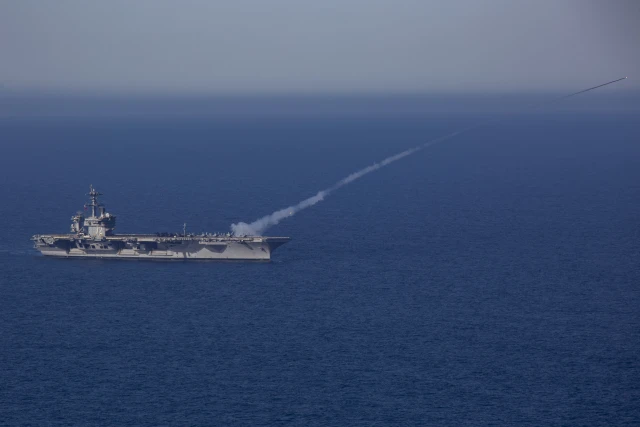
The first incident came when an Iranian Shahed-139 drone “aggressively approached” the aircraft carrier USS Abraham Lincoln, about 500 miles from Iran’s southern coast in the Arabian Sea, said Capt. Tim Hawkins, spokesman for the US Central Command (CENTCOM).
“The Iranian drone continued to fly toward the ship despite de-escalatory measures taken by US forces operating in international waters,” Hawkins said, adding that it was shot down by an F-35C fighter jet.
“No American service members were harmed during the incident, and no U.S. equipment was damaged,” he added.
The Iranian state-affiliated Tasnim News Agency claimed that the Islamic Revolutionary Guard Corps (IRGC) lost contact with a drone during a “reconnaissance, surveillance and filming” mission.
Several hours later, fast gunboats belonging to the IRGC Navy attempted to board a U.S.-flagged merchant vessel in international waters near the Strait of Hormuz.
Hawkins said two boats passed the ship three times at high speeds, threatening by radio to board and seize the tanker, while a drone flew overhead. The situation was resolved when the USS McFaul Destroyer escorted the vessel from the area while the U.S. Air Force provided air support, the CENTCOM spokesman said.
This was another example of Iran’s “unprofessionalism and aggressive behavior” that increases the risk of miscalculation for vessels operating in the area, Hawkins said, warning that the U.S. wouldn’t tolerate this kind of “harassment” in international waters.
U.S. President Donald Trump considered canceling the planned negotiations with the Iranian regime but ultimately decided against it, U.S. officials told The Wall Street Journal.
Commenting on Tuesday’s events, Jason Brodsky, policy director for the United Against Nuclear Iran think tank, said, “The Iranian regime is testing and probing ahead of the diplomacy – as it always does – but this is also occurring during the 10-Day Dawn marking the anniversary of the Islamic Revolution, and the regime likes to shoot propaganda videos of its drones approaching U.S. aircraft carriers. So this is all part of the show.”
Speaking to reporters later on Tuesday, Trump declined to talk about the summit’s location but confirmed that talks are ongoing.
“They are negotiating. They’d like to do something. We’ll see if something is going to be done. They had a chance to do something a while ago, and it didn’t work out, and we did Midnight Hammer,” Trump said, referring to the airstrikes on Iran’s nuclear program last June.
“I don’t think they want that happening again. They would like to negotiate. We are negotiating with them right now.”
The Iranian regime will try to drag out the talks with negotiations over the nuclear program while ignoring other issues, Brodsky warned. “It seeks to have long discussions about a nuclear program buried under rubble that’s not a real threat right now, in exchange for sanctions relief, while ignoring the other issues which are bigger priorities at the moment.”
“It’s also happy to keep the spotlight on its nuclear program which is in shambles and not the massacre of its own people,” he wrote on 𝕏.
Israeli Iran expert at the Institute for National Security Studies think tank, Raz Zimmt, noted, “Iran’s room for flexibility is likely limited to the nuclear program and does not extend to missiles or proxies. Therefore, the main questions are whether the maximum concessions Iran is prepared to offer meet the minimum concessions Trump is willing to accept, and what he is willing to offer Iran in return.”
Iranian Foreign Minister Araghchi, who is expected to lead the Iranian negotiating team, called his colleagues in Oman and Turkey, as well as the prime minister of Qatar, on Tuesday, according to Axios.
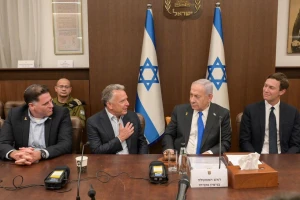
Witkoff met with Prime Minister Benjamin Netanyahu in Israel on Tuesday, with discussions reportedly focused on Iran. IDF Chief of Staff Lt. Gen. Eyal Zamir, Mossad Director David Barnea and Military Intelligence Chief Maj.-Gen. Shlomi Binder were also reportedly in attendance.
You might also like to read this: