University of Haifa researchers set sail in Neolithic-era reed boat




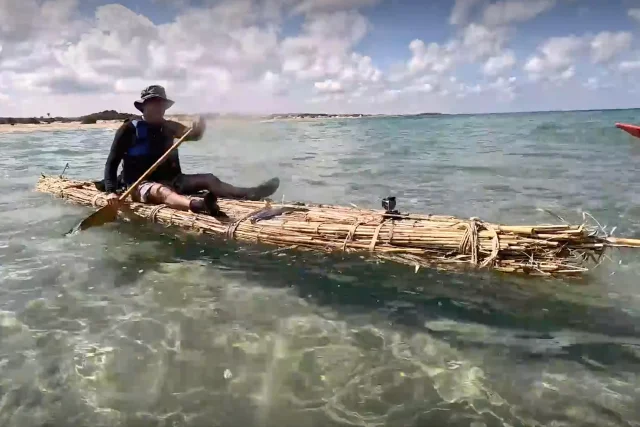
Researchers at the University of Haifa have taken to the Mediterranean in a 4-meter-long reed boat modeled after a watercraft that may have been used by Neolithic people thousands of years ago.
The experimental vessel, built by master’s student Shay Niv from the university’s Department of Maritime Civilizations, was designed to test a theory about how ancient coastal communities traveled and fished in the Mediterranean.
Although researchers have discovered evidence of dozens of Neolithic settlements beneath the waters off the Carmel Coast, including fishing equipment and other marine artifacts, no actual boats from the period have ever been found.
Researchers have been exploring the seafloor along and around the Carmel Coast for more than 40 years, uncovering evidence of settlements built when sea levels were much lower than they are today. The remains of these ancient villages have been submerged for thousands of years.
“At the sites, we found fishhooks, fishing-net weights and fish bones,” said Prof. David Friesem of the University of Haifa’s School of Archaeology and Maritime Cultures.
“We therefore know that Neolithic people in the eastern Mediterranean sailed into deeper waters and knew how to exploit marine resources. Some even reached Cyprus and settled the island, bringing plants and animals with them from the mainland,” he explained.
The absence of actual boats has led researchers to speculate that the watercraft used by these ancient seafaring communities may have been constructed from relatively flimsy, perishable materials.
Niv’s boat was built from 1,600 reeds of the type that has grown in the Levant since ancient times. As part of his research, he examined ancient sources and archaeological evidence, including reliefs, paintings and clay models, to investigate what kinds of watercraft may have been used in the region.
One ancient source he examined was the biblical account of Moses, in which Moses’ mother places him in a small basket made from reeds and sets him in the Nile River to protect him from Pharaoh’s soldiers.
After gathering enough information to understand the basic construction process, the team first built a small-scale model to test the concept.
“Before investing the resources required to build a full-size vessel, it was important for us to first build a small-scale model with the students in order to test the boat’s buoyancy and sailing capability,” explained Prof. Deborah Cvikel, head of the Department of Maritime Civilizations.
The model proved successful, allowing the researchers to move on to the full-size vessel. The team harvested reeds and assembled the other materials before Niv took the completed boat to the beach at Neve Yam over the weekend for a final test.
“It’s like fulfilling a dream: starting with a theoretical idea and ending with a full-size boat that is tangible and real,” Niv said.
“The success of the experiment does not prove that this is exactly what Neolithic watercraft looked like,” Friesem cautioned. “But it does show that a reed boat represents an optimal use of the natural resources available in the coastal environment.”
You might also like to read this: