Toward a unity gov’t? Likud, Eisenkot’s Yashar party hold first meeting as Liberman doubles down on opposition
Meeting is followed by harsh attack from Eisenkot against Netanyahu
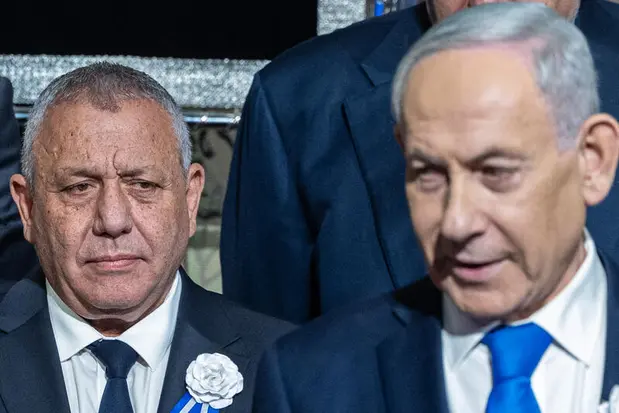
Representatives of the Likud and Yashar parties met for the first time on Sunday to discuss the possibility of forming a unity government, despite widespread skepticism about the talks' success after several Change Bloc members said they were opposed to a coalition with Prime Minister Benjamin Netanyahu.
The Yisrael Beitenu party, The Democrats, and Yair Lapid's Yesh Atid faction reportedly remain firmly opposed to serving in a government with Netanyahu, raising questions about whether Gadi Eisenkot can secure sufficient support within his own political bloc for a unity arrangement.
Sunday’s meeting came amid an ongoing a public exchange of blows. On Saturday, Netanyahu called on Yashar to enter unity negotiations “without preconditions.” Yashar, in response, accused him of “spin” while noting that a meeting had already been scheduled before his public appeal. An earlier meeting was canceled after Netanyahu’s controversial Knesset speech.
In a joint statement, the parties said the meeting, which also included a representative of Naftali Bennett's Together (Beyachad) party, took place "in a constructive atmosphere" and that dialogue would continue.
Yashar representative Chili Tropper told Ynet News that the meeting was “substantive” and said they would continue efforts to form a government. Likud representative Ofir Katz added, “We hope this isn’t just for appearances. The talks will continue.”
One way to read these numbers: Yisrael Beteinu is bound to disappoint most of its voters, no matter what happens. via aChord, Nov. 8-11 https://t.co/4dThiiKknO
— Israel Elects (@israel_elects) November 11, 2026
However, a statement by Eisenkot released later that evening cast serious doubt about the chances for success, triggering another exchange of harsh statements. It followed a Channel 12 report alleging that the arrests of Ra’am activists on election day were orchestrated by Netanyahu beforehand.
"The conduct of outgoing Prime Minister Netanyahu and those around him poses a tangible, direct, and immediate threat to Israeli democracy," Eisenkot said.
"There is not a single corner of Israel that has not been corrupted, distorted, and subordinated to serve Netanyahu’s personal political survival. There is no restraint he has not abandoned and no boundary he has not crossed. Under no circumstances must Netanyahu continue to hold the reins of power for even one more minute."
"Under no circumstances must Israel be dragged into another round of elections while he is prime minister. It is clear that as long as he remains in office, there will be no more fair and proper elections in Israel," he stated.
The Likud party responded by noting that Netanyahu was "extending a hand in the name of unity" but is being met with "daily statements filled with attacks and incitement in venomous language."
"The absurdity of Eisenkot’s wild incitement is beyond belief," the party said.
Following the deadlock between the Likud and Yashar blocs from last month’s elections, many analysts, journalists and public figures called for a unity government.
New Likud lawmaker Elisha Madan, who lost both legs fighting in the Gaza Strip at the start of the war, set up a tent outside the Knesset on Saturday, vowing to stay there until a unity government was established.
However, Sunday’s meeting was broadly seen as a political gesture rather than the start of real negotiations. Shirit Avitan, political analyst at i24 News, said the meeting itself was the message. “Apart from the fact that it took place, no real progress can be said to have been made between the two sides. Yashar’s and Likud’s conditions are incompatible, and that suggests this is a campaign.”
According to Channel 13, both sides rejected mutual requests for gestures of good faith during the meeting.
On Saturday, Yashar was reportedly prepared to offer Likud a place in a unity government, but only if Netanyahu agreed to step aside and Eisenkot served as the sole prime minister, without a rotation arrangement.
Under this arrangement, Netanyahu would be unable to serve even as a minister due to his ongoing corruption trial. However, Yashar reportedly would seek to establish a new framework allowing him to continue working on diplomatic affairs while addressing arrangements concerning his official residence, security and personal affairs.
Meanwhile, Likud reportedly asked representatives of Yashar and Together not to rule out Itamar Ben Gvir’s Jewish Power party as a coalition partner.
Yashar is reportedly prepared to weigh a coalition with any party except Ben Gvir’s, according to Ynet News.
While Likud and Yashar explored the possibility of a unity government, other opposition leaders continued discussing alternative coalition arrangements.
Also on Sunday, Lapid met with The Democrats’ party chairman, Yair Golan, to discuss “coordinating steps ahead of forming a government that would be good for Israel,” according to a joint statement.
The two left-leaning leaders have repeatedly ruled out joining any coalition with Netanyahu. On Sunday, Golan once again called to “meet with the leaders of the Arab parties, explore partnerships based on substantive issues, and stop letting Netanyahu and his poison machine determine who is legitimate and who is not.”
Notably, the only representative of Together at the unity meeting was a close confidant of Bennett; the party is a merger of Bennett and Lapid’s respective factions, though Lapid and his Yesh Atid party are viewed as much less likely to enter a coalition with Netanyahu.
Likud Minister Miri Regev on Saturday called for unity in a social media post while ruling out a government backed by Arab parties, whom she described as “terrorism supporters.” In response, veteran Yesh Atid lawmaker Merav Ben Ari retorted, “How can anyone unite with people like you? How?”
“Is that what you have to say about representatives of more than 20% of the population? How disgusting,” Ben Ari added.
The unity talks come as Eisenkot has decided to prioritize efforts to form a coalition with the ultra-Orthodox parties, rather than the Arab parties, Channel 12 reported on Friday. The move brings him closer to a strategy advocated by Liberman in a surprising reversal.
Liberman, however, has reportedly ruled out joining a government with the Arab parties, a Likud-led government under Netanyahu, or a minority government. He also rejected an offer to participate in Sunday’s meeting, warning that unity talks are a “trap,” according to Channel 13.
Yisrael Beitenu told the channel: “Both before the elections and after them, our most important goal is to bring the Netanyahu era to an end, and we have no interest whatsoever in giving him artificial life support.”
“This is not a unity government, but a trap for Gadi Eisenkot. We will be happy to cooperate with the Likud after the Netanyahu era.”
Popular article:

interview Easter message of resurrection hope amid war at Jerusalem's Garden Tomb

biblical commentary Let my people go: a Passover message for today

4 IDF soldiers killed, 2 wounded in fighting in southern Lebanon, as Israel eliminates dozens of Hezbollah terrorists

Receive latest news & updates
A message from All Israel News
Help us educate Christians on a daily basis about what is happening in Israel & the Middle East and why it matters.
For as little as $10, you can support ALL ISRAEL NEWS, a non-profit media organization that is supported by readers like you.
Latest articles:

northern front IDF conducts rare strike on Hezbollah weapons shipment in Bekaa Valley as terror group ramps up rebuilding efforts

Hamas seeks to rebuild military infrastructure, expand use of Gaza hospitals

Jewish heirs seek to block $180 million Van Gogh auction over alleged Nazi forced sale
Angela Merkel says Israel ‘went too far’ in Gaza but defends Germany’s commitment to Jewish state

Last Righteous Among the Nations living in Israel, dies at 91