explainer Israeli elections produce no winner, many losers and few paths out of the deadlock
Israel’s elections on Oct. 27 ended with no clear winner, a row of losers and no clear path to majority government.
The current opposition, known as the “Change Bloc,” received 48 seats, its leading party, Yashar chaired by Gadi Eisenkot, gaining 21 seats compared to Likud's 27.
The Arab parties surged with the Joint List earning the fourth highest number of seats with 11 seats, and Ra’am with eight.
Prime Minister Benjamin Netanyahu’s bloc won 53 seats, 11 fewer than the coalition held in the previous government.
The parties’ pre-election promises leave little room for negotiations, while additional conditions further stymy the few fragile paths to forming a government.
Despite the fact that parties have been known to make dramatic departures from campaign promises, and with neither bloc close to securing the 61 seats needed for a parliamentary majority, new elections appear as the most likely outcome.
Here we will examine several different scenarios of how the coalitions negotiations could play out noting that with Israel still mired in war with Hamas in Gaza and Hezbollah in Lebanon and is on high alert for a new flare-up of fighting with Iran.
‘Simple’ majorities with bloc defections & Arab participation
The most straightforward path to to 61 seats would be for one side to convince a party from the other side to defect. However, both sides have systematically vowed not to.
The opposition holds Netanyahu and his government responsible for the circumstances preceding the October 7 Hamas attacks. It also argues that the government's proposed judicial overhaul would weaken the judiciary system.
Seizing the moment to make himself a key player in the negotiations, Yisrael Beitenu leader Avigdor Liberman has said the only sensible coalition would be a Zionist alliance that includes the Likud – but without Netanyahu, which is a non-starter for the party.
Parties in the opposition bloc have also ruled out joining a government with ultra-Orthodox parties, making universal military service and associated pentalities for draft dodgers a central condition of their positions.
Opposition members have also criticized settlement expansion in Judea and Samaria, which Bezalel Smotrich’s Religious Zionism/Zehut party views as a central accomplishment.
Netanyahu only needs eight more seats and so a defection from the opposition could push him over the edge. The only realistic options are Liberman or Bennett, however even they have only seven seats apiece.
Beyond the tricky numbers game, some opposition leaders such as Yair Lapid and Yair Golan are unlikely to join a coalition with Netanyahu under any scenario.
The biggest outlier is the surprising results from the Arab parties whose 19 seats could act as kingmakers by joining either side. But the Joint List contains openly anti-Zionist lawmakers and its leaders ideologically oppose joining an Israeli government.
Ra’am made history once when it joined the Bennett-Lapid government in 2020, though its current eight seats would also not be enough to help Eisenkot reach 61. Ra'am leader Mansour Abbas has sought to establish the party as a pragmatic political partner, although his reluctance to call Hamas a terrorist organization has drawn fire, making him an unlikely partner for Netanyahu's camp.
Minority government
Most parliamentary systems have the option of forming a “minority government,” which in Israel means a coalition of parties with fewer than 61 seats. Without its own majority, such a government must rely on opposition support for every vote, making it inherently unstable.
Before the elections, the option was floated that Eisenkot could form either a minority government with Ra'am. But the resulting deadlock from the election has promoted the bloc to consider another option: a minority government supported not just by both Arab parties or possibly the ultra-Orthodox parties.
Channel 12 News’ Ben Caspit said the parties could reach out to Ra’am while also suggesting that “a solution can be found” in order to cooperate with the ultra-Orthodox Shas party.
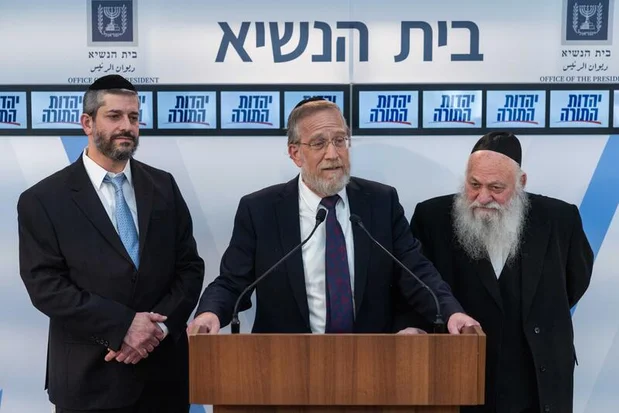
One of the ultra-Orthodox parties, United Torah Judaism, declined to recommend anyone for prime minister stoking speculation that it is vying to join the Change bloc. In exchange, the opposition would offer a draft law with conditions the party can accept such as fewer penalties for dodgers.
The Change Bloc could also take control of the Knesset by replacing the speaker, then form a small, unstable minority government before calling new elections. This could be possible if the Arab parties and one ultra-Orthodox party abstain. Such a move would serve to replace Netanyahu's caretaker government and place Eisenkot as prime minister until a government is formed or new elections are called.
This would also allow the Change Bloc to present votes on a state commission of inquiry for Oct. 7 and laws designed to disqualify Netanyahu from serving as prime minister.
Unity
A unity government remains an option, though it s becoming less likely by the day against the backdrop of escalating, mutual recriminations over the Shin Bet investigation into alleged foreign interference in the election.
The likeliest scenario is a coalition based on Netanyahu’s Likud and Eisenkot’s Yashar, who have a combined 48 seats and then buy in from several smaller parties to reach a majority.
However, the heads of the opposition parties have publicly ruled out this option. Netanyahu has said he is ready for a “broad national government,” however, he insists on running in and keeping his current partners—the ultra-Orthodox parties and Jewish Power led by Itamar Ben Gvir.
Unless a major security escalation changes the political landscape, one or more parties abandon key campaign promises or a party leader makes major concessions, Israel could face months of continued political uncertainty, stalled coalition negotiations and, eventually, another election campaign.
Popular article:

interview Easter message of resurrection hope amid war at Jerusalem's Garden Tomb

biblical commentary Let my people go: a Passover message for today

4 IDF soldiers killed, 2 wounded in fighting in southern Lebanon, as Israel eliminates dozens of Hezbollah terrorists

Receive latest news & updates
A message from All Israel News
Help us educate Christians on a daily basis about what is happening in Israel & the Middle East and why it matters.
For as little as $10, you can support ALL ISRAEL NEWS, a non-profit media organization that is supported by readers like you.
Latest articles:

Evangelicals' absence at the polls could carry a steep price for Christians – and Israel
Israel questions impartiality of newly elected ICJ judges

Israel faces $10 billion funding gap for US weapons after military aid ends – report
Haredi UTJ party won’t recommend Netanyahu as PM, Eisenkot set to win President’s mandate to establish new gov’t
Massive pro-Israel rally draws tens of thousands in Peruvian capital