Iran has around 2,500 ballistic missiles, restocking for future conflict - report
‘The smoke of war will sting your eyes’ - Iranian leadership warns of renewed military action
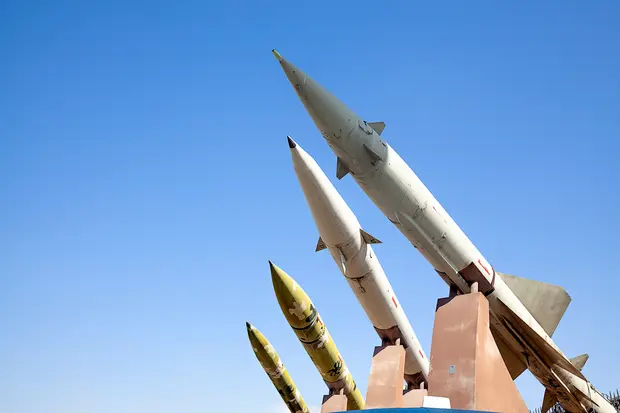
The Islamic Republic of Iran possesses an arsenal of between 1,500 and 2,500 ballistic missiles, the Wall Street Journal reports.
Citing U.S. intelligence, the Journal noted that Iran’s capacity to attack targets belonging to the U.S. and its regional allies is substantial, despite severe blows inflicted on the Iranian military during the last two rounds of conflict between Iran and the U.S. and Israel.
The WSJ noted that Iran continues to rebuild its ballistic missile program, although the U.S. blockade has forced it to rely more on previously stockpiled missile components.
A recent report by an Israeli open-source intelligence site, Netziv.net, said that satellite imagery from early November reveals extensive excavation and construction work near two large Iranian missile bases.
Last week, the Islamic Revolutionary Guard Corps (IRGC) unveiled what it claims is a new underground "missile city," which hosts both ballistic and cruise missiles, alongside launchers.
The site is not the first such "missile city" unveiled by the Iranian regime. Iranian media have shown similar underground missile facilities, built to withstand strikes by U.S. or Israeli planes.
Iran has used short-range ballistic missiles and drones to inflict damage on U.S. military installations in the Persian Gulf area, resulting in some U.S. military assets being moved to Israel, which offers better air defense systems.
Recent reports indicate that Iran has improved the efficiency of its attacks with help from Russian and Chinese intelligence, primarily satellite data, and relying on mixed attacks involving both drones and ballistic missiles.
Gulf countries have also been pressuring U.S. President Donald Trump not to return to active military operations, over fears that an Iranian response could cripple their economies.
Mossad chief Roman Goffman visited Washington over the weekend for a series of sensitive meetings with Trump administration officials, Hebrew media reported. Goffman was sent to convey the Israeli assessment that renewed military action against the Islamic Republic is necessary due to continued work on Iranian nuclear sites, and the work to rehabilitate its ballistic missile program.
At the same time, Iranian Parliament Speaker Mohammad Bagher Ghalibaf on Sunday warned that the Islamic Republic is ready for military action, urging the United States to “accept our seven conditions” for an agreement.
“We don’t care at all whether America wants to negotiate or go to war; if they accept our seven conditions, the path to an agreement is open,” Ghalibaf said in a speech at the opening of the week’s parliamentary sessions.
"This time, if the Americans make a mistake, the capabilities and resolve of Iran’s armed forces will determine the geography of the battle,” Ghalibaf threatened.
He went on to say, “The smoke of a new war will sting many people’s eyes.”
Ghalibaf’s comments came as the IRGC claimed to have hit an early warning radar at a U.S. military base in Bahrain.
“In the second phase of a decisive and crushing response to the blatant aggression by the United States military, the radar of a U.S. air defense site at the Riffa helicopter base in Bahrain was targeted by six drones belonging to the Aerospace Force of the Islamic Revolutionary Guard Corps,” the IRGC said in a statement carried by state-run Islamic Revolutionary News Agency (IRNA).
The IRGC also claimed to have downed another U.S. MQ-1 Predator drone over Iranian territory on Saturday. According to the IRGC, they have downed 17 of the older U.S. drones since the start of the conflict in late February.
Last week, Major General Mohsen Rezaei, the Secretary of the Supreme National Security Council, praised the country’s missile industry in a speech for its “glorious achievements” in the recent conflicts with Israel and the United States.
“The missile industry of the Islamic Republic of Iran stands as a magnificent symbol of faith, courage, innovation, and ‘jihadi management,’” Rezaei said in a speech at the unveiling of a new missile city during Iran’s national Aerospace Week.
Rezaei said that the missile industry “has evolved into one of Iran’s primary instruments of deterrence.”
Ebrahim Azizi, head of the National Security and Foreign Policy Commission, told the Islamic Revolutionary News Agency that Iran stands ready to deliver a “more painful and more tormenting” response to the U.S., should it resume military operations.
Azizi claimed that in the 12-day war against Israel, and in the 40-day war against the U.S. and Israel, “we brought America to its knees.”
He continued, saying, “Without a doubt, in the continuation of this battle, if the enemy makes any miscalculation, we will deliver a response that is more regret-inducing, more painful, and more tormenting than before.”
Similar comments were made by Major General Mostafa Izadi, Deputy Commander-in-Chief of the IRG), in an interview with the Hezbollah-run Al Mayadeen news agency.
Izadi told the Lebanese outlet that the regime stands ready to “inflict painful blows upon the enemy,” in the event of renewed conflict.
“This time, we are prepared with even greater readiness, enhanced operational capacity, and more extensive resources to carry out operations and inflict painful blows upon the enemy,” Izadi said.
Popular article:

interview Easter message of resurrection hope amid war at Jerusalem's Garden Tomb

biblical commentary Let my people go: a Passover message for today

4 IDF soldiers killed, 2 wounded in fighting in southern Lebanon, as Israel eliminates dozens of Hezbollah terrorists

Receive latest news & updates
A message from All Israel News
Help us educate Christians on a daily basis about what is happening in Israel & the Middle East and why it matters.
For as little as $10, you can support ALL ISRAEL NEWS, a non-profit media organization that is supported by readers like you.
Latest articles:
Israel faces pressure to ease entry of winter supplies into Gaza
Recent Eilat earthquake exposes Israel’s lack of preparedness for a major event

15 years of photos capture 'flesh and blood' of Jerusalem beyond its stones

Israeli study points to potential new treatment for type 1.5 diabetes

Jerusalem Botanical Gardens expands with new $3.8 million art gallery, sculpture trail