Iran’s IRGC signals plans for missiles beyond 2,000 km, vows to 'demonstrate' capabilities
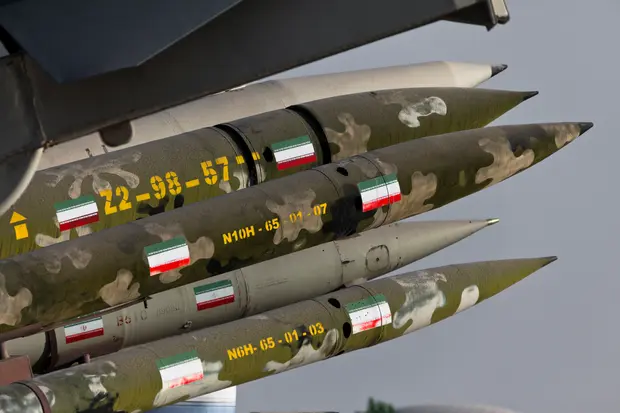
Gen. Hossein Mohebbi, spokesman for Iran’s Islamic Revolutionary Guard Corps (IRGC), said on Saturday that the organization would no longer adhere to a 2,000-kilometer (1,200-mile) limit on its ballistic missiles, adding that it was prepared to “demonstrate these capabilities in practice” rather than simply talk about them.
The statement follows a declaration last week attributed to Iran’s Supreme Leader Mojtaba Khomeini, warning that “any kind and level of threat” from the United States or Israel would be met with an IRGC response that would be “without geographic limits.”
Last March, Iran fired two missiles at the joint U.S.-UK military base at Diego Garcia in the Indian Ocean, approximately 4,000 kilometers (2,500 miles) from Iran. One missile failed in flight and crashed into the ocean, while the other was intercepted by a U.S. warship.
This remains the only reported instance of Iran firing missiles with a range exceeding 2,000 kilometers.
However, intelligence officials have long warned that Iran’s space program incorporates technologies that could be transferred to the development of long-range intercontinental ballistic missiles.
In a related development, NBC News reported on Saturday that U.S. President Donald Trump is considering the possibility of resuming military action against Iran. According to the report, advisers have told Trump that if he intends to take action, he should do so before the new Congress is sworn in in January.
The shift in control of both houses of Congress following last week’s midterm elections could severely limit the president’s ability to take action during the final two years of his term.
Meanwhile, an announcement by U.S. Central Command (CENTCOM) on Saturday indicated that it was moving forward with “Task Force Iron Gate,” a plan to restrict Iran’s ability to smuggle materials through overland routes in neighboring countries and across the Caspian Sea.
CENTCOM estimates that its naval blockade in the Strait of Hormuz has already halted roughly $25 billion worth of Iranian crude oil exports. The new initiative calls for coordinated efforts with the U.S. Departments of Justice, State, Energy and Treasury to shut down alternative routes for both imports and exports.
“The establishment of Task Force Iron Gate reinforces the success of our ironclad blockade against Iran at sea,” said Admiral Brad Cooper, the commander of Central Command.
“Strengthening CENTCOM’s collaboration with U.S. interagency partners will further constrain Iran’s ability to finance terrorism, rebuild weapons factories, and replenish their military,” Cooper continued.
Regarding the potential expansion of Iran’s ballistic missile capabilities, analysts have pointed out that the country’s existing missiles, with ranges of up to 2,000 kilometers, already place parts of Greece and the Balkans, the entire Arabian Peninsula, the Levant and most of Egypt within reach.
However, analysts have also cautioned that Iran expended a large percentage of its missile arsenal in previous rounds of conflict and lost many more to U.S. and Israeli airstrikes.
Developing and producing missiles with significantly longer ranges could take several years, they noted, suggesting that Iran’s threats to deploy such weapons in the near future should not be taken at face value.
Popular article:

interview Easter message of resurrection hope amid war at Jerusalem's Garden Tomb

biblical commentary Let my people go: a Passover message for today

4 IDF soldiers killed, 2 wounded in fighting in southern Lebanon, as Israel eliminates dozens of Hezbollah terrorists

Receive latest news & updates
A message from All Israel News
Help us educate Christians on a daily basis about what is happening in Israel & the Middle East and why it matters.
For as little as $10, you can support ALL ISRAEL NEWS, a non-profit media organization that is supported by readers like you.
Latest articles:

President Herzog gives mandate for forming next government to Eisenkot

Holocaust survivor returns to Berlin on Kristallnacht anniversary, urges Germany to fight antisemitism

Israel is losing America – new statistics reveal a political earthquake
Trump confirms US military carried out 'minor strikes' on Iran's Qeshm Island

Irish hospital association calls for boycott of Israeli pharmaceutical giant Teva