President Herzog gives mandate for forming next government to Eisenkot
Yashar party leader will have 28 days to form coalition government
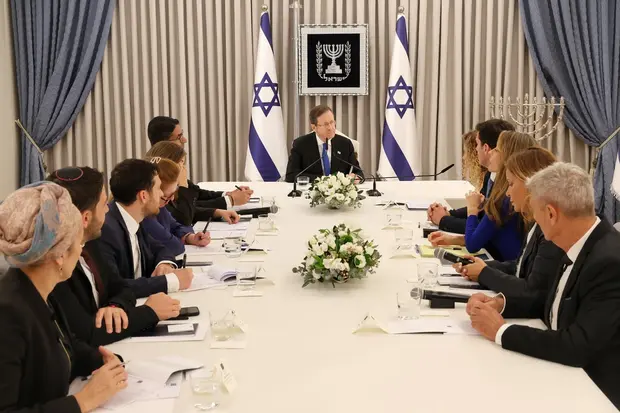
Israeli President Isaac Herzog announced Saturday evening that he would give Yashar party leader Gadi Eisenkot the mandate to form the next government, following several consultations with political parties.
Herzog said the choice to give the mandate to Eisenkot came following consultations with parties with a total of 67 Knesset seats that had recommended the Yashar party leader.
In a statement by the President’s office, Herzog formally invited Eisenkot to the President’s Residence on Sunday, Nov. 8, for an official ceremony to mark the occasion, which will be broadcast live on Israeli television.
“This is the time to form a national emergency government,” Eisenkot posted to his social media account following the announcement by Herzog’s office. “I will do everything to make sure we are worthy.”
זו העת להקמת ממשלת חירום לאומית. אעשה הכל כדי שנהיה ראויים 🇮🇱 https://t.co/18Q3eIE6g0
— Gadi Eisenkot - גדי איזנקוט (@gadi_eisenkot) November 7, 2026
Following the ceremony, Eisenkot will have 28 days under Basic Law: The Government to form a new government. If he is unable to reach a coalition agreement in that time, Eisenkot will be able to request an extension of up to 14 days.
At the end of that time, Eisenkot will either announce the successful formation of a coalition government, or announce to Herzog that he has not been able to reach an agreement, at which point, Herzog will hold additional consultations with party leaders before selecting another party head to form a government.
At this point, it is not clear whether Eisenkot will be able to form a coalition government, despite the recommendations of parties holding a majority of the Knesset.
The ultra-Orthodox United Torah Judaism party (7 seats) chose not to recommend anyone, while the Arab Joint List, representing 11 Knesset seats; and Ra’am, with 8 seats; have recommended Eisenkot, even without a coalition agreement.
The B’Yachad (Together) party of Naftali Bennett and Yair Lapid, 12 seats; the Democrats, 8 seats; and Israeli Beitenu, 7 seats; also recommended Eisenkot, while the rest of the parties recommended Benjamin Netanyahu.
However, Israeli Beitenu leader Avigdor Liberman reiterated over the weekend that he would not join a minority government supported by the Arab parties, even if they are not part of the coalition. Liberman said that such an arrangement would lead to a quick collapse of the government, paving the way for Netanyahu to return to the prime minister’s office.
Liberman pointed to the Lapid-Bennett government, formed in 2021, which lasted “a little over a year,” saying, “A minority government will last much less time, and at the end of it we will get Netanyahu back with 70 seats for another four years, and from there the path to the destruction of the Third Temple will be short.”
Liberman also expressed a willingness to reach a compromise agreement with the ultra-Orthodox parties, despite previously campaigning against them, saying, “in light of the range of challenges we are facing today, the national interest must stand above any other consideration.”
Shortly before President Herzog announced his decision, Prime Minister Benjamin Netanyahu released a video calling on parties of the “Change Bloc” to form a unity government with his existing coalition, claiming that “a government dependent on Hamas supporters won’t fight Hamas.”
Netanyahu claimed that an Eisenkot government reliant on the Arab parties could see the same upheaval as is currently happening in Europe.
“With a government like that, Israel simply won’t survive,” Netanyahu said.
“I call for the establishment of a government of national unity which will include all the parties of the national camp, and all the Zionist parties which want to protect our country, the one and only state of the Jewish people,” Netanyahu said. “A national unity government will permanently remove the nuclear threat from Iran, protect Israel as a Jewish state, and bring unity among us.”
Following the release of the video statement, Eisenkot’s Yashar party responded by stating that Netanyahu had “divided” Israeli society, stating that Likud was welcome to “accept Eisenkot’s four principles” and join a unity government under his leadership.
Yashar said that Netanyahu did not honor previous unity agreements and pointed to his previous promise not to form a government with Jewish Power leader Itamar Ben Gvir as a senior minister.
“If Likud and its allies are suddenly interested in ‘unity’ and a broad government, they are more than welcome to publicly announce the dissolution of their alliance with the extremists, their acceptance of Gadi Eisenkot’s four principles, and their willingness to join a government under Prime Minister Eisenkot,” the Yashar party said in a statement.
Democrats party leader Yair Golan, who has supported the involvement of the Arab parties in a coalition government, said he open to accepting the ultra-Orthodox parties, as long as they agreed to compromise.
Golan called for increased Haredi enlistment in the military, and for the ultra-Orthodox to respect the secular “way of life.”
“Just as we respect the Haredi way of life, we expect they will also respect our way of life,” Golan said in a statement. “In our municipalities it needs to be possible to go out on Shabbat, drink coffee, and, God forbid, get there on public transportation.”
Popular article:

interview Easter message of resurrection hope amid war at Jerusalem's Garden Tomb

biblical commentary Let my people go: a Passover message for today

4 IDF soldiers killed, 2 wounded in fighting in southern Lebanon, as Israel eliminates dozens of Hezbollah terrorists

Receive latest news & updates
A message from All Israel News
Help us educate Christians on a daily basis about what is happening in Israel & the Middle East and why it matters.
For as little as $10, you can support ALL ISRAEL NEWS, a non-profit media organization that is supported by readers like you.
Latest articles:
Israel is losing America – new statistics reveal a political earthquake

Trump confirms US military carried out 'minor strikes' on Iran's Qeshm Island
Irish hospital association calls for boycott of Israeli pharmaceutical giant Teva
Democratic Socialist Nithya Raman wins Los Angeles mayor race, alarming some Jewish voters over Israel stance
Palestinian Authority seeks EU backing for UN resolutions targeting Israeli policies in Judea and Samaria