Nazi-looted painting returned to Jewish heirs, sells for $42 million
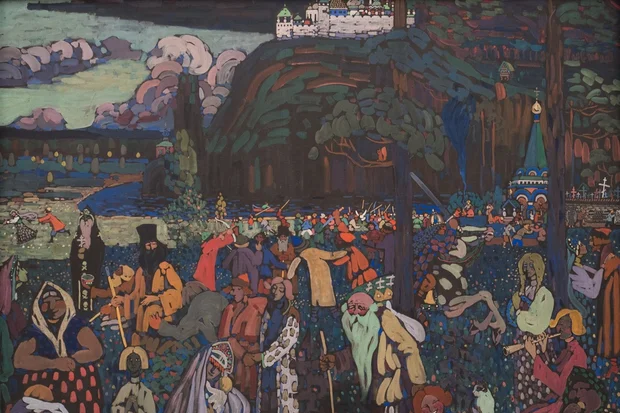
A painting by Russian artist Wassily Kandinsky, looted by the Nazis from a Dutch-Jewish family in the Netherlands, was sold at an auction in London earlier this month for almost $US 42 million.
Titled "The Colorful Life," the 1907 masterpiece was purchased in 1927 by Dutch-Jewish industrialists Emanuel Lewenstein and Hedwig Lewenstein Weyermann, who lived in Amsterdam. After being looted by the Nazis, it was acquired by the German bank Bayerische Landesbank in 1972 and spent about 50 years on loan to the Lenbachhaus Museum in Munich, Germany.
The painting was returned to the Lewenstein heirs in 2023 following a recommendation by an independent German advisory commission.
After a six-minute bidding war, it sold for £31.56 million (about $US 42 million), including fees – well above its estimated price of £18 - 25 million ($23.9-33.2 million). Measuring approximately 1.3 m by 1.6m (4.3 by 5.3 feet), the work is considered an important transitional piece in Kandinsky’s artistic development.
Born in Moscow in 1866, Kandinsky moved to Germany in 1928, but immigrated to Paris five years later after the Nazis forced the Bauhaus to close. He had unusual thoughts and feelings about color, believing each one had a mysterious life of its own. He also had a keen interest in the nonrealistic styles of Russian folk painting.
Kandinsky moved from 19th-century realism and impressionism toward abstraction, becoming a pioneer of abstract art alongside Paul Klee.
Nazi leader Adolf Hitler and his party allegedly believed that avant-garde styles like the Bauhaus art and design movement were "degenerate" and a threat to German tradition, considering them to be culturally "Bolshevik" and closing down the famous Bauhaus school in 1933.
A second Kandinsky painting looted from the German-Jewish Stern family was returned to the heirs after hanging for decades in the Van Abbemuseum in Eindhoven in the Netherlands. It sold at Sotheby’s for $44.9 million in 2023. “Development in Brown, is a somber piece painted in 1933, around the time the Nazis closed the Bauhaus. The title and color palette are thought to reflect the Nazi brownshirts, who tried to eliminate his abstract artistic style.
The Nazis looted an estimated 650,000 works of art across Europe, as well as Jewish-owned bank accounts, businesses and other assets. They also seized millions of books and manuscripts, religious artifacts, furniture, gold and jewelry.
According to the EBSCO Information Services, Nazi art looting intensified after the occupation of Paris in 1940. The Allies later formed the Monuments Men, a team that recovered thousands of stolen artworks during and after World War II. Despite decades of restitution efforts by researchers and organizations such as the Claims Conference, hundreds of thousands of artworks and cultural artifacts are still believed to be missing or unreturned.
Popular article:

interview Easter message of resurrection hope amid war at Jerusalem's Garden Tomb

biblical commentary Let my people go: a Passover message for today

4 IDF soldiers killed, 2 wounded in fighting in southern Lebanon, as Israel eliminates dozens of Hezbollah terrorists

Receive latest news & updates
A message from All Israel News
Help us educate Christians on a daily basis about what is happening in Israel & the Middle East and why it matters.
For as little as $10, you can support ALL ISRAEL NEWS, a non-profit media organization that is supported by readers like you.
Latest articles:

'We will cut out your tongue': Gazan teacher was threatened after questioning anti-Jewish education in UNWRA school

With over 85% of votes counted, Israeli elections end without clear path to viable coalition

Trump to impose unity government on Israel? - Reports claim US president pushing for government without controversial ministers

US tells Gulf nations to prepare for possible military campaign in Iran following midterm elections

The last votes that could change everything – Israel awaits count of 600,000 'double envelopes'