EXPLAINER A brief history of Arab parties participating in Israeli governments
Following record-high Arab voter turnout in the Israeli election a few weeks ago, questions have emerged both in Israel and abroad over whether, and to what extent, Arab parties should participate in government.
For example, on Hebrew-language social media, left-leaning journalists and Israelis shared a clip showing the late Prime Minister Yitzhak Rabin condemning inquiries about his government’s reliance on Arab parties as “racism” and berating a journalist for asking.
Since the establishment of the Jewish state, Israeli Arabs have been citizens with full voting privileges and the right to represent their interests via Arab-dominated parties. Nevertheless, the history of the Arab parties in Israel, particularly their participation in government, is relatively short.
Today’s Arab parties present a somewhat bewildering picture: an extremely broad political spectrum represented by just two entities: the Islamist Ra’am party and the Joint List, which is an alliance of the Communist and Arab-Jewish Hadash party, the secular Arab nationalist Ta’al party and the Palestinian Nationalist Balad party.
Direct participation in the Israeli government has only taken place during two short periods: first, outside support for the Rabin government by the Hadash party and the Arab Democratic party (Mada) during the Oslo Accords period from 1992 to 1996; and later, when Ra’am joined the Bennett-Lapid government from 2021 to 2022 – the first and so far the only time an Arab party has been a full member of an Israeli government.
The satellite party era
In the early years of the state, after the large-scale War of Independence with Israel’s neighbors that resulted in hundreds of thousands of Arabs fleeing the country, Israel's relations with the remaining Arab community were naturally characterized by deep and mutual mistrust.
Parts of the community were subjected to a military governance system with strict movement restrictions and localized curfews, which lasted from Israel’s foundation in 1948 until about 1966.
During this period, the main political representation for Arabs came from the Jewish-Arab communist parties and so-called Arab “satellite lists” dependent on the ruling socialist Mapai party. While they were part of the larger Mapai framework, there was no direct Arab participation in government.
The satellite parties were ad hoc political lists established only for each election and often focused on a region; for example, the “Democratic List of Nazareth” or the “Arab List for Bedouins and Villagers.”
The “Golden Age”
After slow developments in the 70s and 80s, today’s party landscape quickly took shape in the wake of the first tangible, direct influence exerted by Arab parties on an Israeli government, even without being a full part of it.
“That was the most successful political partnership that Arab citizens had, and we refer to it as the golden age in the political engagement of Arab citizens in Israel,” Mohammad Darawshe, Mada’s Elections Campaign Manager at the time, told ALL ISRAEL NEWS in a recent interview.
In 1992, Rabin, who was then IDF chief, formed a government led by his Labor party, which included the newly established left-wing Meretz alliance and the ultra-Orthodox Shas party, and held a narrow majority of just 62 of the required 61 seats.
Rabin then established an unprecedented arrangement in which the Hadash and Mada parties didn’t join the government outright, but their five seats provided a “safety net” in case some of the government’s lawmakers defected. This gave Rabin the political room needed to pass the highly controversial Oslo Accords.
In September 1993, those five seats became crucial when Shas left the coalition, leaving the government fully dependent on the votes of Hadash and Mada to fend off no-confidence motions and help it pass major measures connected to the Oslo Accords.
After Rabin’s assassination in November 1995, his successor Shimon Peres continued the arrangement. In return, the Arab parties secured several political gains, including canceling laws they considered discriminatory and significant infrastructure investments in Arab communities.
Darawshe recalled, “We drafted a 28-item agreement. One of them was to engage in Israeli-Palestinian cross-Green Line negotiations; not solve the Palestinian problem, not bring peace to the Middle East, but engage in negotiations… and the 27 other items were only about socioeconomic issues that relate to the lives of Palestinian citizens in Israel. And by the way, all 28 items were completed and fulfilled.”
However, regarding the Eisenkot bloc’s current deliberations over a possible coalition with Arab parties, Darawshe warned that “what is remembered [from that period] in the psyche of the liberal camp is that you can get killed if you do not have a Jewish majority.”
On the other hand, a coalition that first secures a Jewish majority before bringing in Arab partners risks offending the Arab parties. As Darawshe said, “In a way, [it] is insulting for the Arab parties because they say we should be treated as equal parliamentarians and not as a reserve.”
First Arab coalition partner
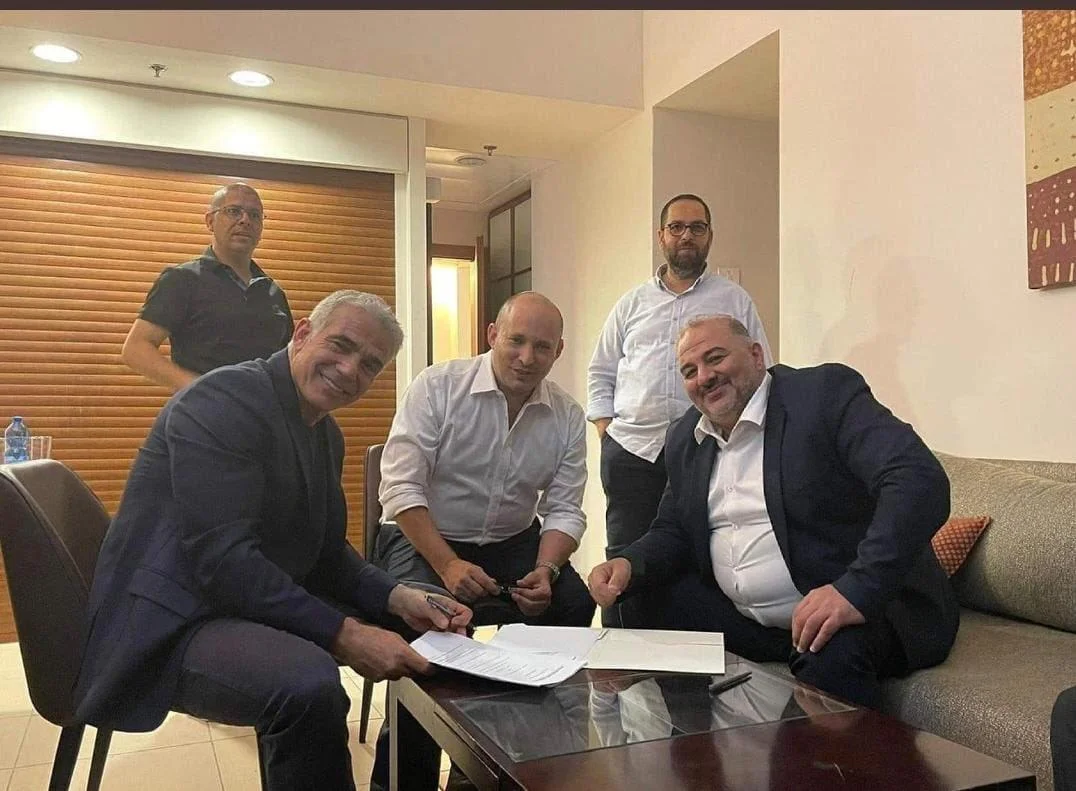
Thirty years later, Ra’am made history when it joined the Bennett-Lapid government in 2021, becoming the first full Arab member of a governing coalition in Israel.
Ironically, Benjamin Netanyahu, who today criticizes the opposition for even considering relying on Arab parties for outside support, helped pave the way for the Islamist party to join an Israeli government for the first time.
After another round of elections resulted in deadlock once again, Ra’am leader Mansour Abbas left the Joint List alliance and said he was open to cooperating with any coalition that would help Arab citizens in practical ways.
Netanyahu was the first to explore this possibility, despite having publicly ruled out a coalition with Ra’am during the election campaign. After holding several in-person meetings with Abbas, during which he reportedly offered significant concessions, Netanyahu failed to persuade other members of his bloc to support the move, particularly Bezalel Smotrich and his Religious Zionism party.
Eventually, Abbas joined Bennett and Lapid and became a minister without a portfolio. The short-lived government passed several significant bills aimed at improving the living conditions in Arab communities, particularly among Bedouins in the Galilee and Negev regions.
The period also revealed the risk of political instability and Israeli security – depending on which side one takes – faced by a government reliant on the support of one of today’s Arab parties.
In recent weeks, many right-wing politicians have noted that none of the Arab parties would support the government’s current security policies toward Hamas in Gaza or its efforts to maintain security zones in Syria and Lebanon. Even more concerning, according to this argument, a government reliant on support from an Arab party would have to think twice before going to war with the Iranian regime.
A frequently cited example is Ra’am’s coalition freeze in April 2022, after the party condemned Israeli security forces over clashes at Jerusalem’s Al-Aqsa compound. One lawmaker threatened to quit the coalition, and the party suspended its participation in both the coalition and the Knesset for two weeks.
At the time, Ra’am was still subject to the authority of a Shura council of Islamist scholars, which had ordered the move. Since then, the party has detached itself from direct dependence on the council, although it remains part of the broader Islamic Movement.
Arab politicians and votes for Jewish parties
For the sake of completeness, it is worth mentioning two other ways Arab voters have previously exerted influence on Israeli governments
Over the years, significant portions of the Arab vote have gone to Jewish parties, reaching as high as 30% in the 90s and still around 14% in 2022, according to the Israel Democracy Institute.
Arab and Druze politicians have also served in Jewish parties, including as ministers.
Druze Labor member Salah Tarif was the first non-Jewish politician to serve as a minister in Israel after being appointed minister without portfolio in 2001 under then-Prime Minister Ariel Sharon.
In 2007, Labor lawmaker Raleb Majadele became the first Muslim Arab to hold that post when he was appointed minister of Science, Culture and Sport in then-Prime Minister Ehud Olmert’s cabinet.
Popular article:

interview Easter message of resurrection hope amid war at Jerusalem's Garden Tomb

biblical commentary Let my people go: a Passover message for today

4 IDF soldiers killed, 2 wounded in fighting in southern Lebanon, as Israel eliminates dozens of Hezbollah terrorists

Receive latest news & updates
A message from All Israel News
Help us educate Christians on a daily basis about what is happening in Israel & the Middle East and why it matters.
For as little as $10, you can support ALL ISRAEL NEWS, a non-profit media organization that is supported by readers like you.
Latest articles:

interview 'Bridges for Peace' puts Christian love for Israel into action

1969 Dutch Eurovision winner Lenny Kuhr moves to Israel – cites antisemitism, family ties

Israel bars French far-left leader Mélenchon in response to France's entry ban on settlement leader

Change Bloc divided over coalition with Arab or ultra-Orthodox parties after week of negotiations

Huckabee fires back as Senate Democrats target US-Israel intelligence ties: 'Shocking!'