








Preparing for further conflict, Israel gears up for first elections since Oct 7
Political tensions are high in the lead up to the October elections
Despite the unresolved conflict with Iran, Hamas' continued presence in Gaza, and IDF deployments in Lebanon and Syria, many Israelis view the upcoming election as every bit as important as the country's security challenges.
The upcoming elections are seen by many in Israel as the first time the general public can judge the coalition government for its performance over the past four years.
A significant portion of the Israeli public is upset with how the coalition government responded to calls for an investigation into the events surrounding the Oct. 7, 2023, Hamas massacre.
While previous failures, such as the attacks that sparked the Yom Kippur War in 1973, led to state commissions of inquiry, the coalition government has firmly resisted one, arguing the public would not trust its findings.
Opinion polls, however, consistently show that a significant majority of Israelis support such an inquiry, including many who voted for the coalition.
As the country braces for political arguments and advertising, trying to convince voters which parties are best to run the country, the parties have begun to finalize their candidate slates ahead of the elections.
There has been a significant change in the political landscape among the opposition in the lead-up to the election season. The decline in voters for traditionally left-wing parties has led to a merger between Labor and Meretz, called The Democrats, under former IDF deputy chief Yair Golan.
The Democrats held their primaries last Monday, announcing the slate for the 10 seats the party is expected to achieve, based on recent polling.
However, the Democrat Party leader, Yair Golan, has confidently stated his belief that the party could garner over 1 million votes. Speaking at the National Security Conference hosted by Ynet in partnership with the Institute for National Security Studies (INSS), Golan said that if his party wins 15 seats, he plans to ask for the Defense Minister position.
“If we receive 15 seats, then I also believe I will be defense minister, but that is not what is important right now,” Golan said, before noting that getting good results for the opposition parties is more important.
Golan said that former IDF Chief of Staff Gadi Eisenkot appears to be the “natural candidate” for the position of prime minister, based on recent polls showing a higher preference for Eisenkot among those surveyed.
“As things look right now, Eisenkot will be the natural candidate,” Golan stated.
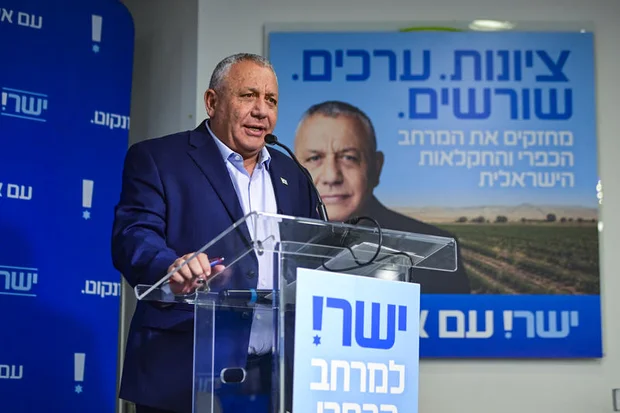
Eisenkot, who is leading the newly formed Yashar! (Straight) Party, billed as a centrist, Zionist party, gained attention on Monday after his party paid for advertisements in Hebrew in Cyprus, a popular summer vacation destination for Israelis.
Billboards bearing Eisenkot’s picture, along with a political message, appeared this week, next to the airport.
“Landed? Had fun? Now come back and win!” One of the billboards, bearing Eisenkot’s picture, said. Another billboard had the message, “Enjoy! You deserve it.”
The billboards mark the first time that election campaigns have engaged in advertising outside of Israel’s borders in several years.
The advertisement abroad came amid reports that the coalition government was considering enacting new policies and procedures that could make it harder for some Israelis to return in time for voting.
As Prime Minister Benjamin Netanyahu left for a visit to the United States on Monday, where he is expected to meet with President Donald Trump, the top internal court of his Likud party rejected his request to cancel primaries in the event of a security escalation.
“The Likud is not a party of one man, and it will lose its vitality if it becomes one,” the three-member panel wrote in a ruling. The court also said, “There is no place to open in advance even a crack at canceling the primaries.”
The Likud party, which is one of only a few Israeli parties to hold primaries, begins its convention on Monday.
Netanyahu recently secured a significant expansion of his influence within the ruling Likud Party after a key internal committee approved a plan allowing him to personally select eight candidates on the party's Knesset slate.
Netanyahu had originally demanded the right to choose ten slots on the party’s slate but reduced that to eight in a compromise agreement.
Political polls, which are often inconsistent with actual election outcomes, have predicted a drop from Likud’s current 32 Knesset seats to around 25 seats. Similar polls show Eisenkot’s party garnering around 30 seats.
Former Prime Minister Naftali Bennett, who recently returned to politics, joining with opposition head Yair Lapid to form the new Beyachad (Together) party, also spoke at the Ynet and INSS-hosted National Security Conference, saying he is focused on replacing the current government.
Bennett indicated that he is not demanding the role of prime minister as part of any upcoming coalition agreement.
“If, in order to replace this terrible government, the government of the massacre, the failure and draft evasion, I need to be a wheel, then I will be a wheel,” Bennett stated, quoting Zionist leader Joseph Trumpeldor.
“I am committed to replacing this government and delivering victory at any cost,” Bennett added. “I am not obsessed with the position. I am obsessed with repairing the State of Israel.”
He also said he would be willing to partner with Likud to form a strong Zionist government, as long as Netanyahu stepped down.
“He has to go home,” Bennett said.
The Religious Zionism party, which also hosted recent primaries, posted the results, showing a strong result for Settlement Minister Orit Strock. Along with the Jewish Power party of National Security Minister Itamar Ben Gvir, Religious Zionism has pushed for support for settlements in Judea and Samaria, even approving aid to illegal wildcat settlements.
Recent polls have shown Religious Zionism would just barely clear the election threshold, likely garnering only 5 Knesset seats.
The rhetoric of political discussions has been highly charged in recent weeks, leading President Isaac Herzog to call for caution and unity in his recent address before the fast of Tisha B’Av.
“On this day, both Holy Temples of the Jewish people were destroyed. For two thousand years, this day has reminded us of the price of polarization, division, and hatred among us,” Herzog said in his address. “This year, that message carries even greater weight, as we enter the period of elections.”
“Elections are a test of Israeli democracy, and they are also a test of the unity and cohesion of Israeli society,” Herzog said, urging elected leaders not to “cross red lines” in their rhetoric.
“Do not turn rivals into enemies!” Herzog warned, adding that “elections are not a civil war.”
Popular article:

interview Easter message of resurrection hope amid war at Jerusalem's Garden Tomb

biblical commentary Let my people go: a Passover message for today
4 IDF soldiers killed, 2 wounded in fighting in southern Lebanon, as Israel eliminates dozens of Hezbollah terrorists

Receive latest news & updates
A message from All Israel News
Help us educate Christians on a daily basis about what is happening in Israel & the Middle East and why it matters.
For as little as $10, you can support ALL ISRAEL NEWS, a non-profit media organization that is supported by readers like you.
Latest articles:
North American Jewish organizations to recruit 100 professionals to combat antisemitism
‘No need’ for pre-election Iran strike, IDF chief says as gov’t, opposition trade blame for potential escalation – report
terror attack 2 Israeli soldiers killed, 2 terrorists eliminated in Hebron shooting; IDF says much larger attack was prevented
analysis A people dwelling securely? Israel’s strategic standing, 3 years after Oct 7

Hamas on wheels: What I found in Dearborn reveals a troubling history and a battle over Israel