Israeli defense tech showcased at Marrakech Airshow amid growing ties with Morocco


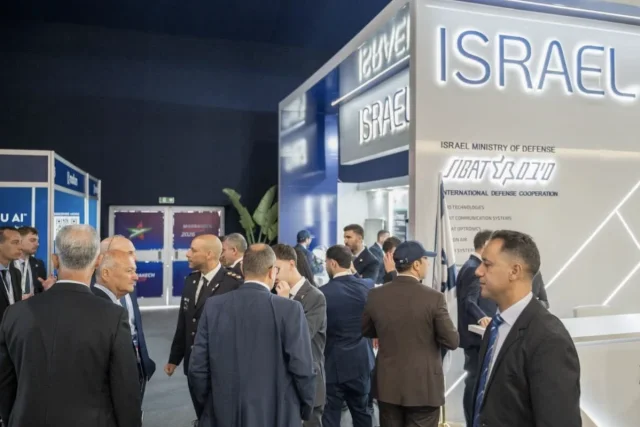
Israel opened its first pavilion at the Marrakech Airshow in Morocco, the Israeli Defense Ministry announced Thursday, highlighting expanding security and diplomatic ties between the two countries.
The International Defense Cooperation Directorate, known as SIBAT, hosted the pavilion, where eight Israeli defense companies showcased combat-tested technologies, which included AI-powered robotic systems, laser-guidance systems for first-person-view (FPV) drones, satellite communications and loitering munitions.
SIBAT chief Brig.-Gen. (ret.) Yair Kulas described Israel’s participation in the airshow as an “important milestone for the Defense Ministry and Israel’s defense industry.” He said the event offered a “platform for expanding international defense cooperation and building long-term partnerships.”
Morocco and Israel normalized diplomatic relations in 2020 under the U.S.-brokered Abraham Accords. The two countries, which had maintained covert ties for decades, subsequently expanded their commercial and security cooperation.
Last month, Israel and Morocco marked the sixth anniversary of the Abraham Accords. Israeli Foreign Minister Gideon Sa’ar and his Moroccan counterpart, Nasser Bourita, agreed during a meeting in New York with U.S. Ambassador to the UN Mike Waltz to upgrade bilateral relations and exchange ambassadors. The two countries agreed to increase direct flights and arrange additional high-level visits in the coming months.
“The friendship between the Moroccan and Jewish peoples has deep roots and a rich history,” Sa’ar said at the meeting. “The declaration we signed today outlines practical ways to upgrade ties between Israel and Morocco for the benefit of both peoples, and we will work to implement it.”
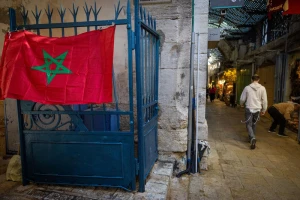
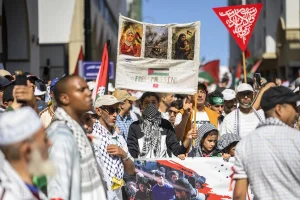
Despite the Moroccan government’s close ties with Israel, normalization remains controversial, with opposition in Morocco particularly pronounced among Islamist groups. Last month, anti-Israel protesters rallied against Rabat’s decision to deepen relations with Jerusalem.
Yasmine Hasnaoui, a political scientist at Morocco’s Hassan First University, said opposition to normalization was not new. Nevertheless, she argued that mutual interests would sustain bilateral ties.
“Morocco does not stop those things. Has Morocco changed its course? Morocco did not stop its relations with Israel, because Morocco sees itself as a mediator in the Palestinian and Israeli cause,” Hasnaoui said.
Morocco’s interest in acquiring advanced Israeli defense systems, coupled with Israeli defense companies’ interest in expanding exports, makes the North African country an increasingly important market for Israel’s defense industry.
Israel’s participation in the Marrakech Airshow contrasts with its exclusion from several European defense exhibitions amid deteriorating diplomatic relations and disagreements over Israeli policies in Gaza and Judea and Samaria (West Bank).
In June, for example, the French government blocked Israeli participation in the Eurosatory defense exhibition in Paris but eventually permitted Israeli companies to display defense systems without government involvement, and prohibited the exhibition of offensive weapons used by Israel during the war since Oct. 7, 2023. Israeli defense companies were also barred from participating in the NIDV Exhibition Defense & Security (NEDS) in the Netherlandsm, held annually in Rotterdam and focused on the naval defense sector.
You might also like to read this: