Hamas double agents misled Israel ahead of Oct. 7 attack – report


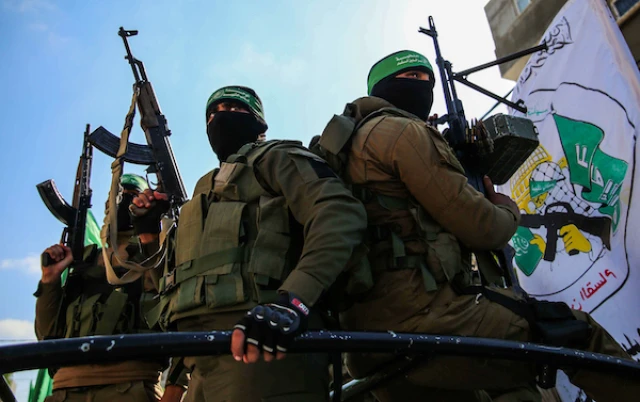
Hamas leaders used double agents as part of a deception strategy to lull Israel into a false sense of security ahead of the Hamas-led Oct. 7 massacre, according to a report published Wednesday by the Jerusalem Center for Security and Foreign Affairs (JCFA).
The report, authored by Lt.-Col. (res.) Yehonatan Duhoch-Halevi, found that the terrorist organization used double agents to mislead the Israel Security Agency (Shin Bet) ahead of the attack. As late as Oct. 6, the day before the massacre in southern Israel, Israeli intelligence was receiving false signals that it was business as usual in Gaza and that no attack was imminent. This deception reportedly enabled Hamas to consolidate its forces and conceal its operational plans before launching the attack.
Some 6,000 Gazans, including 3,800 terrorists from Hamas’s elite Nukhba unit, invaded southern Israeli border communities on Oct. 7, 2023. Approximately 1,200 people, most of them civilians, were murdered, and 251 people were kidnapped and taken into Gaza.
On the morning of the attack, the Israel Defense Forces (IDF) reportedly had only about 600 troops deployed along the Gaza border, including administrative personnel, according to the book "In the War Room," by Jerusalem Post journalist Yonah Jeremy Bob and Wall Street Journal journalist Elliot Kaufman.
Since the massacre, Israel has targeted terrorists who participated in the attack. Israel recently released figures indicating that approximately 4,000 of the 6,000 individuals who entered Israel that day had been eliminated during the ensuing conflict.
Hamas senior leader Khaled Mashal had acknowledged in late 2023 that deception had played a central role in the group’s strategy for the attack.
“Regarding the aspect of strategic deception and the method of deception, as I mentioned, there was a general feeling that [Gaza] [under Hamas leadership] was focusing on its affairs, and wanted to bring in a certain amount of fuel, electricity and aid, meaning [Gaza] was licking its wounds and pains because of the blockade imposed on it, and after the 21 war [Hamas] did not respond to the escalation [in actions] carried out by the occupation in al-Quds and Al-Aqsa,” Mashal said in an interview.
Mashal said Israel’s response to clashes at Al-Aqsa Mosque during Ramadan 2023 reinforced the impression that Gaza was preoccupied with its own affairs. He said the Israeli holiday season, from Sept. 15 to Oct. 6, further helped sustain that perception, as Hamas leaders sent additional deceptive messages to Israeli intelligence to conceal their plans for an attack.
He also acknowledged that the deception strategy behind the Oct. 7 attack was inspired by Egypt’s surprise attack on Israel in 1973 during the Yom Kippur War, which began on the holiest day of the Jewish calendar.
“A message, in order to fulfill its purpose, must be an indirect message, meaning messages that will not be understood [by the enemy] to be deception messages, which the enemy will swallow. The enemy also uses deception against others, and the resistance succeeded in deceiving the enemy, and it picked up false messages,” Mashal said during the 2023 interview. “After that, there was concealment, meaning avoiding exposing the preparations: Of course, the tunnels...”
The JCFA report also suggested that Hamas deceived the former Palestinian Authority (PA) Minister of Prisoner Affairs Sufian Abu Zayda, who had previously served as an intermediary between Hamas and Israel. According to the report, Hamas official Ghazi Hamad, who reportedly met with Abu Zayda before the October 7 attack, falsely told him that then-Hamas leader Yahya Sinwar had approved a potential deal with Israel for the release of prisoners.
The account reportedly reinforced Israel’s mistaken assessment that Hamas was pursuing an agreement rather than preparing for war.
You might also like to read this: