Aramaic: the language that outlived empires



In the 8th century B.C., the Assyrian envoy stood below the gates of the besieged city of Jerusalem, capital of Judah, and threatened its inhabitants in Hebrew.
The Judean officials shouted back, “Please speak to your servants in Aramaic, since we understand it. Don’t speak to us in Hebrew in the hearing of the people on the wall.” (2 Kings 18:26)
Why in Aramaic? The Assyrians spoke Akkadian, and the Judeans spoke Hebrew. So why was Aramaic, the language of Damascus, relevant in Jerusalem?
Aramaic was the language of the Aramean tribes roughly near the area of today’s Syria and Iraq. Genesis 31:47 tells us that even Laban spoke Aramaic, as he calls a witness heap “Jegar Sahadutha” in Aramaic, which Jacob calls “Gal’ed” in Hebrew.
Around 1200 B.C., a huge civilization collapse took place in most of the eastern Mediterranean, called the Late Bronze Age collapse. This made it possible for the Aramean tribes to expand significantly. There was no unified Aramean kingdom; rather, a network of Aramean kingdoms, Aramaic-speaking city-states and trade networks that slowly spread inland, as opposed to the Phoenicians, whose language and trade networks spread westward along the shores of the Mediterranean. This was around the same time as the era of Judges and the kingdom of David and Solomon.
When Israel and Judah were split up into separate kingdoms, Damascus was a powerful local kingdom, and it sometimes threatened, sometimes ruled over, the northern kingdom of Israel. This is where we hear stories from 2 Kings about the wars of Ahab and Ben-Hadad, King Hazael, and the Aramean military leader Naaman, whose leprosy was healed by Elisha the prophet.
This means that when the Assyrians conquered the Middle East in the 8th century B.C., the Aramaic language was already widespread and a useful language used by both merchants and diplomats. It is in this context that Judean officials plead with the Assyrian envoy to speak Aramaic, so he speaks to the king and the officials only, and not in Hebrew to the common people. A request he ignored, as his goal was to turn the people against the king.
Assyria adopted Aramaic as a useful lingua franca in its western parts, both because it was already well-established, but also because it was practical. It was written using an amazing innovation – an alphabet. The Akkadian cuneiform writing system had hundreds of signs, with a system similar to that of Egyptian hieroglyphs, and it was typically written on clay tablets. It could take years for a scribe to master it. Aramaic had adopted the Phoenician concept of a 22-letter alphabet written with ink on parchment or papyrus.
Once the Assyrians conquered the Arameans and exiled them, Aramaic spread over an even bigger territory, and so Aramaic became more and more used, alongside Akkadian, within the empire. This continued to be the case when the Babylonians destroyed Nineveh and took over their empire. Judea had survived the Assyrian attack, but succumbed to the Babylonians 115 years later. Many of the Judeans exiled to Babylon adopted Aramaic as their language, and it continued to be the case under the Persians. It is in this context that large parts of the books of Daniel and Ezra were written in Aramaic. In fact, from the era of the Persian Empire, there are written records in Aramaic from as far apart as Elephantine and Bactria – in today’s Egypt and Afghanistan.
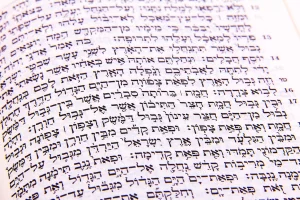
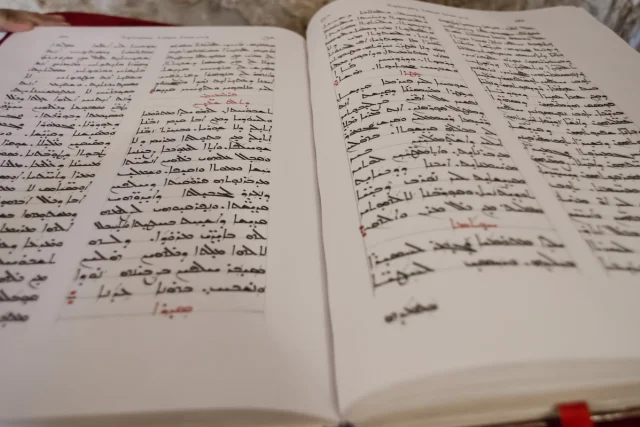
Aramaic’s rise also changed the way Jews wrote. Ancient Hebrew had originally been written in the script now called Paleo-Hebrew. Under Persian rule, Jews increasingly adopted the Aramaic imperial script, even for writing Hebrew, and it was this alphabet that gradually developed into the square Hebrew letters used today. The same Aramaic family of scripts also produced Syriac, still used today by Assyrian Christians, while another branch, Nabataean, eventually developed toward the Arabic script. The Aramaic alphabet is thus the “grandfather” of both the Hebrew, the Syriac, and the Arabic alphabets.
Some of the Dead Sea Scrolls are written in the newer square Aramaic-derived script similar to today’s Hebrew, but they preserve the name YHWH in the ancient Hebrew letters, almost like putting the divine name in an antique font.
With the era of the Second Temple, the Jews brought Aramaic with them back to Israel. It had become the daily language of many of them, while Hebrew kept its status as a religious and liturgical language. Aramaic, once the language used by diplomats so ordinary Judeans would not understand, had become an everyday Jewish language, while Hebrew retained particular prestige in religious and literary life. Almost a complete switch from the previous situation in the 8th century.
And then came Alexander the Great. And then the Romans.
Jesus grew up in a highly linguistically diverse landscape. A Jewish merchant at the time of Jesus might joke with his family in Aramaic, pray or study in Hebrew, and conduct business deals with outsiders in Greek. Greek had become the dominant international language in many settings, alongside the deeply rooted Aramaic. Hebrew was still a spoken language in some communities and settings, but the New Testament demonstrates Jesus speaking Aramaic with expressions like “Talitha Kumi,” “Abba,” and “Eftaha.”
The Jewish Aramaic of Jesus’ world was written in essentially the same Jewish square script used for Hebrew (which, if you remember, did originate from the original Aramaic alphabet). After the destruction of the Second Temple, Aramaic became one of the central languages of rabbinic Judaism, and anyone who wants to study Judaism needs to learn it. Its status within Judaism is second only to Hebrew. It’s the language of the Kaddish prayer, and of the Targums – ancient Aramaic translations and interpretive renderings of the Bible. Both Talmuds are written in a mix of Aramaic and Hebrew by people who were fluent in both and expected the same of their readers. The Talmud even preserved a tradition that Aramaic was the language of Adam, the first man (Sanhedrin 38b). This Jewish Aramaic, however, also developed its own form, heavily influenced by Hebrew. The Hebrew language of the time also underwent significant influence from Aramaic.
Aramaic also became one of Christianity’s great literary languages. Christians farther east spoke Syriac, an eastern dialect of Aramaic, and translated the Bible into it. The best-known version is the Peshitta, which remains important in Syriac churches today. Despite occasional claims that the Peshitta preserves the “original Aramaic New Testament,” it is not the language Jesus would have spoken in Galilee and is generally understood as a translation of the Greek New Testament. Earlier Syriac Gospel translations existed as well.
With the Islamic conquest, Arabic replaced Aramaic in most of the area of the Levant, but Aramaic never quite went away. Many words and phrases that are distinct for the Levantine dialect of Arabic (spoken in Jordan, Palestine, Syria, and Lebanon) are significantly influenced by Aramaic, especially in traditional agricultural vocabulary, tools, food, and place names. The Syriac and Chaldean branches of Christianity that survived under the Muslims retained a liturgy in the Syriac dialect of Aramaic. In some isolated regions and in some villages, Aramaic continued to be used as a regular daily language, and still is, in villages like Maaloula. Many of these areas were decimated or wiped out by the Syrian civil war and/or IS, and their descendants who fled to the Western world don’t always succeed in retaining the language among the younger generation.
In modern Israel, Aramaic often functions as Latin does in English: an old sister language supplying learned, legal, or slightly elevated vocabulary. For example, just as English uses the Latin prefix “tri-“ for anything that has to do with three, such as trilingual, triangle, or triathlon, Hebrew uses “tlat-“ from Aramaic in similar ways, in expressions like “tlat-meimadi,” three-dimensional, or “tlat-sifrati,” a three-digit number. A mortgage is called a “mashkanta” in Hebrew, taken directly from Aramaic. Often, an expression in Hebrew can feel “regular” while saying the same expression in Aramaic makes it elevated or scholarly.
“On the one hand… on the other hand…” is in regular Hebrew “mitzad echad… mitzad sheni…” but if you use the Aramaic expression, “michad gisa… me’idach gisa…,” you make yourself sound like a learned professor from the Hebrew University. The language that used to be common became fancy. The fancy liturgical Hebrew became common. Almost as if it went full circle since the time of the Assyrian envoy before Jerusalem’s wall, when the commoners spoke Hebrew and the diplomats Aramaic.
But there are also Aramaic expressions that became so common in Modern Hebrew that they are now part of spoken Hebrew, and most don’t even know that it’s Aramaic. Words like “beaya” for problem, or “uvda” for fact, or even the famous untranslatable common slang word “davka” used in Yiddish as “dafke,” originate from Aramaic.
Aramaic never produced a great empire of its own, yet somehow it outlived the empires that adopted it. It began in the Bible as the language of Laban and Israel’s northern enemies, became the language of Assyrian and Persian diplomats, then an everyday language of the Jewish people, the language spoken by Jesus, a language of rabbis and Christian theologians, and finally a hidden layer inside both Modern Hebrew and Levantine Arabic.
When the Assyrian envoy stood outside Jerusalem in the 8th century B.C., the Judean officials asked him to speak Aramaic precisely because the ordinary people on the wall could not understand it. More than 2,700 years later, Israelis use Aramaic words every day without even realizing it.
Few languages have traveled quite so far.
You might also like to read this: