Morocco-Israel ties strengthen despite renewed anti-Israel protests



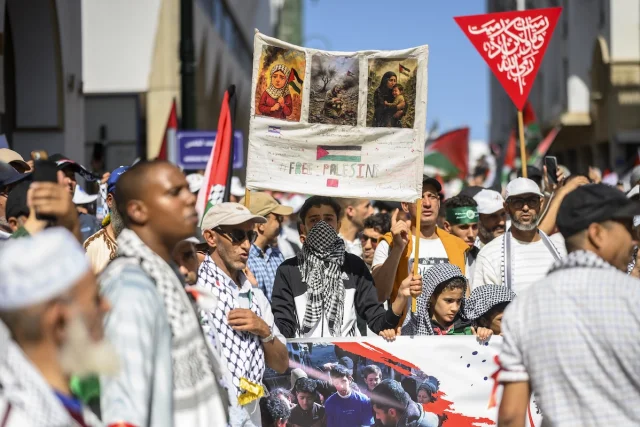
Morocco and Israel are moving toward deepening bilateral relations despite renewed anti-Israel protests in Morocco calling for an end to diplomatic ties with the Jewish state.
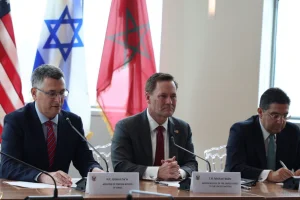
Earlier this month, Morocco and Israel agreed to expand their bilateral relations and exchange ambassadors. Moroccan Foreign Minister Nasser Bourita, Israeli Foreign Minister Gideon Sa’ar and U.S. Ambassador to the United Nations Mike Waltz met in New York to mark six years of diplomatic relations between Morocco and Israel. Morocco also agreed to deepen its economic ties with Israel.
However, opposition to normalization with Israel is not new in Morocco and has continued despite the government’s decision to strengthen relations.
“There are always demonstrations against normalization,” said Yasmine Hasnaoui, a political scientist at Hassan First University in Settat.
“Morocco does not stop those things. Has Morocco changed its course? Morocco did not stop its relations with Israel, because Morocco sees itself as a mediator in the Palestinian and Israeli cause,” Hasnaoui explained.
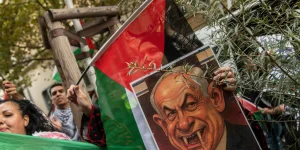
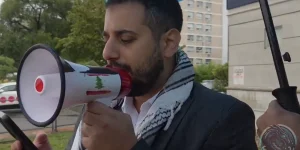
Anti-Israel demonstrators in the Moroccan capital Rabat chanted, “The people want the fall of normalization,” according to Moroccan media reports. Protesters in Marrakech meanwhile chanted, “No ambassador, no embassy.”
Moaz al-Hajri, national coordinator of the Moroccan Front for Supporting Palestine and Opposing Normalization, called the Israeli liaison office’s move to Mehdi Ben Barka Avenue in Rabat “a provocation to the Moroccan people and to the memory of the martyr Mehdi Ben Barka.”
Ben Barka was a prominent opposition leader during Morocco’s independence era who disappeared in Paris in 1965 after calling for limits on royal power. Israeli media reports have alleged that Israel's Mossad assisted Moroccan agents in tracking him.
The conservative Islamist Justice and Development Party (PJD) has also opposed diplomatic relations with Israel. Although the PJD led Morocco’s government when Rabat normalized relations with Jerusalem in 2020, the party has since taken an opposition stance.
“They are against normalization, and they have demonstrated that on several occasions, except when they were in government,” Hasnaoui explained. “They will take to the streets against what Morocco has done recently in upgrading the status of relations and establishing embassies. But I do not think it will touch the sovereignty of the country when it comes to the Western Sahara."
Despite the protests and opposition from political groups, experts say Morocco’s relationship with Israel is rooted in broader strategic interests and is not dependent on any single political party.
Einat Levi, an expert on Israeli-Moroccan ties, emphasized that the strength of Morocco-Israel ties extends beyond party politics.
“Morocco-Israel relations are anchored in something broader than party politics,” Levi said in an interview with The Media Line. “They reflect a strategic direction led by the king and the highest levels of the Moroccan state, built on long-standing ties, shared interests and a common heritage.”
Israel and the United States recognized Morocco’s claims to the disputed Western Sahara as part of the 2020 normalization agreement. At the same time, Morocco has continued to call for implementation of a two-state solution and publicly backed the Palestinian Authority.
Former senior Israeli official Eli Bar-On, who heads the regional development organization MENA2050, credited the United States with helping establish and sustain the growing relationship between Morocco and Israel.
“In many ways, it has been a trilateral relationship: Israel, Morocco and the United States,” Bar-On said. “Both Israel and Morocco have very strong alliances with the US, and that was a key pillar of this relationship.”
Levi welcomed the diplomatic upgrade but stressed that both governments need to focus on implementing stronger bilateral agreements.
“Diplomatic momentum does not last forever,” she warned. “The task now is to build on what has already been achieved and, above all, to give real substance to the many agreements signed since relations were renewed. The burden of proof is now on us.”
Last week, Bourita defended the controversial UNRWA agency and criticized Israeli proposals concerning annexation in Judea and Samaria. He also condemned violence by Jewish settlers.
Israel, meanwhile, moved to outlaw UNRWA after saying it had documented the participation of UNRWA employees in the Hamas Oct. 7, 2023, atrocities.
Former senior Israeli official Eli Bar-On, who heads the regional development organization MENA2050, credited the United States with helping establish and sustain the growing relationship between Morocco and Israel.
“In many ways, it has been a trilateral relationship: Israel, Morocco and the United States,” Bar-On said. “Both Israel and Morocco have very strong alliances with the US, and that was a key pillar of this relationship."
Levi welcomed the diplomatic upgrade but stressed that both governments need to focus on implementing stronger bilateral agreements.
“Diplomatic momentum does not last forever,” she warned. “The task now is to build on what has already been achieved and, above all, to give real substance to the many agreements signed since relations were renewed. The burden of proof is now on us."
You might also like to read this: