Israeli company Microcon Vision unveils laser system giving small drones precision targeting capability

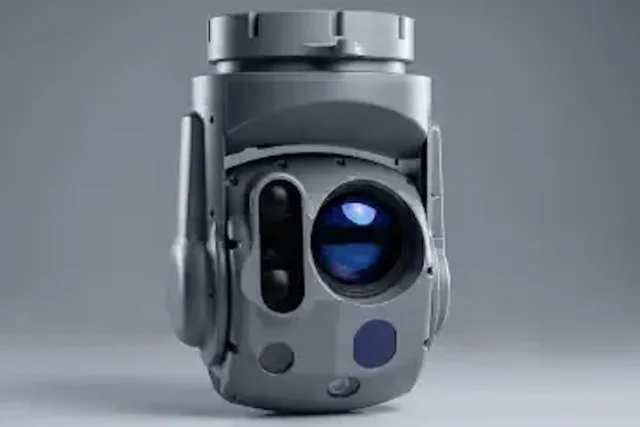
Israeli optics company Microcon Vision has developed a lightweight laser-targeting system designed to allow small drones to identify and designate targets for long-range missiles, artillery and other aircraft.
The company announced this week that its MICRO-D sensor payload weighs 1.9 kilograms (4.2 pounds) and can be mounted on small unmanned aircraft. The company also announced initial orders from unnamed customers, with first deliveries expected by the end of 2026.
Microcon Vision CEO Chen Almog said most of the initial orders came from security agencies in the United States.
“The growing use of smaller tactical platforms is creating a need for capabilities that until now have largely been available on larger systems,” he said.
“MICRO-D was developed to address this gap, allowing smaller platforms to take a more active role in the sensor-to-shooter chain," Almog continued. "The initial orders we have received reflect the operational demand we are seeing for this type of capability, particularly in the U.S., where our cooperation with our affiliate CONTROP USA provides U.S. customers with local business presence, effective program execution, local technical and field support, significantly enhancing our ability to serve our customers and partners.”
Laser designation for airstrikes has traditionally been carried out by ground troops who must approach targets and use handheld systems to keep a laser trained on them, potentially exposing the troops to considerable danger.
Larger fixed-wing aircraft and helicopters can also carry laser range finders and designators, allowing air-launched bombs and missiles to be guided accurately to targets. However, larger aircraft can make it more difficult to maintain the element of surprise.
The MICRO-D is designed to shift that capability onto smaller unmanned platforms. According to the company’s announcement, it uses a designator with “an output of 30 millijoules” that “complies with STANAG 3733, the NATO standard for laser designator coding used with laser-guided munitions.”
The company has not disclosed the system’s effective range, which remains classified. However, it said the MICRO-D is designed to operate on drones flying “at lower altitudes, including below cloud cover.”
The company said the unit “packs seven sensors and functional channels into a single two-axis gyro-stabilized gimbal,” including “a daylight camera, a thermal imager, target tracking and the laser designator. The system also provides several simultaneous video outputs, line-of-sight stabilization, an airborne tracker and inertial navigation. Optional AI-based software adds video motion detection and automatic target recognition.”
The system uses Ethernet connections and includes software development tools designed to connect its sensors to ground stations through several options, including MAVLink, a messaging protocol widely used by commercial and military drones to communicate with ground control stations.
The company also said the MICRO-D complies with National Defense Authorization Act sourcing requirements, which restrict certain Chinese-made components from use in U.S. military drones.
The system does not contain germanium, a material commonly used in thermal-camera lenses. China, the world’s leading supplier of germanium, has imposed export restrictions on the material.
Microcon Vision is a subsidiary of CONTROP Precision Technologies, an Israeli electro-optics company that operates under the auspices of Rafael Advanced Defense Systems.
You might also like to read this: