12 people killed in Houthi attacks on Riyadh’s main international airport, as Yemen conflict heats up
Series of airport strikes leads to closures, flight cancellations in capital city


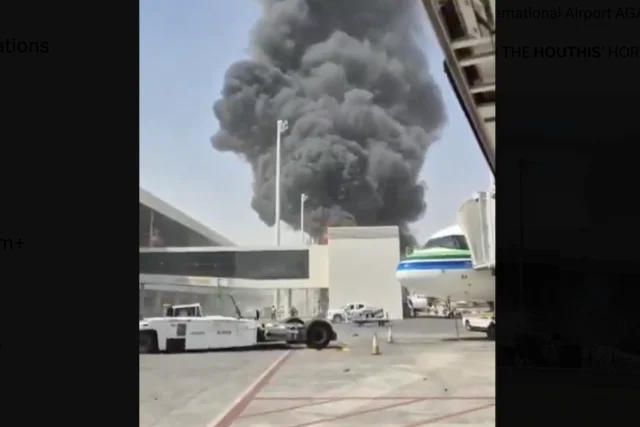
At least 12 people were killed and 309 injured in a Houthi attack on the King Khalid International Airport in Riyadh, Saudi Arabia, on Saturday.
In a statement, Saudi Arabia’s General Authority of Civil Aviation (GACA) said the attack on Riyadh’s international airport on Saturday killed 12 people of various nationalities: four Saudi citizens, two Bangladeshi nationals, and one person each from the United States, Egypt, Jordan, Syria, Palestine, and Sudan.
Additionally, 309 people were injured and taken for medical treatment at various hospitals in the capital.
The GACA also indicated that the attack caused material damage to the airport, necessitating a temporary closure of the facility.
MASS CASUALTIES IN RIYADH The damage from the attack on Riyadh’s King Khalid International Airport is extensive. Saudi authorities now report 12 people killed and 309 injured after the airport was struck. The Saudi-led coalition blames the Iran-backed Houthis for the attack. Airport operations were suspended as authorities assessed the damage.
— Mossad Commentary (@MOSSADil) October 11, 2026
The attack followed two previous attacks on Thursday and Friday, carried out by the Ansar Allah terror group, more popularly known as the Houthi rebels, after the name of their founder, Hussein al-Houthi.
Those attacks caused heavy damage to a commercial plane parked near the airport, and killed four people, with impacts also reported at Abha International Airport.
The Houthis claimed responsibility for the attacks on Friday, but had not yet claimed responsibility for the Saturday attack.
The Saudi-led coalition in Yemen, however, announced that the attack was carried out by the Houthi rebels, calling it a “full-fledged war crime,” and vowing to retaliate.
U.S. President Donald Trump condemned the Friday attacks, and said on Saturday that American forces might join Saudi Arabia in strikes on the Houthis.
JUST IN: 🇺🇸🇸🇦🇾🇪 Trump announce that the US may join Saudi Arabia in the war on Yemen Reporter: Have you decided whether to join the Saudi strikes on the Houthis? Trump: We may. We're going to look at it. We just found out about the recent attack. We will make a decision. We move very quickly.
— Megatron (@Megatron_ron) October 10, 2026
“It’s not a good thing,” President Trump said. “I’m not happy.”
U.S. Secretary of State Marco Rubio also condemned the attacks as “reprehensible.”
The United States strongly condemns the recent attacks on the Kingdom of Saudi Arabia by the terrorist Houthis, including today’s strike on King Khalid International Airport in Riyadh that took numerous innocent lives, including an American citizen. These reprehensible attacks demonstrate a blatant disregard for innocent civilian life. They must stop now. We stand with the Kingdom of Saudi Arabia and its people and extend our condolences to the victims and their families.
— Secretary Marco Rubio (@SecRubio) October 10, 2026
“These reprehensible attacks demonstrate a blatant disregard for innocent civilian life. They must stop now,” Rubio said, while affirming that the U.S. stands “with the Kingdom of Saudi Arabia and its people and extend our condolences to the victims and their families.”
The previous attacks on the King Khalid International Airport had also led to a temporary closure of the airport, before services resumed on Friday.
Saudi and Houthi forces have been engaged in escalating conflict over the past few weeks, after renewed fighting with he Yemini coalition saw the Houthi rebels attempt to seize the entire western coastal region.
After Saudi airstrikes in support of coalition efforts to recapture the coastal areas, the Houthis began to attack targets in Saudi Arabia, including repeated attacks on the King Khalid airport, as well as attacks on Saudi oil facilities.
Additionally, on Saturday evening, the Yemeni Coalition announced a projectile landed near the King Fahd International Airport in Dammam, in the eastern part of the country. Brigadier General Turki Al-Maliki, the official spokesman for the Saudi-led coalition forces, announced the impact, but did not mention any damages or casualties.
Despite the attacks, two major Saudi energy and investment conferences said that events scheduled for later this month will proceed as scheduled.
Europe's EASA aviation safety body on Friday issued an updated warning, recommending that airlines avoid certain areas of Saudi airspace due to the continued Houthi attacks.
Multiple airlines have announced temporary flight suspensions to the Riyadh airport following the attacks.
Global flight tracker Flightradar24 showed hundreds of flight cancellations following the attacks on Thursday and Saturday.
At the same time, schools in Riyadh were reported to have shifted to an online format for a week, following the attacks.
“Following instructions from the Ministry of Education, all schools in Riyadh will switch to distance learning for the entire week,” an email sent to parents by the Saudi education ministry read.
It is the second time in less than a month that such a switch has occurred.
The attacks appear to have raised questions about the effectiveness of the recently signed Mecca Defense agreement, as both Turkey and Pakistan have been reluctant to commit any troops to offensive operations against the Houthis.
Meanwhile, despite their outstanding disagreements in Yemen, the United Arab Emirates Ministry of Foreign Affairs issued a condemnation of the Houthi attacks on the airport.
In a statement, the UAE “condemned in the strongest terms the attacks by the Houthi group on King Khalid International Airport,” calling them a “flagrant violation of the sovereignty of the Kingdom of Saudi Arabia.”
This article originally appeared on ALL ARAB NEWS and is reposted with permission.
You might also like to read this: