Saudi-backed Yemeni forces launch Houthi counteroffensive with support from Mecca Pact members Turkey, Pakistan
First time Saudi-Turkish-Pakistani alliance was invoked since being signed on Aug 7




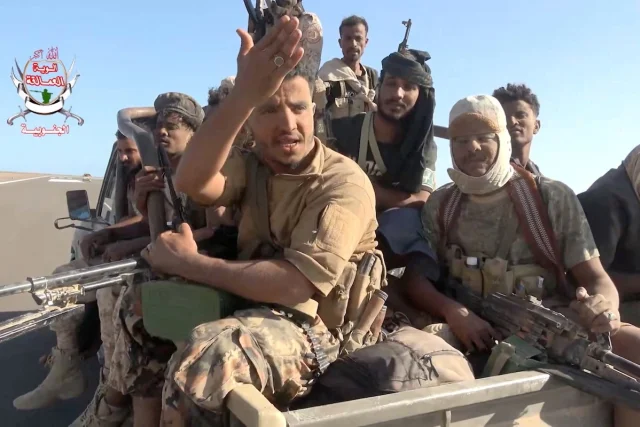
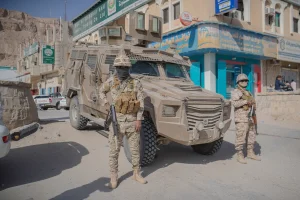
After weeks of Houthi successes, Saudi-backed Yemeni government forces reported significant progress on Monday after launching a large-scale counteroffensive aimed at dislodging the Iranian-backed terror group from the Bab el-Mandeb strait.
The terrorists had overrun most of Yemen's western coastal plain over the last month, seizing total control of the strategic waterway and imposing a blockade on Saudi shipping.
However, while Saudi-backed forces reportedly managed to roll back Houthi troops on the coast, the terrorists nearly cut off the city of Taiz in the mountainous interior.
Military officials told Reuters on Sunday that the Houthis were advancing along the last route connecting Taiz with Aden, the seat of the internationally recognized government, which could allow them to encircle the city of hundreds of thousands of civilians with large numbers of fighters.
The think tank Institute for the Study of War (ISW) assessed that the Saudi-backed offensive, which is accompanied by airstrikes from 100 fighter jets, “will likely succeed in capturing Mokha in the short term. Saudi Arabia and the Yemeni government likely launched the offensive to accomplish the limited objective of securing the Bab al-Mandeb.”
NEW: The Yemeni government, backed by Saudi air power and international coalition military support, launched an offensive to capture Mokha city and secure the coastline along the Bab al Mandeb Strait on October 4. This offensive will likely succeed in capturing Mokha in the short term. Saudi Arabia and the Yemeni government likely launched the offensive to accomplish the limited objective of securing the Bab al Mandeb. (1/2) Other Key Takeaways: Yemeni government-aligned forces will likely stop offensive operations within the next seven to 14 days to rest, resupply, and consolidate their positions to prevent a Houthi counteroffensive. The Yemeni government will need to secure its own defensible line before its offensive culminates in order to ensure it can repel Houthi attacks combining drones and ground forces, which the Houthis employed in early September. Allied air and intelligence support almost certainly made this offensive possible. Over 100 Saudi aircraft provided air support to Yemeni government-aligned forces during the initial assault, and US intelligence is reportedly supporting the air campaign. Saudi allies in the Mecca Pact are providing military aid to Saudi Arabia, and Saudi Arabia announced on October 5 that Pakistan and Turkey are taking “practical measures” to defend Saudi Arabia pursuant to the Mecca Pact requirements. The Iranian regime appears increasingly concerned that mounting economic pressure could threaten internal stability and is combining its attempts to manage its wartime economy with expanded efforts to deter and prepare to suppress possible unrest. Iran is likely reconstituting and enhancing its ability to target distant US regional military targets and commercial shipping through improvements in missile accuracy, range, speed, and targeting capabilities. Iran is likely aiming to increase its ability to deter US airstrikes targeting Iranian assets, impose costs on the United States, and preserve strategic initiative in the conflict by prioritizing improvements to its missile capabilities.
— Institute for the Study of War (@TheStudyofWar) October 6, 2026
“Over 100 Saudi aircraft provided air support to Yemeni government-aligned forces during the initial assault, and US intelligence is reportedly supporting the air campaign.”
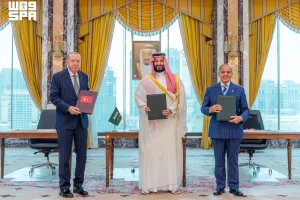
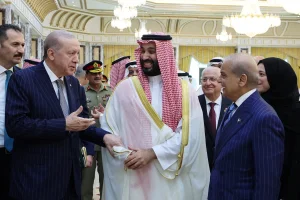
The latest developments came as Saudi Arabia, Turkey and Pakistan activated their Mecca Joint Defense Agreement for the first time, with the partners vowing to send aid to the kingdom.
On Sunday, the government of Yemen announced it would launch a broad counteroffensive aimed at “recovering the remaining territories” held by the Houthis, restore state institutions, “liberate” the capital Sanaa and end the Houthi “coup.”
The next day, Mecca Pact members held an emergency meeting in Riyadh. Saudi Defense Minister Khalid bin Salman later declared that they had “agreed to activate collective deterrence measures, within the framework of the Alliance, in response to the attacks and all those responsible for them.”
This marks the first time the alliance has been invoked since it was signed on Aug. 7. It came under strong criticism following the Houthi offensive, during which the terror group also struck oil infrastructure, military bases and civilian areas in Saudi Arabia. The kingdom also claimed that drone attacks targeted the holy city of Mecca, a claim the Houthis denied.
The Emergency Meeting of the Strategic Political and Defense Committee under the Makkah Alliance for Defense reaffirmed the solidarity and unity of our countries in confronting the heinous attacks against the Kingdom and the holy sites. The committee agreed to activate collective deterrence measures within the framework of the Alliance in response to the attacks and all those responsible for them.
— Khalid bin Salman خالد بن سلمان (@kbsalsaud) October 5, 2026
According to a joint statement published by Pakistan’s Foreign Ministry, the three countries would “provide the agreed military forces and capabilities, and ensure their rapid deployment” to Saudi Arabia.
Turkish officials told the news outlet Middle East Eye on Tuesday that Ankara also plans to increase its military support for the kingdom, focusing on defense missions for the western part of the crucial East-West pipeline, the capital Riyadh and the holy cities.
Two officials said technical teams, air defense systems and electronic warfare equipment had already been deployed there since last year.
Another senior official added that “additional equipment, technicians, emergency response teams and accompanying combat forces” would be dispatched.
In addition, the Turkish military will reportedly send experienced pilots and aircraft to counter Houthi drones and ballistic missile strikes.
“We don’t plan to send a large group of soldiers and have no plans to directly intervene in Yemen,” the senior Turkish official said.
Speaking to Iran International, Thomas Juneau, a Yemen expert and non-resident fellow at the Sana’a Center for Strategic Studies, cautioned that the chances of success for the Saudi counteroffensive remain unclear.
“I think it’s too early to talk about sustainable gains against the Houthis at this point. I think we need more time to see the dust settle,” Juneau said.
“If it turns out that the losses are limited to the southwest corner of Yemen, that is not surprising in the sense that that was difficult for the Houthis to hold,” he noted, adding that Houthi operatives would remain close enough to the strategic waterway to threaten shipping, as they have done in recent years. “So that would not be a strategic setback for them,” Juneau said.
You might also like to read this: