Former hostage Eli Sharabi urges UN rights council to investigate Hamas abuse of hostages



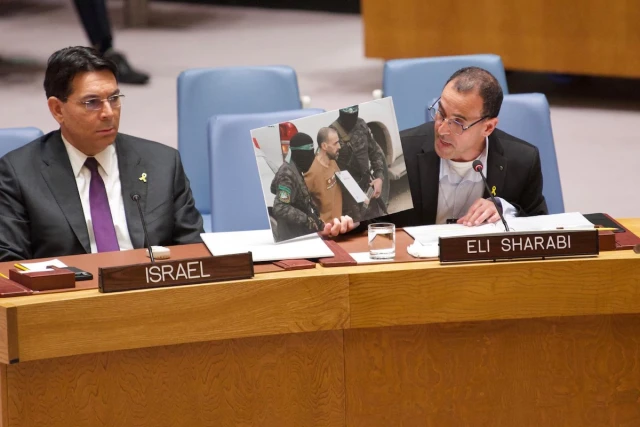
Former Israeli hostage Eli Sharabi urged the United Nations Human Rights Council on Thursday to recognize the treatment of hostages held in Gaza as torture and demand criminal investigations into those responsible.
“Mr. President, my name is Eli Sharabi. I am a survivor of torture,” Sharabi said in a prerecorded address to the UN body.
“For 491 days I was held underground, chained, starved, beaten and humiliated,” he continued.
“I have chosen the road of justice, beyond politics and grounded in our shared humanity,” Sharabi said. “This council must recognize the torture, demand criminal investigations, and confront the terror.”
“Name these crimes. End impunity,” he added.
Sharabi was kidnapped from his home in Kibbutz Be’eri during the Hamas-led October 7, 2023, attack. His wife, Lianne, and their daughters, Noiya and Yahel, were murdered during the attack. His brother Yossi was also abducted and later killed in captivity.
Sharabi was released in February 2025 after 491 days in captivity as part of a ceasefire and hostage-release agreement. He said he only learned after his release that his wife and daughters had been murdered.
His prerecorded address was played during the 63rd session of the UN Human Rights Council in Geneva, after the Jerusalem Institute of Justice (JIJ) allocated its speaking time to the former hostage. His speech coincided with the release of a new report by the institute titled “Kidnapped: Hostage-Taking as a Form of Torture.”
The report, based on testimony from released hostages and healthcare professionals, documents what it describes as widespread physical and psychological abuse in captivity. According to the report, at least 78 released hostages showed signs of starvation, acute malnutrition or severe muscle wasting, while 68% of hostages held for more than 200 days were forced to participate in propaganda videos.
“The Jerusalem Institute of Justice documented the deliberate starvation of over 78 hostages,” Sharabi said. “I returned weighing just 44 kilos.”
The JIJ report argues that the treatment of hostages should be investigated as torture, war crimes and crimes against humanity, and calls for accountability through criminal prosecutions and the use of universal jurisdiction.
“The abduction of infants, elderly people and entire families from their homes, together with systematic torture and abuse, constitutes a grave assault on the fundamental values of humanity,” said Uri Morad, JIJ's director of international law and public diplomacy.
“The report points to an urgent need for a comprehensive response, including updated international legislation and the use of universal jurisdiction, to ensure that everyone responsible – from those who planned the crimes to the last guards in the tunnels – is held fully accountable,” he said.
“Silence in the face of these atrocities, or describing hostage-taking as merely a bargaining tool, amounts to the normalization of torture.”
Casandra Sol Sans, the JIJ's law and research officer, said the report’s legal analysis found that the Oct. 7 hostage-taking went beyond arbitrary detention and met the legal criteria for torture and crimes against humanity.
“The documented practices – from extreme isolation and inhumane conditions in tunnels to the use of psychological warfare – satisfy the elements of the offenses under the Rome Statute and the UN Convention against Torture,” she said.
“Because this involves breaches of fundamental, non-derogable rules of international law, states around the world have a legal duty to exercise universal jurisdiction, investigate and prosecute those responsible.”
The JIJ report also calls on international bodies and governments to recognize former hostages and their families as victims of torture.
Sharabi has continued to speak publicly about his experience in captivity and advocate for the hostages. In March 2025, he addressed the UN Security Council, where he described his 491 days in captivity and called on the international community to work for the release of the remaining hostages.
In May 2025, Sharabi published his memoir, Hostage, recounting his 491 days in Hamas captivity. The English-language edition was released internationally in October 2025.
You might also like to read this: