Israel watches closely as US approves massive arms sales to Egypt, Gulf states



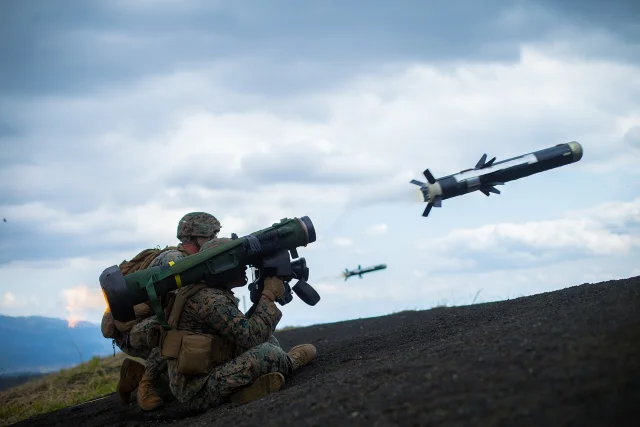
Israel is watching closely after the U.S. State Department approved more than $2 billion in proposed arms sales to Egypt, Kuwait and the United Arab Emirates, with Israeli officials particularly concerned about a planned $832 million sale of Javelin anti-tank missiles to Egypt.
The State Department notified Congress last Friday of the proposed sales, which include more than 2,000 FGM-148 Javelin missiles and up to 200 Javelin launch units for the Egyptian Army.
Israel is guaranteed by U.S. law that Washington will maintain the Israel Defense Forces’ “qualitative military edge” over its regional neighbors. However, the State Department’s standard assessment states that "the proposed sale of this equipment and support will not alter the basic military balance in the region."
Almost half of the proposed package is for a close Israeli ally, the United Arab Emirates, which is seeking to purchase $1.04 billion worth of up to 10,000 laser-guided Advanced Precision Kill Weapon System-IIs (APKWS-IIs) configured for both air-to-air and air-to-ground use. The weapons are most likely intended to deter and, if necessary, attack Iran, giving Israel little reason for concern.
The package also includes about $400 million in repair services and parts for Kuwait’s Patriot air defense systems. The systems saw extensive use during Iran’s bombardment of its neighbors during Operation Epic Fury in March and April of this year, and experts have speculated that Kuwait will ultimately need to spend much more than $400 million to replenish its interceptor stocks and restore the systems to an acceptable state of readiness.
However, the proposed sale to Egypt is raising more questions in Israel.
Large numbers of American-built Javelin missiles have been supplied to the Ukrainian Army in recent years, where they have been credited with destroying hundreds of Russian tanks and other armored vehicles, as well as fortified bunkers.
Some Israeli officials are quietly concerned that Egypt could soon acquire large numbers of the weapons, given that the IDF is the only military with large numbers of armored vehicles that Egypt is likely to use them against.
Egypt’s other two land-bordering neighbors, Libya and Sudan, do not possess armored forces that pose a serious threat.
Israel fought Egyptian troops in five major wars between 1948 and 1973. There has been what is described as a “Cold Peace” between the two countries since the 1979 Camp David Accords, but the state of non-war is based largely on deterrence and a handful of shared geostrategic objectives that have been maintained with American support.
One example is the $1.3 billion in Foreign Military Financing (FMF) that Egypt is authorized to receive each year for U.S. weapons purchases. Israel receives $3.3 billion in annual FMF under a separate agreement.
The FMF arrangements were part of the broader U.S. security framework established following the Camp David Accords. The treaty also included Israeli purchases of Egyptian oil and natural gas produced in the Sinai Peninsula.
Although those energy sources have since been depleted, the two countries have found other ways to cooperate on energy production in recent years.
Despite their security cooperation, cultural exchanges, tourism and business ties between Israel and Egypt remain limited after almost five decades, while hostility toward Israel remains widespread in Egyptian civil society.
The timing of the proposed arms sales is also notable. The State Department announcement came just one day after it announced that it was waiving human rights-related restrictions on $320 million in Foreign Military Financing for Egypt, releasing funds that had previously been withheld.

Please take a moment to join believers worldwide praying for Israel right now. Add your light to the live prayer map—and show the world one more watchman praying for the peace of Jerusalem.
You might also like to read this: