Israel expands domestic ammunition production as uncertainty grows over US bomb supply




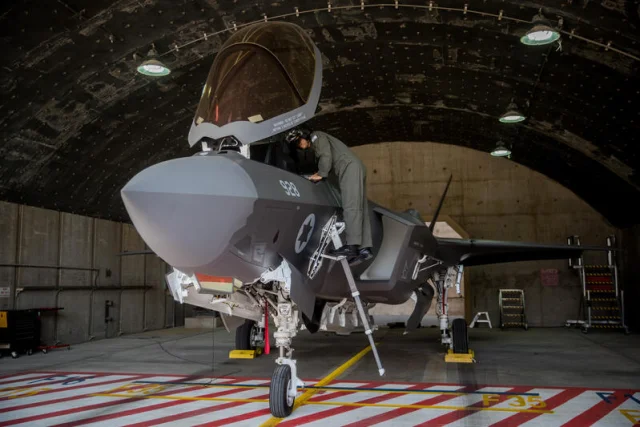
Israel is expanding its ability to field domestically produced precision munitions as Rafael Advanced Defense Systems and Lockheed Martin accelerate the integration of Rafael’s SPICE 1000 precision-guided weapon onto Israel’s F-35 fighter jets.
Rafael announced the integration this week, saying the joint project with Lockheed Martin is being carried out at the U.S. company’s facilities.
The move comes as uncertainty grows around future U.S. weapons deliveries to Israel, following a decision by Rep. Gregory Meeks, the top Democrat on the House Foreign Affairs Committee, to withhold approval for a proposed $2.8 billion U.S. bomb sale to Israel.
The SPICE 1000 has been used extensively by the Israeli Air Force from F-15 and F-16 aircraft during recent long-range operations against Iran and Iran-backed forces in Yemen and elsewhere. The integration will initially focus on Israel’s F-35I Adir fleet, with the potential for the weapon to become available to other F-35 operators in the future.
The SPICE 1000 guidance kit converts 1,000-pound-class general-purpose and penetration bombs into precision, stand-off weapons. Rafael says the system has a range of approximately 125 kilometers, or 78 miles, and uses an electro-optical seeker and scene-matching technology to guide the weapon to its target. The company also produces the heavier SPICE 2000 and smaller SPICE 250.
The expansion of Israel’s domestic munitions capabilities has become a growing priority as the country has expended large quantities of weapons during years of intense military operations.
The issue has taken on additional significance following Meeks’ decision on Wednesday to oppose the Trump administration’s proposed sale of 40,000 2,000-pound bombs to Israel.
Meeks said he remains “firmly committed to Israel’s security and its ability to defend itself against serious regional threats” but has concerns “about how these munitions could be used in densely populated areas of Gaza and Lebanon.”
“The Trump administration has not provided sufficient assurances that these weapons will be used by the Netanyahu government in accordance with US law and with appropriate protections for civilians,” he added, although he also said that his request for clarification does not weaken Congressional backing “for Israel’s legitimate defense needs.”
Rather, he said, “It reflects Congress’s responsibility to ensure that US-funded weapons are used lawfully, responsibly, and with meaningful safeguards for human life.”
Meeks’ objection does not by itself prevent the administration from proceeding with the proposed sale. The administration could seek to bypass the normal congressional review process by declaring the transaction an emergency national-security requirement.
The development comes as the F-35 is also receiving renewed attention following its recent combat operations in the Middle East.
At the Air & Space Forces Association’s 2026 Air, Space & Cyber Conference in National Harbor, Maryland, on Monday, U.S. Air Force officers Maj. Gen. Brian Laidlaw and Col. Charles A. Fallon praised the F-35’s performance during recent air campaigns.
“When properly resourced, we showed without a doubt how well this airplane can perform in combat,” said Laidlaw, while Fallon praised the F-35’s low maintenance profile.
“When we can start cutting down from hours to minutes, that really matters and that equals people’s lives,” Fallon said.
Both officers also praised the F-35 for the versatility of missions it can perform, the weapons it can carry and its modular systems, which can be integrated into its operational cycle.
The F-35’s performance has also highlighted the importance of rapidly integrating new weapons onto the aircraft. U.S. Air Force officials said the recent combat experience demonstrated the need to accelerate the process of qualifying and integrating weapons for emerging missions.
Lockheed Martin has acknowledged Israeli contributions to the success of the F-35 program, as the Israeli Air Force and U.S. Air Force continue to gain operational experience with the aircraft.
The SPICE 1000 integration therefore represents both an expansion of Israel’s domestically developed precision-strike capabilities and another example of the close technological cooperation between Israel’s Rafael and Lockheed Martin.
You might also like to read this: