Senior Iranian officials used diplomatic passports to smuggle suitcases of cash to Hezbollah - report
Despite severe economic crisis, Islamic Republic continues to financially support Hezbollah




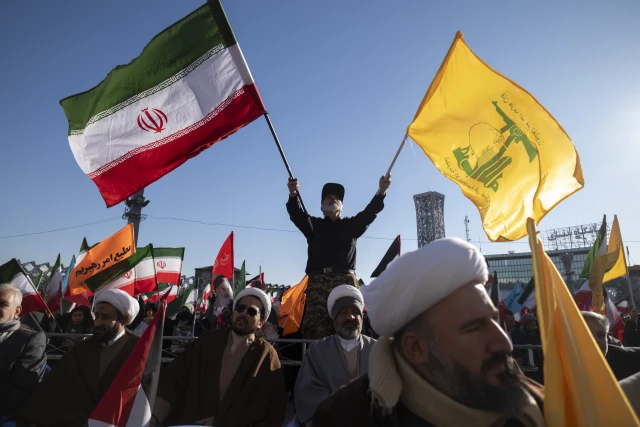
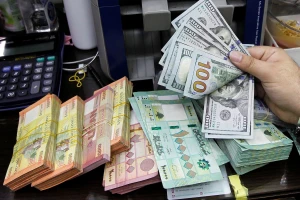
High-ranking Iranian officials have been transporting suitcases full of cash on diplomatic flights intended to fuel Hezbollah's rebuilding effort, opposition-linked Iran International reported on Tuesday.
Iranian Foreign Minister Abbas Araghchi, the secretary of Iran’s Supreme National Security Council, Ali Larijani, and six other Islamic Republic officials were reportedly involved in smuggling the cash into Lebanon.
The regime officials used their diplomatic passports, which allow them to avoid customs inspections, the news agency reported.
Iran International named Mohammad Ebrahim Taherian-Fard, Mohammad Reza Shirkhodai, Hamid Reza Shirkhodai, Reza Nedai, Abbas Asgari, and Amir Hamzeh Shiranirad as the six diplomats involved in the operation to transfer hundreds of millions of dollars in cash to Hezbollah.
The news outlet published a photo from Jan. 8, in which Taherian-Fard can be seen traveling on a diplomatic flight to Beirut, alongside Araghchi.
“He was carrying a suitcase full of dollars for Hezbollah, confident that with a diplomatic passport no one would inspect his luggage,” the outlet claimed.
Taherian-Fard (70) previously served as Iran’s ambassador to Turkey and held several senior diplomatic roles, including special assistant to then–foreign minister Mohammad Javad Zarif and special envoy for Afghanistan affairs.
Iran International also reported that, during his trip to Lebanon in October, Ayatollah Ali Khamenei’s advisor, Larijani, took suitcases of cash to give to Hezbollah.
“At the time, a Lebanese newspaper reported that he was carrying $300 million in cash in his suitcases. Sources close to the Lebanese president denied the report, but an intelligence source in a European country told Iran International that the cash transfer did indeed take place,” the outlet said.
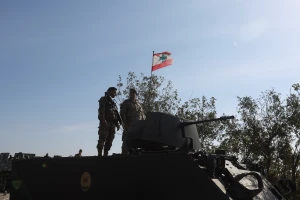
The transfer of large sums of cash comes as Hezbollah seeks to rebuild its military capabilities following its devastating conflict with Israel in the latter half of 2024. The group sustained significant damage to its command structure, weapons and cash stockpiles, and financial networks during targeted Israeli strikes before and during Operation Northern Arrows, many of which focused specifically on Hezbollah’s financial infrastructure.
Cash transfers from Iran to Lebanon using civilian aircraft are not a new phenomenon. Last year, Israeli Foreign Minister Gideon Sa’ar warned about such transfers by the Iranian Quds Force between Tehran and Beirut.
“There is an intensified Iranian effort to smuggle money into Lebanon for Hezbollah to restore its power and status,” Sa’ar told a group of U.S. senators on a visit to Israel at the time.
“This effort is being carried out, among other channels, via Turkey and with its cooperation,” he stated.
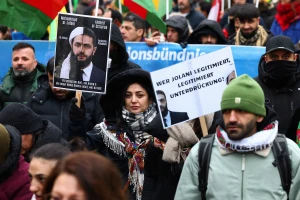
Last year, Hezbollah supporters held protests at Beirut Airport after the Lebanese government prevented an Iranian plane from landing. It was reportedly carrying significant amounts of cash for Hezbollah. Israel had also warned that it would take action if the money transfers from Iran to Lebanon continued.
At the beginning of 2025, Israel actively prevented Iranian flights from landing at Beirut airport, prompting Hezbollah to protest what it described as a de facto blockade. Israel imposed the restrictions to prevent Iran from attempting to smuggle weapons and cash to Hezbollah forces.
The Shia terror group demanded that the Lebanese government “reverse its decision to prevent Iranian planes from landing at Beirut Airport, and take serious measures to prevent the Israeli enemy from imposing its dictates and violating national sovereignty.”
On Dec. 25, the Wall Street Journal reported that the Islamic Republic had transferred hundreds of millions of dollars in oil revenue to Hezbollah in Lebanon over the past year, using exchange offices, private companies, and a money transfer network in Dubai.
Hezbollah recently asked Iran, which is facing a severe financial crisis, to double the $1 billion in pledged funding to rebuild its military infrastructure to a level that could challenge Israel. The Iranian government considers Hezbollah to be one of the main pillars of the “axis of resistance.”
The recent transfers of cash to Hezbollah, despite the significant economic need in Iran, demonstrate the importance that the Islamic Republic attaches to its main terror proxy.
You might also like to read this: