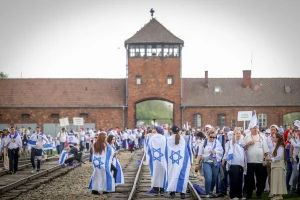
Int'l Holocaust Remembrance Day observed as Israel welcomes home its final hostage from Gaza





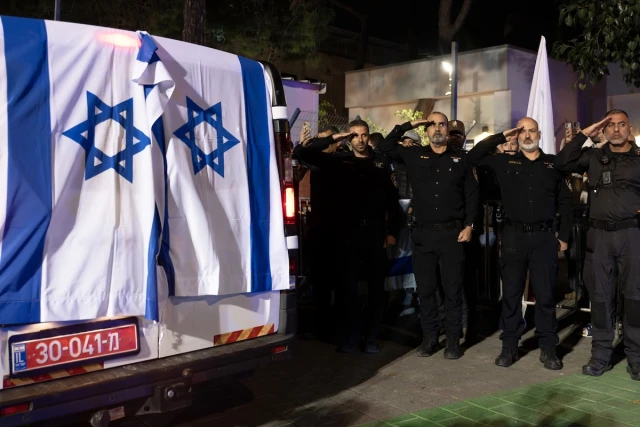
The body of Ran Gvili, the last Israeli hostage held in Gaza, was brought back one day before International Holocaust Remembrance Day, as many nations prepared to remember the six million Jews murdered by the German Nazi regime.
In the same week these events unfolded, synagogues around the world were reading the Torah portion Beshalach, which recounts in Exodus 13 how the Israelites carried Joseph’s bones out of Egypt, fulfilling his request to be buried in Israel.
As Israel and the Jewish people worldwide mourn and honor the memories of the Holocaust victims, it highlights some of the values and beliefs about death and grieving in Jewish culture.
“I just want to tell you that he was found intact, with his uniform and everything on him,” Police Commissioner Danny Levy told Itzik Gvili, the bereaved father of Ran. “You are receiving your son as he was when he went out – even with a tear in his pants. I don’t know if that is any comfort, but it was important to me to tell you these details, that you should know.”
It might seem strange to say that Ran had come back “as he was when he went out,” but it is very important in Judaism to bury bodies whole. The lengths to which ZAKA volunteers went to collect every possible bit of Jewish blood following the Oct. 7 massacre indicates how precious the bodies of the dead are – and how central burial traditions remain.
In Orthodox Judaism, the soul of a person is in the blood, based on Leviticus 17. “That blood is the blood with the soul, and every drop is like a Bible that was burned,” ZAKA volunteer Simcha Greiniman told ALL ISRAEL NEWS, “and when we have a situation where the Bible was burned, we collect every drop of ashes to make sure that we respect the Bible.”
The Law of Moses reveals the great significance of death, with many of its laws of impurity tied to blood and the loss of life. Contact with a dead body renders a person unclean for a week, according to Numbers 19:11, which states, “Whoever touches the dead body of any person shall be unclean seven days.”
The rest of the chapter goes on to detail the laws governing impurity caused by contact with the dead and throughout the law, an overarching theme emerges – emphasizing both the gravity of death and the sanctity of life.
There are many differences between Jewish and Christian traditions when it comes to death and burial, such as the way funerals are conducted. According to Judaism, the dead should be buried as soon as possible, often on the same day, to avoid contamination and decay. In Jewish tradition, the soul is in a state of turmoil until the body is properly laid to rest.
While many in the West are used to flowers at a funeral, in Judaism, flowers and music are seen as inappropriate, and the brief service is conducted primarily to honor the dead, rather than to provide comfort to the bereaved.
According to the Chabad movement, Jewish people must be buried “as they were born” in line with Jewish law, complete with all their limbs and organs. As they explain, “The human body is considered as sacred in death as it was in life, as it contained a G‑dly soul.” For this reason, it is not common for Jewish people to donate organs after death, and cremation is not considered acceptable. Often wrapped in only a simple white shroud to indicate the equality between all people, bodies are either buried directly into the ground or in a simple casket with holes, returning them to the ground from which they were created.
Tombstones are a tradition that goes back to Genesis 35, when Jacob set up a stone to mark the grave of his wife Rachel. The Talmud says that “Jewish gravestones are fairer than royal palaces” (Sanh. 96b) reflecting the principle of the highest respect paid to the dead, and the desire to ensure they are buried in the most honoring way possible, with the contrast of being left out to be “food for beasts of prey” which is a fate wished only on Israel’s enemies in the Bible.
The Kaddish prayer is recited by mourners at the foot of the grave, facing east, with heads bowed as members of the congregation respond “Amen.” Interestingly, it never mentions death. Instead, the Kaddish is a declaration of faith that magnifies and sanctifies God’s name, even in the face of loss. The following is the text of the Kaddish prayer:
Exalted and hallowed be His great Name.
Throughout the world which He has created according to His Will. May He establish His kingship, bring forth His redemption and hasten the coming of His Messiah.
In your lifetime and in your days and in the lifetime of the entire House of Israel, speedily and soon, and say, Amen.
May His great Name be blessed forever and to all eternity. Blessed and praised, glorified, exalted and extolled, honored, adored and lauded be the Name of the Holy One, blessed be He.
Beyond all the blessings, hymns, praises and consolations that are uttered in the world; and say, Amen.
May there be abundant peace from heaven, and a good life for us and for all Israel; and say, Amen.
He Who makes peace in His heavens, may He make peace for us and for all Israel; and say, Amen.
For a week following the death, it is traditional for families to “sit shiva,” a time of mourning to which friends and family can join them to pay their respects and honor their life and memory.
The Kaddish prayer is also recited every year on the “yahrzeit” or anniversary of the death, marking each year of their passing, as we also stop to remember the six million murdered in the Holocaust each year, most of whom never had the proper burial they should have had.
While there may not be flowers at most Jewish cemeteries, it is common to see stones placed on the graves, markers that someone has visited and that the person has not been forgotten.
We will remember them.
You might also like to read this: