A journey home, from exile to Israel: Interview with Holocaust survivor Meir Figdoor



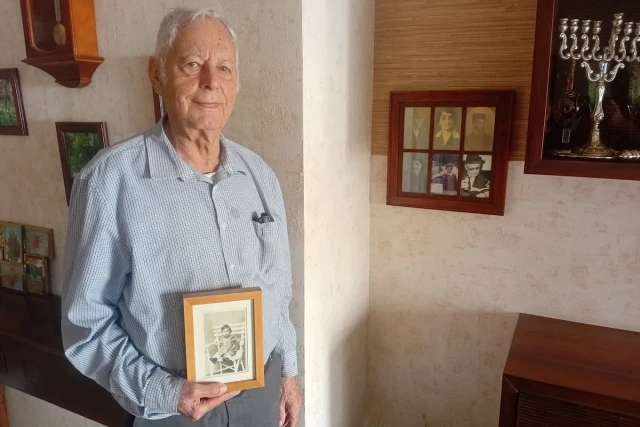
In an interview with Christian journalist Paul Calvert, Holocaust survivor Meir Figdoor recounted a traumatic childhood marked by upheaval, loss, and extraordinary survival, tracing his family’s journey from Austria to Israel during some of the darkest chapters of Jewish history.
Figdoor was a small child with a stable family life when Nazi Germany annexed Austria in 1938. He recalled how things changed rapidly as Jews were stripped of their rights and livelihoods, and how the situation plunged his family into poverty.
“We had Austrian accents, we spoke German; we had many friends. But suddenly everything changed. The Nazis came. They came to our home, and they forced my father to sign something saying he was a thief and he had stolen things.”
Branded as criminals, staying in Austria was no longer possible, and the family was forced to flee. After initially being denied a place on the immigration list, a last-minute intervention secured their passage, and they escaped Europe aboard the overcrowded ship Atlantic, traveling down the Danube and across the Mediterranean.
The harrowing journey was made even worse by disease, overwhelming fear, and the death of his baby sister, Rivka. Figdoor said he remembers seeing coffins lowered into the sea during the voyage.
Upon arriving in Haifa, British authorities began transferring Jewish refugees from their ships onto a different vessel, the Patria. His family was still waiting to board when another disaster struck.
“Again, our mother, by making us the end of the line, had saved our lives because we weren’t on Patria when it exploded,” he explained. Figdoor noted that 256 people were killed in the incident, and many more were injured.
Instead of receiving immediate refuge, the family was detained by British authorities and eventually exiled to Mauritius, where young Figdoor, from age 3 to 8, lived in a prison camp that separated men from women and children. He told Calvert that life was harsh – marked by hunger, illness and long periods of time without his father – but he also shared good memories from his childhood.
After the war, Figdoor and his family finally reached Israel, but he faced new struggles as a displaced child who didn't speak or understand Hebrew. In addition, he was placed in a series of children’s homes because his parents did not have stable housing at first.
Eventually, he was reunited with them in their first family home in Israel: “That was one of the happiest moments that I remember, that we had a family home, however tiny it was,” Figdoor said.
Reflecting on rising antisemitism today, Figdoor spoke with conviction: “The place for the Jews is just here in Israel. This is where they should be.”
His story serves as a powerful testament to both perseverance and resilience, drawn from a life shaped by flight, detention and exile – and a deeply moving journey toward survival and safe refuge.
Click below to listen to Paul Calvert's full interview with Holocaust survivor, Meir Figdoor.
You might also like to read this: