northern front IDF conducts rare strike on Hezbollah weapons shipment in eastern Lebanon as terror group ramps up rebuilding efforts
IDF estimates Hezbollah will join Iran, attack Israel if new fighting breaks out
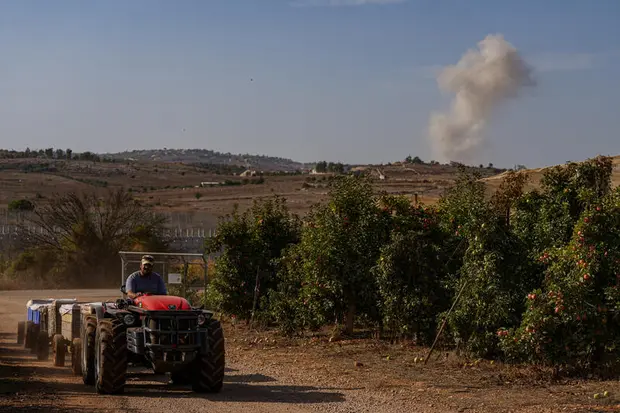
Following weeks of relative quiet on the Lebanese front, the Israeli military announced Monday that it had struck a weapons shipment in Bekaa Valley intended to reach Hezbollah near the Syrian border, following an earlier operation that detonated an approximately 35-meter-long (115-foot-long) underground terror tunnel in southern Lebanon.
Recent media reports suggest Israel is closely monitoring developments in Lebanon amid growing concerns over Hezbollah’s intensive efforts to rebuild its military capabilities.
IDF Military Intelligence recently warned that there is a high likelihood that Hezbollah will join Iran in the event of war with the regime, Army Radio reported. The IDF has reportedly identified a series of buildup operations near the Yellow Line in recent weeks in preparation for a next round of fighting.
“Smuggling has resumed via trucks crossing the Syria–Lebanon border (albeit on a much smaller scale); weapons factories in Lebanon are operational; and Hezbollah has resumed manufacturing missiles and rockets, assembling explosive drones, and training and recruiting terrorists,” the intelligence report said.
The Israeli Air Force carried out a rare strike in Lebanon's eastern Beqaa Valley overnight, Lebanese media reports. The strike reportedly hit an area near the Lebanon-Syria border. According to Israeli security sources, the strike was intended to thwart a weapons shipment destined for Hezbollah in Lebanon. It marks the first Israeli strike in the area in several months. The IDF has not commented on the reports.
— Emanuel (Mannie) Fabian (@manniefabian) November 16, 2026
On Monday, the Israeli military said it struck a weapons shipment “in the Janta area along the Syrian-Lebanon border… where numerous weapons shipments have been transferred in the past.”
This was the first strike deep within Lebanese territory in several months. Lebanese media also reported Monday that the IDF “abducted” two men from a home in Shebaa, near the border. The military has not commented on the report.
“Hezbollah continues to exploit various areas across Lebanon for terror activity, weapons smuggling, and the movement of terrorists, in violation of the understandings and in order to threaten the State of Israel,” the IDF said.
Israeli troops apprehended two Lebanese men on the outskirts of the southern town of Shebaa overnight, according to Lebanese media. Lebanon's National News Agency reports that the troops raided and searched the home of the two men, who are brothers, "ransacking its contents and damaging belongings," before taking the pair away and leaving the area. The IDF has not yet commented on the reports.
— Emanuel (Mannie) Fabian (@manniefabian) November 16, 2026
The airstrike came amid several recent announcements by the Lebanese army of high-profile weapons seizures.
On Nov. 13, the Lebanese Armed Forces (LAF) published images showing a cache of weapons and ammunition seized during a raid in Beirut’s Dahiyeh district, Hezbollah’s main stronghold. LAF described the operation as a “high-quality security operation” and said that a large amount of weapons had been seized, though it did not explicitly link the weapons to Hezbollah.
However, Israeli security think tank Alma Research Center warned, “Considering the quantity and characteristics of the weapons seized, it is difficult to regard this operation as a significant achievement... Even if the seized weapons do belong to Hezbollah… their seizure has no meaningful operational impact on the organization’s military capabilities.”
Alma also wrote: “As during the ceasefire period from November 2024 to February 2026, we continue to witness an enormous gap between the Lebanese Armed Forces’ public reports of weapons seizures and the reality on the ground. The false impression of progress persists.”
At the start of last month, Lebanon’s Internal Security Forces announced the seizure of a truck carrying hundreds of kilograms of explosives on the road between the Bekaa Valley and Beirut. Hezbollah later acknowledged that the truck belonged to the group but demanded its return. Authorities confiscated the truck and refused to hand it back to Hezbollah.
The IDF says it recently demolished a 35-meter-long Hezbollah tunnel in the southern Lebanon town of Majdal Zoun. The tunnel was located during operations of the 300th "Baram" Regional Brigade in the area. The IDF says the tunnel featured two rooms where Hezbollah operatives would reside in. After it was scanned, combat engineers of the elite Yahalom unit blew up the tunnel, the military says, attaching footage of the demolition.
— Emanuel (Mannie) Fabian (@manniefabian) November 15, 2026
These incidents highlight Hezbollah's efforts to rebuild its capabilities, which were destroyed by the IDF in recent years. The Israeli military currently estimates that Hezbollah possesses about 10,000 rockets and missiles, most with a range capable of reaching northern Israeli communities.
At the same time, Hezbollah has reportedly resumed smuggling operations from Iran through Iraq and Syria to Lebanon.
“Syria is no longer a smuggling superhighway as it used to be,” a senior Israeli military official said, “but in our assessment, Hezbollah is still managing to smuggle weapons across the Syria–Lebanon border.”
The report also noted that the IDF is preparing for potential ground raids against Israeli troops stationed in the security zone.
“This is a threat that could materialize, and we are preparing for it,” a senior military official said. “Whenever we have identified such preparations in recent months, we have acted against them.” Such preparations by Hezbollah include the building of new observation posts in villages near the Yellow Line and the installation of cameras to monitor the movement of Israeli forces
Despite these preparations, the IDF has carried out relatively few strikes, even as a senior official acknowledged that “Our target bank there is full.”
The IDF is particularly concerned about Hezbollah’s buildup of explosive drones, especially fiber-optic-guided models, which the terror group used to kill 16 Israeli soldiers during the most recent round of fighting.
According to Army Radio, Hezbollah assembles the drones in its own facilities and is training many dozens of additional operatives to use them.
However, the IDF is reportedly holding back from striking drone facilities, many located deep inside Lebanon, including in the Bekaa Valley, due to U.S. pressure following the ceasefire in Operation Lion’s Roar against Iran.
Despite the Lebanese government’s stated efforts to bring all weapons under state control, Hezbollah and its representatives continue to defy Israel, arguing that it is the only force capable of confronting it.
Hezbollah MP Ali Fayad said, “The Lebanese state, with all its capabilities, all its relations, and all its gambles, cannot reach a position in which it can force Israel to withdraw from Lebanese territory and stop its hostile actions against Lebanon.”
Last week, Hezbollah leader Naim Qassem said Lebanon should prioritize stopping Israeli strikes on its territory, and secure a full withdrawal to allow displaced residents to return to southern Lebanon and begin reconstruction.
In a speech, Qassem framed Hezbollah's position as a choice between surrender and continued resistance, insisting that the group will have to retain the ability to fight Israel when necessary.
Popular article:

interview Easter message of resurrection hope amid war at Jerusalem's Garden Tomb

biblical commentary Let my people go: a Passover message for today

4 IDF soldiers killed, 2 wounded in fighting in southern Lebanon, as Israel eliminates dozens of Hezbollah terrorists

Receive latest news & updates
A message from All Israel News
Help us educate Christians on a daily basis about what is happening in Israel & the Middle East and why it matters.
For as little as $10, you can support ALL ISRAEL NEWS, a non-profit media organization that is supported by readers like you.
Latest articles:
Hamas seeks to rebuild military infrastructure, expand use of Gaza hospitals

Jewish heirs seek to block $180 million Van Gogh auction over alleged Nazi forced sale

Angela Merkel says Israel ‘went too far’ in Gaza but defends Germany’s commitment to Jewish state
Toward a unity gov’t? Likud, Eisenkot’s Yashar party hold first meeting as Liberman doubles down on opposition

Last Righteous Among the Nations living in Israel, dies at 91