'Heading for escalation': Lebanese Army can’t and won’t disarm Hezbollah, Israel tells US envoy Ortagus
Lebanon & Israel agree to send civilian representatives to meeting for first time




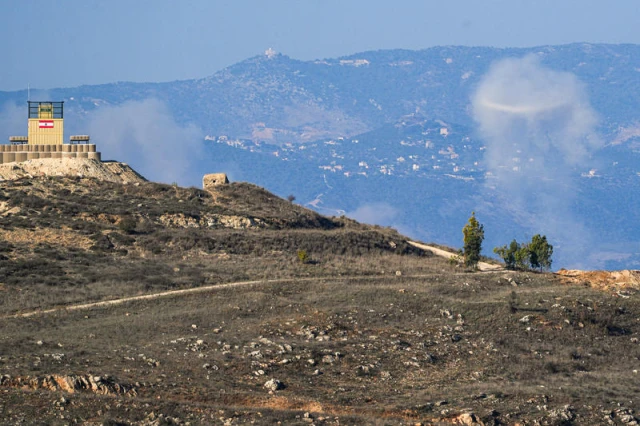
During a visit by Morgan Ortagus, U.S. Deputy Special Envoy to the Middle East, Israel presented intelligence showing that the Lebanese military is unable to effectively confront Hezbollah, and warned her that the situation is headed for escalation, according to Israeli media reports.
Ortagus, who continued to Lebanon on Wednesday, visited Israel against the backdrop of increasing tensions in recent weeks, and a two-day pause in Israeli airstrikes against Hezbollah during the visit of the pope in Lebanon.
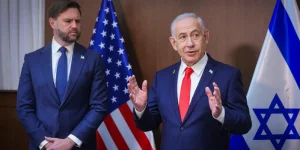
She met with Prime Minister Benjamin Netanyahu and Defense Minister Israel Katz at the Prime Minister’s Office in Jerusalem on Tuesday.
According to Ynet News, Israeli officials told Ortagus that despite the Lebanese government’s pledge to disarm Hezbollah, the Lebanese Armed Forces (LAF) neither wishes nor is able to disarm the terror group, due to the fact that many of its soldiers are Shiites, among other reason.
“We do not see Hezbollah disarming through an agreement, and therefore there is no point in continuing with this agreement. We are heading toward escalation and will decide when, according to our interests,” a security official told Ynet.
Nevertheless, both countries for the first time agreed to send civilian representatives to a meeting of the ceasefire monitoring mechanism, apparently due to American pressure.
This would mark the first direct, official talks between the countries by civilian representatives, rather than by military officials.
Netanyahu’s office said the prime minister “instructed the Acting Director of the National Security Council to send a representative on his behalf to a meeting with government-economic elements in Lebanon. This is an initial attempt to establish a basis for a relationship and economic cooperation between Israel and Lebanon.”
The question of whether to send a civilian representative had caused considerable controversy in Lebanon in recent days, where some see it as a tacit recognition and normalization of Israel.
Lebanese media said that former ambassador to the U.S., Simon Karam, would represent the country at the meeting of the ceasefire monitoring mechanism scheduled for Wednesday in a-Naqoura, southern Lebanon.
Ortagus was expected to reiterate the American threat that if the government doesn’t disarm Hezbollah, the U.S. would allow Israel to act according to its interest.
Col. (res.) Dr. Jacques Neriah, researcher at the Jerusalem Center for Public Affairs, warned that the repeated American threats didn’t succeed in changing the situation.
“They told the Lebanese: if you don’t do the job, Israel has the power to do it. But despite our daily strikes, Hezbollah has rebuilt its strength. The units have recovered, the factories for producing missiles and UAVs have reopened, and weapons are flowing in from Syria,” said Neriah.
Syrian Interior Ministry security units thwarted a shipment of some 1,250 landmines destined for Hezbollah in Lebanon. According to the Ministry, four suspects were arrested at the smuggling site in Al-Jobeh near the Syria-Lebanon border, and a fifth killed in a firefight. pic.twitter.com/yZajFYTSDh
— Ariel Oseran أريئل أوسيران (@ariel_oseran) December 2, 2025
On Tuesday, Syria’s Interior Ministry announced that it confiscated a shipment of some 1,250 landmines destined for Hezbollah, arresting four suspects in the town of al-Jobeh near the Syria-Lebanon border, and killing another suspect in the ensuing firefight.
In addition to Ortagus, Lebanon expects visits from Qatar’s Prime and Foreign Minister, Mohammed bin Abdulrahman Al Thani, as well as a delegation from the UN Security Council.
The delegation will discuss the third report prepared by the Lebanese Army regarding the disarmament of Hezbollah.
You might also like to read this: